Social media is Middle East's 'new rising force', PR congress told
Experts discuss trends in news reporting and challenges posed by online platforms
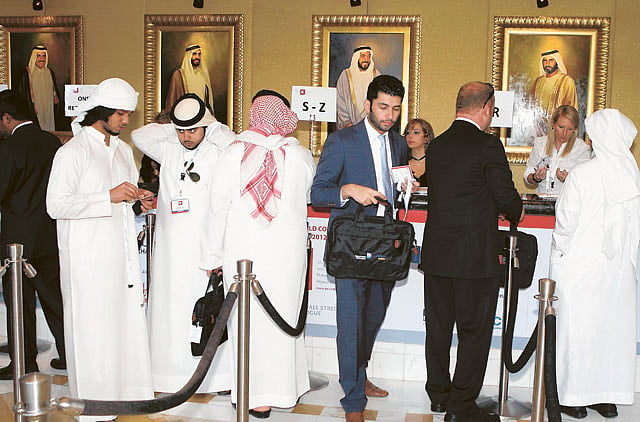
Dubai In recent years, particularly after the Arab Spring, the Middle East has seen a surge in the number of people using social media to communicate, relate and break news, said specialists Thursday during the 20th Public Relations World Congress.
"It is not journalists who are now delivering the content. The masses have started to come up with their own narratives of reality. This is increasingly becoming an integral part of media," said Wadah Khanfar, former director-general of the Al Jazeera Network and co-founder of Sharq Forum, Qatar.
According to Maha Aboueienein, head of communications Mena global communications and public affairs at Google, UAE, this new platform can be characterised by four things — speed, source, access and audience.
"Speed: the speed at which it works creates a challenge for people to manage reputation. Source: it's no longer the broadcaster or advertiser who is the source of the news, it's the people. Access: anybody who has access to the internet is empowered to create change. Audience: it's not enough for us to watch news. We want to participate in it. Audience defines what is news or not. People take news, accelerate it and help participate by making it viral," said Aboueienein.
The rise of this form of media has seen news open up to a whole range of new platforms. According to Michael Peel, Middle East correspondent of the Financial Times, one notable change has been a shift from print to online to include video and audio, podcasts.
Khanfar said another change is the increased use of video. "Social networking is moving towards video. People will film their news, analysis and personal life through video. It will be much more personal," he said.
While social media offers dialogue and diversity it also presents a number of challenges. "As we feed into social media, we've got two challenges, the first is to meet the passion of an activist, and create a balanced response. The second is speed. Social media is moving much faster than us and we need to catch up," said Francis Matthew, Editor at Large of Gulf News.
However, while social media is now an integral part of the news industry, there will always be the need for a newsroom and professional journalists.
"Newsrooms will continue to shrink, but they will exist. There will be a necessity for a newsroom. One reason is prioritisation, which will be necessary for the flood of information coming through social networks," Khanfar.
Now in the age of citizen journalism, professional journalists must become more authoritative in their subject matter and media organisations almost have to take on the role of think tanks, said Khanfar.
"A professional journalist will have to have depth, contextualisation and knowledge rather than just process and write a story."
According to Rick Powell Jr, chief communications officer, Bloomberg, New York, the other factor that differentiates news made on social media platforms and the professional news journalism is trust.
"The main issue is trust. We're rooted in delivering financial news to clients that need it everyday. People need to trust the content," said Powell.
Dubai Barack Obama's upcoming re-election campaign is set to be the biggest social media campaign yet said an advisor to the current president, Roger Fisk at the 20th Public Relations World Congress yesterday.
"The 2012 re-election will be the largest social media exercise ever conducted. Social media is key to making the campaign personal and empowering people to be the campaign," said Fisk, who currently coordinates diplomatic and trade missions for the US Cabinet and President Obama.
According to Fisk, using social media throughout Obama's 2008 campaign was a game changer for the then-candidate. As the National Director of Special Events, Fisk led a grassroots campaign that built up the largest donor base of $100 million in history by mixing social media and online platforms with traditional media.
"Imagine wandering into this staggering tornado of social media without a map, without a guide, and without a clear definable goal," said Fisk describing their initial foray into using this relatively new form of communication.
"The most important thing to understand about the Obama campaign's approach to social media was that we were hungry. We started with no institutional support, since that was all with our rivals; we started with no operations, since the other candidates either had run before or had been planning to run for years. It is liberating to start with virtually nothing: no organisation, no brand, no supporters. We had so little that we literally could not afford to have neither walls nor ceilings built around us. We had to grow, grow, grow."
Sign up for the Daily Briefing
Get the latest news and updates straight to your inbox
Network Links
GN StoreDownload our app
© Al Nisr Publishing LLC 2026. All rights reserved.