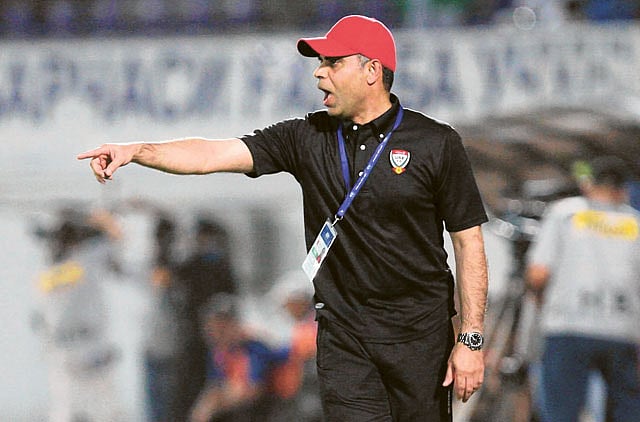
Dubai: Nessun Dorma, Gazza's tears and Roger Milla's corner flag celebration. Current UAE Under-23 national team coach Mahdi Ali would have lived and breathed Italia 90, even more so had he not been laid up at home injured.
Despite being in UAE coach Carlos Alberto Parreira's plans to travel to Bologna and Milan to face Colombia, West Germany and Yugoslavia in Group D of their first and so far only World Cup appearance, the then 25-year-old midfielder and Al Ahli regular was cruelly ruled out at the last minute.
The disappointment of missing such a landmark event in his nation's history would go on to shape him, leaving him with no defining moment in a five-year run with the national squad, which never saw him pick up an official cap.
Overlooked and written off, Ali's tale is one of remarkable turnaround. Those he would have been forced to watch on TV 22 years ago, such as Argentina's Diego Maradona, Italy's Walter Zenga, Spain's Quique Sanchez Flores and Austria's Josef Hickersberger, all now coaching domestically in the UAE, are doffing their hats to him.
Guiding his country back onto the international stage for the first time since Italia 90, with debut qualification to the Olympics this summer, Ali is determined to address business as a coach which was left so unfinished as a player.
His run into London 2012 has included 2010 Asian Games silver, a quarter-final finish in the 2009 U20 World Cup and triumph in the 2006 U17 Gulf Cup, 2008 U19 Asian Cup and the 2010 U23 Gulf Cup.
Capable
He's been with this U23 squad since 2003, when they were 16 and has become the unlikeliest of candidates to mould a generation many truly believe capable of re-qualifying to the last 32 of a World Cup finals — Ali's old stumbling block.
Despite all this home-grown success, and the obvious respect and understanding of local players, he's still only been afforded the briefest of considerations with club sides, filling caretaker roles for Al Ahli and Bani Yas between high-profile sackings, as the fascination with foreign expertise continues to trump common sense.
Even with the UAE senior post left vacant since Srecko Katanec's failed World Cup 2014 qualification bid, Ali's name has only been a passing afterthought either to Diego Maradona or Raymond Domenech.
The epitome of a nation ruled out, as it faces Uruguay, Great Britain and Senegal at the games this summer, Ali's story humanises how doubt in someone or something can spur such a determined reply.
Heartbroken
Ali, perhaps now part of the fabric of the UAE psyche having been so embroiled and heartbroken by its footballing past, told Gulf News: "We're always used to hearing people say the UAE can't do anything. But we're always happy with what we are doing and what we can achieve. We cannot say what we can or cannot do. Only time will prove this.
"I think all groups at the Olympics are strong and all teams are tough. We're happy to be in this competition and playing against the host nation at Wembley gives us a real challenge, but it's also a good chance for us to show our credibility and show that the UAE do have good players and a good team."
Speaking of his own entitlement to coach the senior national squad, Ali, who among Eid Baroot and Abdul Al Mistaki, remain the most highly thought after Emirati coaches, said: "I think the results will say that and all the results that have been achieved. But I think this judgement has to be made by the media and the fans. I can't discuss that.
"I am just happy to have changed and challenged a mindset which says we also need a foreign coach. I'm happy that I've played a part in that change for my fellow Emirati coaches and changed prejudices."
Like a big brother
Hamdan Al Kamali, captain of the Olympics team said: "Mahdi Ali brought a huge amount to the team. He oversaw a number of wins in a short space of time thanks to his special relationship with the players. He's not just a coach; he's also like a big brother who takes an interest in his players away from the pitch and helps them."
Ask the UAE FA President Yousuf Al Sarkal what he thinks of Mahdi's chances and the question is returned: "If we decide to give an Emirati coach the chance, would the media support the decision for long? Football is not all about winning, you lose sometimes. The media reacts quickly here win or lose. Will you turn against an Emirati coach as quickly as you'd support him?"
But with an age-old disconnect between the grassroots development of players using big name coaches only highly experienced in dealing with end products, the need for an Emirati, who speaks, thinks, cares and is the embodiment of his team, has never been greater.
The seed of hiring in help to coach players who would become the next wave of home-grown tacticians has finally borne fruit and it's up to the UAE football to notice the change, with or without an Olympic upset!
Sign up for the Daily Briefing
Get the latest news and updates straight to your inbox
Network Links
GN StoreDownload our app
© Al Nisr Publishing LLC 2026. All rights reserved.