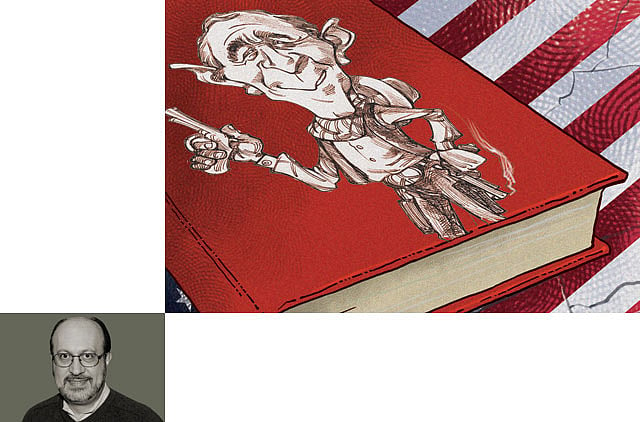
Cartoonists had a field day. One asked whether there were any books inside the new George W. Bush Presidential Library and Museum at Southern Methodist University in Dallas, Texas, answering with the perfunctory: “Just Cliff Notes.” Another pointed to an empty patch of land next to the facility, describing it as the “WMD Wing,” while a third portrayed a wheel-chair bound Statue of Liberty bewildered at the “32,000 handicapped parking spots” outside its main entrance. Perhaps the worst was one that depicted the former president holding an air force pilot’s helmet under his arm, below a sign that read: “Fiction Accomplished”.
Commentators were equally harsh, save for a few supportive revisionist columns that perceived the dedication as an “occasion for both friends and critics of the former president to press their case,” in an effort “to spin his humanity”. For the majority, however, it was “Shock and Awe in Dallas”.
In the event, and as customary, all living presidents and first ladies gathered to inaugurate the $250 million (Dh919.5 million) library, not only to bolster a shattered legacy, but also to portray internal stability. All five spoke, even if Jimmy Carter, perhaps the most decent man who filled the post in contemporary times — since he refused to kill a few million Iranians when he could have launched a revenge invasion in the aftermath of the 1979 hostage crisis — focused on one of the few non-controversial issues that preoccupied Bush: His commitment to fight AIDS in Africa. Carter also thanked Bush for his assistance to help solve the bloody disaster in Sudan.
Bill Clinton referred to the President’s Emergency Plan For AIDS Relief (Pepfar), a $15 billion programme over five years (2003–2008) that ushered in health access initiative to combat AIDS throughout Africa, along with a variety of other diseases like tuberculosis and malaria. He too stressed what a decent man Bush was and, true to his jovial self, Clinton concluded that he “liked” his successor, stressing that they did “a lot of speeches together,” which narrowed the relationship to that of a successful business proposition that ensured supplemented incomes to former heads of states.
The equally loquacious Barack Obama honoured “the life and legacy of the 43rd president,” as he revealed the existence of a letter from Bush on his desk when he stepped into his office on January 20, 2009, without revealing its contents. Still, he insisted that “to know the man is to like the man, because he’s comfortable in his own skin”. “He knows who he is,” and “doesn’t put on any pretences. He takes his job seriously, but he doesn’t take himself too seriously. He is a good man,” concluded Obama.
The ceremony, which was witnessed by important figures who helped Bush rule, ranging from vice-president Dick Cheney to the former British prime minister, Tony Blair, skipped the pesky issues that defined the two Bush terms — from 9/11 to Katrina to the invasion and occupations of Afghanistan and Iraq. There was not a peep about the perpetual “war on terror” or the WMDs (weapons of mass destruction) and the lies that accompanied what turned out to be successful marketing that made Madison Avenue blush. Nothing was said of the thousands of Americans and the millions of non-Americans who died in vain.
Instead, the world witnessed a celebration of a man and an administration that failed to defend the interests of the US, who rushed into wars fought on credit and who literally bankrupted the economy of the most powerful country on earth.
The “Decider,” as Bush liked to call himself, introduced “enhanced interrogation techniques” or, more accurately, torture, as an official US policy. Few grasped the true meaning of such an engagement although members of the bipartisan Constitution Project task force stated that it was “indisputable that the United States engaged in the practice of torture”. This was no idle accusation, but a carefully crafted analysis, which addressed a variety of concerns ranging from clandestine “black site” prisons to complete outsourcing of what were illegal actions under the Constitution.
It is now fashionable to compare Bush to Harry S. Truman as if the Missourian was anything but an overrated executive who, it may be correct to conclude, lost China and conceded the atomic bomb to the Soviet Union. Nevertheless, and unlike Truman — whose record in the bloody Korean War was at least balanced by the Marshall Plan that saved Europe from famine — Bush left the White House with no lasting legacy. Save one: He lied.
The aim of a Presidential Library and Museum is to showcase accomplishments that, presumably, add value to the nation. Inside the Dallas facility, one is bound to find mementoes from 9/11, including a section of twisted metal from the New York City Twin Towers, though equally devastating events that shaped the Bush presidency deserved careful evaluations too. Without playing down the significance of 9/11 or, for that matter, the wars that followed, it may be facile to invite the public to decide how to respond to such calamities.
History will record what an unmitigated disaster the G. W. Bush presidency was even if time and distance could improve his reputation. No library and museum will change the fact that he inherited a relatively healthy republic, but left it in a mess. Oh, and this may be worth mentioning en passant, nothing will erase the dishonour he brought to the US on the world stage.
Dr Joseph A. Kechichian is the author of Legal and Political Reforms in Saudi Arabia (Routledge, 2012).
Sign up for the Daily Briefing
Get the latest news and updates straight to your inbox
Network Links
GN StoreDownload our app
© Al Nisr Publishing LLC 2026. All rights reserved.