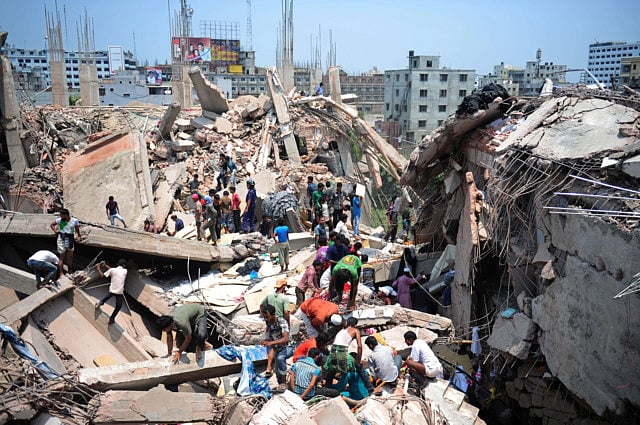
In the wake of last week’s factory collapse in Dhaka, a dangerous argument has been making the rounds of the blogosphere. The argument, voiced by outlets as diverse as Slate and the Spectator, is that the economic benefits of the sweatshop economy override concerns about the rights of factory workers.
Sweatshops, the argument runs, do not pay much (about $40 or Dh147 a month in Bangladesh), but they pay a good deal more than subsistence agriculture, the primary alternative available to poor workers in developing countries. The appeal of a higher wage, steadier hours and, for women, independence draws workers from rural areas to urban slums in search of factory work. Globalisation, and with it the outsourcing of manufacturing labour from rich countries to poor ones, has lifted millions out of extreme poverty (defined as living on less than $1 a day). Shutting down sweatshops completely will only erase those gains.
This is true up to a point, but it does not follow that the model cannot be improved.
The pro-sweatshop argument, of course, is favoured by the anti-regulation right, but it finds itself mirrored on the left, which also attempts to impose a false choice between accepting sweatshops as they are and having no factories at all. Anti-sweatshop activists often fold their critique of sweatshops into a broader critique of globalisation. Pushing not only for raised safety standards, but also for wages that match those in the developed world is a tactic that will have the effect of shutting down developing world manufacturing altogether. Businesses need to save some money on labour in order to justify the additional cost of manufacturing abroad.
Indeed, many anti-sweatshop campaigners will be quite happy to see these factories closed down, globalisation reversed and manufacturing jobs returned to the West. That makes it hard to take them seriously when they claim to have the best interests of Bangladeshis at heart.
Instead, campaigners need to separate the issue of western industrial decline (and what to do about stagnant post-industrial economies), from the wages and working conditions of developing world factory workers. They need to advocate for a better and more humane globalisation, not against globalisation altogether.
Part of that should be about making a distinction between wages, which do not have to be the same everywhere, and workers’ rights, which should. The cost of living in Bangladesh is far lower than the cost of living in the US or Europe. Campaigners should be pushing for Bangladeshi workers to make a living wage relative to the local cost of food and shelter. According to Bangladeshi labour organisations, that will be at least $60 per month.
Yet, if the cost of living varies from place to place, the cost and value of a life should be the same everywhere. That is why every worker deserves a workplace that is clean and safe and the right to organise to protect themselves against abuses. When Slate’s Matt Yglesias argues that workers’ deaths in Bangladesh are, in effect, justified by the country’s poverty (his euphemism for this is that Bangladeshi workers are willing to accept “different choices [than American workers] on the risk–reward spectrum”), he is conflating the cost of a life with the cost of living, confusing a person’s human worth with their socio-economic status. That is wrong.
The arguments advanced by both pro and anti-sweatshop commentators take for granted that the status quo is good for business. Cheap labour is undoubtedly a boon for companies, but shoddy standards are not. Buildings that collapse or catch fire, unclean workplaces where workers routinely fall ill ... mean halted production and lost revenue. They also mean bad press and falling share prices, which is why western firms generally provide themselves with plausible deniability of links to these sweatshops when disaster strikes.
The problem for many multinationals has been that keeping managers on site in every country is prohibitively expensive. Instead, they have opted for complex supply chains where key decisions fall to independent contractors who are not accountable to shareholders. Modern data technologies can close this gap: Startups like SourceMap can help businesses manage their supply chains more directly. That kind of transparency will be good for companies and workers alike.
Perhaps the most insidious aspect of the sweatshop debate, however, is in the way commentators blithely offer up a description of the status quo as a defence of it. Bangladeshi workers did choose these jobs — and they chose them on the rational basis that these jobs pay more than the available alternatives. Therefore, pro-sweatshop commentators, like the Spectator’s Alex Massie, argue that sweatshops must be a good thing. But how free a choice is it when the alternative — subsistence agriculture — pays far less than $1 a day, a wage the UN considers the threshold for extreme poverty?
If a choice is “free” only in the most formal sense, then why would we assume it is a good one?
That is the trouble with modern economic discourse and its chief protagonist, homo economicus. It is not simply that pundits are loath to address the subjective questions that surround decision-making. It is that positive thinking — the focus on how decisions are made rather than whether those decisions are good ones — is being substituted for normative analysis.
If all humans are assumed to be equally free and rational in their choices, if we are all homo economicus, then all the choices we make must be good ones. Instead of tackling moral questions, we are attaching moral value to the way things are, and in so doing, we are losing the ability to imagine a better world.
Maha Rafi Atal is a freelance journalist and the executive director of Public Business, a non-profit supporting public-interest journalism about business.
Sign up for the Daily Briefing
Get the latest news and updates straight to your inbox
Network Links
GN StoreDownload our app
© Al Nisr Publishing LLC 2026. All rights reserved.