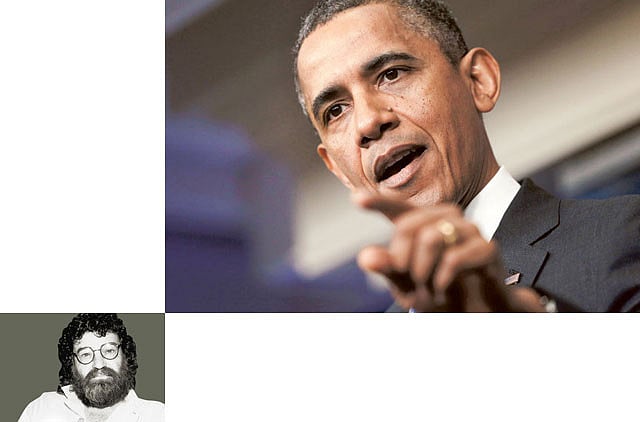
How did we get here from there? In a press conference at the White House last Monday, visiting British Prime Minister David Cameron and President Barack Obama, whose monotonous adherence to caution in foreign policy is now legion, expressed “optimism” that an international meeting on Syria next month will lead to a solution to the country’s civil war. The news is more likely to drive us to stifle a yawn than to hold our breath.
How do we know in advance that this international gathering will be futile, a kind of staged photo-op, that will feature a smiling Vladimir Putin, whose government has armed the Syrian regime and vetoed a UN resolution condemning it? We know it from none other than Obama himself. “I’m not promising that it’s going to be successful”, he told the assembled White House journalists as Cameron stood next to him. “Frankly, sometimes when the Furies have been unleashed in a situation like we’re seeing in Syria, it’s very hard to put things back together”.
We are all familiar with the maxim: “If it ain’t broke, don’t fix it”, attributed to Jimmy Carter’s Director of the Office of Management and Budget, but for the life of me, I’m not familiar with its dialectical opposite, instructing one not to fix something when it is broken — which effectively is what Obama appears to be telling us here.
This is all the more disturbing when you consider that this international conference, slated to be held in Geneva, will effectively buy time for the Syrian regime, putting on hold plans already on the board for the US, France and Britain to begin seriously arming the opposition. Now more than ever, rebel forces, whose fortunes have recently taken a turn for the worse, desperately need that aid, especially given the fact that Al Assad has made battlefield advances with the help of boots on the ground from Hezbollah and Iran.
If the goal of this conference is to negotiate an end to the regime — surely a precondition for any meaningful negotiations — that will envision Bashar Al Assad agreeing to negotiate his own ouster from power and Moscow to reverse its position on regime change in Damascus. Most unlikely.
So what’s the point? “[Secretary of State John Kerry] is right that the ideal endgame for Syria is a negotiated settlement”, editorialised the Washington Post last Wednesday. “But the administration’s rush to enlist Russia and the Al Assad regime in talks before acting to change the balance of forces on the ground means this initiative, like those before it, is more likely to provide excuses for US passivity than an end to Syria’s carnage”.
For all intents and purposes, the US has opted to leave Syria to its own devices, to fend for itself, to find its own way, as if its conflict does not continue to polarise the region, dramatically affecting the country’s neighbours, with well over a million Syrian refugees languishing in Jordan, Lebanon and Turkey, raising a generation of youngsters who, instead of attending classes in the morning, go foraging for food in their refugee camps.
Obama remains passive, even in the face of advice from officials in his administration to play an active role. Additionally, many foreign policy experts and columnists are overwhelmingly in support of military action, despite the unpopularity of such action with a war-weary public. They contend that Russia’s opposition should be no impediment. After all, in the 1990s, Russia had threatened to veto action on Kosovo at the Security Council, yet the US went in multilaterally, took the issue out of the UN and sought out its Nato allies to get moving.
Obama’s Syria policy has been identified as “no policy”, “lacking coherence” and “inviting great damage to US interests”. And wile we are at it, add “bumbling”.
From the outset, the American president has made it clear that the use of chemical weapons by the regime will represent a “red line”, but he has shown that he is a master of obfuscation. After it was revealed recently that the Al Assad regime had indeed used chemical weapons, for example, Obama resorted to double-speak. “The operative word here is ‘perceived’”, he said. “And what I’ve said is that we have evidence that there has been the use of chemical weapons inside Syria, but I don’t make decisions on ‘perceived’ [notions]. I can’t organise international coalitions around ‘perceived’”.
If you are scratching your head over what this means, join the club.
The field, surely, would have been levelled for the rebels had they been protected by a no-fly zone and afforded military aid. Nobody expects Obama to send in the cavalry, but everybody expects him to conduct his country’s foreign policy with a politico-moral impulse, in this case bringing to and end the slaughter of civilians and an equal end to the tyranny of a regime that does not consider itself above inflicting every manner of calculated bestiality on its citizens.
We don’t blame Russia, throughout its history a totalitarian state, whether under Russian Tsars or Communist Commissars, for being Russia. You don’t, after all, blame the beast of prey for being a beast of prey. But the United States advances itself as a liberal democracy, guardian of human rights and desseminator of Jeffersonian principles. The US can continue to do that, if it so wishes, but not with a straight face.
Fawaz Turki is a journalist, lecturer and author based in Washington. He is the author of The Disinherited: Journal of a Palestinian Exile.
Sign up for the Daily Briefing
Get the latest news and updates straight to your inbox
Network Links
GN StoreDownload our app
© Al Nisr Publishing LLC 2026. All rights reserved.