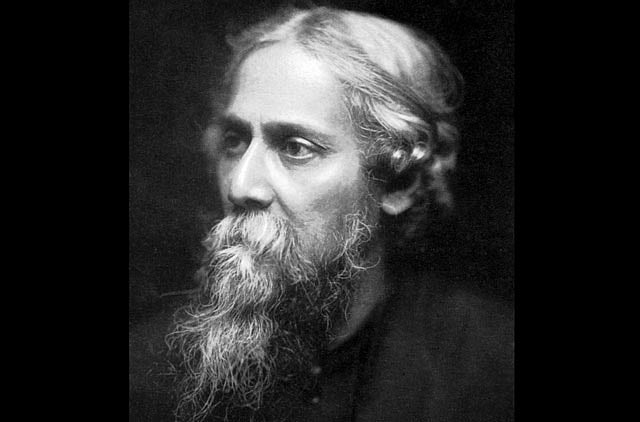
The year-long celebrations stretching from Zagreb to Salamanca, Rijeka to London to mark the 150th birth anniversary of Rabindranath Tagore are winding down and the centenary celebrations commemorating his Nobel Prize for Literature are winding up.
It is daunting to write on the Gurudev — an insipid version of that epithet would be ‘the ultimate master'. And in that simplistic rendition we face our central challenge in understanding this sage and polymath. The expression lost in translation couldn't find a better example than in Tagore for much of his writings loses its authenticity and verve when rendered in English. And his prodigious work covering poetry, painting, music and philosophy only tested the critics further.
Quips scorning his many sided genius are many but none can match: If only Tagore, Wouldn't draw! His literary stuff, Is tedious enough. D.H. Lawrence and Graham Greene have mocked the poet and his early admirers who brought him international recognition, Y.B. Yeats to Ezra Pound became detractors in later life.
This therefore is a perilous journey for an Indian because Tagore is revered in India though not always remembered or read often enough. Unless of course you happen to be a Bengali. And no better caricature of a Bengali than that depicted in a Bollywood comedy movie — Vicky Donor.
Has Tagore like Mahatma Gandhi become a hagiographic symbol — seen behind bank notes or confined to high brow art and culture events? Fleetingly understood and even less followed in practice. Gandhi at least had a Richard Attenborough but Tagore has never had a populariser to mainstream him. Rabindra Sangeet, known as Tagore songs is still sung in Bengal but rarely elsewhere.
Acclaimed historian Ramchandra Guha goes one step further and says ‘intellectuals of Bengal have sold him short. They have provincialised and parochialised Tagore; as a result, this thinker whose ideas extended well beyond Bengal has been turned into a local hero'.
Time enough then to re-look at India's national treasure — the ultimate versifier and moral conscience keeper. Cuttingly Greene called him a ‘pebbly eyed theosophist' for this group — the Bloomsbury set of Virginia Woolf and Lytton Strachey had little time for Tagore.
The Guardian in an article posed this provocative question ‘is his poetry any good'? And the answer was equally dismissive "Don't know". Undoubtedly the English literary establishment has been ambivalent about Tagore and even his famous poem Gitanjali at best had only a small circle of admirers in the West.
Philosophical ideas
To get at the essentials of Tagore, then, one has to turn to a wider circle of critics. Amartya Sen has written extensively on him but let us rely more on Michael Collins, author of Rabindranath Tagore's Writings on History, Politics and Society and British poet William Radice who says Sen's espousal of Tagore limits a fuller appreciation of the Gurudev. Sen dwells more on Tagore's philosophical ideas diverting us away from the Tagore's creative treasures.
To sift through a trove of two thousand songs, eight novels, four novellas, countless poems, plays, essays and paintings is an impossible task. It is therefore with much trepidation that one chooses to pick on Tabu Mone Rekho (Even so remember me) and Amar Sonar Bangla (My golden Bengal). Who can forget those immortal lines from Gitanjali —‘where the mind is without fear and the head is held high' or the novel Gora (Whitey) or Ghare Baire (Home and World).
Tagore was much influenced by the mystic Bauls (wandering minstrels) and in translations the cadences found in the originals are lost. One has only to listen to Mone Rekho in Bengali, written by Tagore, just a few months after the suicide of his sister-in-law to get at the depth of this loss, a bereavement that has a much deeper meaning. Nastanirh [Broken Nest] is also based loosely on the same theme — of forbidden love and hints at Tagore's mixed feelings towards his sister-in-law.
This story has since been immortalised by that maestro Satyajit Ray in his film Charulatha (Lonely Wife) and revolves around Charu's troubling relationship with the young Amal — her husband's nephew. Who can forget that scene from the famous garden-swing sequence, where Charu played by Madhabi Mukherjee is seen contemplating, lorgnette in hand?
To get the full measure of Tagore's genius one has to fall back on Michael Collins, Sen and William Radice. He is the only poet to have composed national anthems for two countries — India and Bangladesh.
Tagore was one of the earliest to talk of the Universal Man; he decried narrow definitions of ethnicity and was prophetic enough to declare that shrill and strident calls of patriotism will ultimately lead us to the Bush Doctrine — Are you with us or against us. His Ghare Baire should be a must read for all those involved in the war on terror.
Sen called him a towering figure in the millennium-old literature of Bengal. With such a hoary tradition, the timeless quality of Tagore can wait for a new dawn.
Ravi Menon is a Dubai-based writer working on a series of essays on India and on a public service initiative called India Talks.
Sign up for the Daily Briefing
Get the latest news and updates straight to your inbox
Network Links
GN StoreDownload our app
© Al Nisr Publishing LLC 2026. All rights reserved.