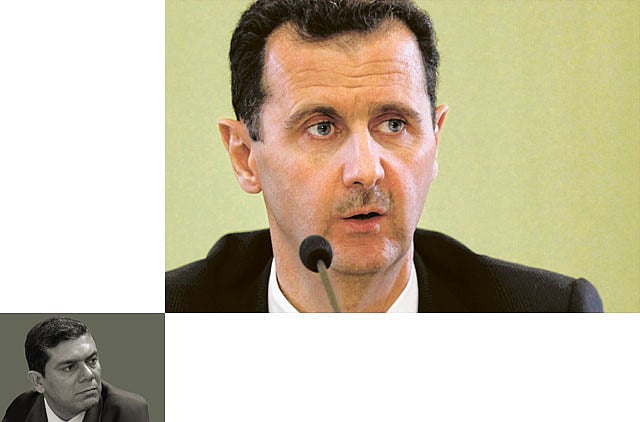
The signs are becoming so obvious that they cannot be ignored: Syria’s two-year-old revolt is entering its penultimate phase and the battle for Damascus is gathering pace. Against many odds, rebels fighting to unseat President Bashar Al Assad have never been as close to achieving their goal as they are today. Military analysts and pundits are talking about the sudden surge in rebel attacks and important gains on the ground. In recent days, military airports have fallen in Deir Al Zour, Aleppo and not far from Damascus. The regular Syrian army has failed to make any significant gains despite relentless shelling of the opposition.
The regime now relies almost entirely on airpower. Even then, its air superiority is being challenged as rebels claim to have downed several aircraft, a few not far from the capital.
Some, like Arab League Secretary-General, Nabeel Al Arabi, expect the regime to fall “anytime”, while others like Russian President Vladimir Putin continue to side with a beleaguered Al Assad. Still signs point to serious dents in the Syrian war machine. After more than a week of heavy fighting the regular army was still unable to secure Damascus International Airport or the main road linking it to the capital. Weeks of heavy bombardment have failed to dislodge the rebels from the strategic town of Darya, southwest of Damascus, which overlooks key army barracks not far from the presidential palace.
Meanwhile, attempts to regain control of Aleppo, Syria’s biggest city, have been unsuccessful. The rebels, who have regrouped in the past few weeks and have apparently adopted a new strategy aimed at taking over army compounds and military airports, now have control of most of Syria’s north and north east. The army has failed to reclaim Deir Al Zour or subdue the towns of the southern governorate of Derra.
What has changed in recent weeks? There is evidence that the Free Syrian Army (FSA) and rebel groups associated with it have received sophisticated armaments, including anti-aircraft missiles and anti-armour rockets. In the past few weeks, the rebels have overrun air defence bases and taken control of existing weapons. This has allowed them to hunt down Syrian fighter jets and helicopters — a big game changer in the ongoing crisis.
So far the regime has not changed its strategy or political position. However, as the battles reach southern districts of the capital, it becomes clear that its military response is not working. Most of the capital’s surrounding districts have fallen to the rebels despite sustained aerial and ground bombardment. On the military front, the army is yet to “liberate” a key strategic area or deal a heavy blow to the rebels.
On the political front, little has changed as well. The joint Arab League/UN special envoy, Lakhdar Brahimi, told the UN General Assembly recently that the situation will only get worse and that the ball is now back in the Security Council’s court. The newly-formed Syrian national coalition has received important international recognition, but it remains doubtful if it has substantial control over the rebels or what role it will play in post-revolution Syria.
The most important development on the international front is President Barack Obama’s warning to his Syrian counterpart that use of chemical weapons will not be tolerated. Nato nations have also said that use of chemical weapons by the regime will warrant an immediate response. Opponents of the regime, like former vice-president Abdul Halim Khaddam, have said that Al Assad will not hesitate to use chemical weapons against his own people as a last resort.
There is no doubt that the regime is now fighting for its survival. If the capital’s airport falls, it will mean that the city will be surrounded from most sides. The mass destruction of Aleppo will be nothing compared to the devastation that will engulf Damascus. In the end, there are many scenarios, including the obvious one of Al Assad fleeing Syria and seeking refuge in some South American country. However, there is always the possibility that he will choose to retreat to the mountains near Latakia where he can hide among his fellow Alawites. A de facto division of Syria, along sectarian and ethnic lines, remains a plausible scenario as well.
Recently, there have been reports that the US, along with Turkey and Jordan, has approved a plan to dispatch a 75,000-strong force to secure Syria’s chemical weapons depot. Foreign intervention will only take place if Damascus falls or if the regime deploys chemical weapons. The battle for the capital could take between a month and three months, according to analysts.
Most of them agree that Al Assad’s fall will be a matter of time. However, the biggest question today is what will happen afterwards? The new national coalition represents most Syrians, but not all. The FSA is a loose umbrella for tens of thousands of former regular army soldiers, local militias and foreign Jihadists. Once Damascus falls, one can expect the same kind of chaos that occurred in Libya after the fall of Muammar Gaddafi, if not worse.
While the regime’s end may be near, the Syrian crisis will be far from over. Syria’s destabilisation will have a spill-over effect on the entire region, including Israel, Turkey, Lebanon and Jordan. The loss of Syria will be a big setback for Iran and Hezbollah, but it will also create challenges for other regimes in the form of extremist groups, some linked to Al Qaida, that will have a big role to play in the future of Syria.
Osama Al Sharif is a journalist and political commentator based in Amman.
Sign up for the Daily Briefing
Get the latest news and updates straight to your inbox
Network Links
GN StoreDownload our app
© Al Nisr Publishing LLC 2026. All rights reserved.