Syrian president Bashar Al Assad is the only Arab leader who inherited the presidency from his father within the framework of a Republican system. Those in the Syrian government saw no harm in overriding constitutional stipulations, and made a fundamental change to the constitutional structure allowing a person below 40 years of age to assume power.
The current Al Assad regime is an extension to the father's method of ruling. Al Assad is upholding the principles followed by his father.
Hafez Al Assad seized power in Syria in 1970 after what he called a correctional move to control the leadership of the Baath Party, which itself had come to power on March 8, 1963 following a military coup.
One of the most prominent principles of Hafez's Baath party was to rule the country alone.
This is an important point, as it has a bearing on the present situation in Syria.
It is only natural for the regime's and the party's shortcomings to come to the fore after having controlled the country for nearly half a century.
But, this system of governance was engulfed by the changes brought about by the Arab Spring, which Syria has experienced over the past 11 months.
Daraa, the Syrian city near the Jordan border, was where the protest movement demanding reforms began, spreading later to larger cities and reaching the suburbs of Damascus itself.
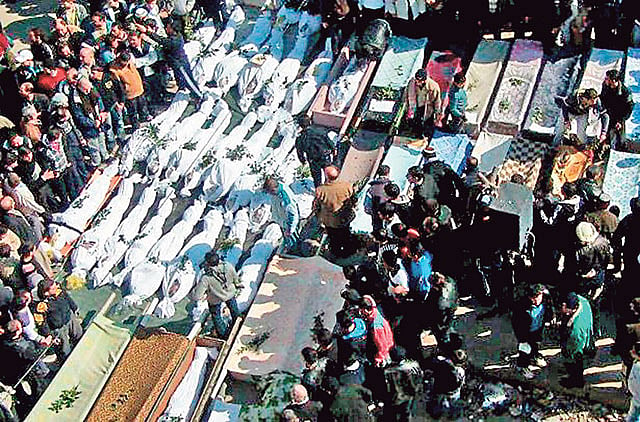
The regime — which is obsessed with security issues — confronted the protests with brutal violence, which led to the escalation of tensions. The protests, which had started peacefully, morphed into the biggest threat to the regime so far. The reform initiatives presented by the opposition could not change the regime's stance. Foreign pressure — from the United States, the European Union and the United Nations — was also unsuccessful.
The fourth speech delivered by Al Assad on January 10, at the Damascus University building, did not have anything new. It was a repetition of his previous message to the effect that there is a conspiracy against Syria in which some Arab countries are also involved.
The situation in Syria has now become extremely dangerous, especially following the Russian and Chinese veto at the UN Security Council on Saturday against an Arab League-backed resolution.
On January 28, the League's observer mission came to an end, with the Syrian regime having controlled all access while the observers were in the country.
Today, after 11 months of bloody clashes and thousands of people dead on the streets, the regime has started losing control. It has almost lost the battle, and there is almost zero support for it at the Arab level. On the international level again, the Syrian regime has no allies except those who are themselves facing a crisis.
Falling reserves
On the political level, the regime has adopted policies that increased its Arab and international isolation. Its strategic alliance with regional forces that have controversial agendas was not a smart move, as it contributed to Syria's isolation from its Arab neighbours and made it a source of concern for other strong neighbouring countries.
On the diplomatic level, the regime failed in marketing its pro-Arab policies. It has also failed in the media war.
Internally, the country's economy is in dire straits as a result of sanctions. The inflation rate is increasing while the foreign currency reserves are depleting. The value of the Syrian pound is going down rapidly.
Though the armed forces and the security apparatus are still under the regime's control, there are indications that it may not be so indefinitely, as a number of military personnel are defecting all the time.
Russia and China have worked to protect the Syrian regime at the Security Council. However, in the long run, even this may not last as both powers have interests in other countries in the region, and more interests with the US and the EU.
Moreover, Russia and China are not in a strategic location that will enable them to counter the pressure exerted by the West.
The Arab Spring has brought down four rulers so far. The last was Yemen's Ali Abdullah Saleh, after he accepted the GCC plan. The Arab League had given Al Assad a similar chance, which he has refused.
The Syrian regime will eventually fall, but not before rivers of blood flow, and not before the economy is completely destroyed.
As a result, Syria's sovereignty will be compromised and its people will suffer for years to come.
The departure of the Syrian regime will also have great repercussions on regional alliances.
Dr Mohammad Akef Jamal is an Iraqi writer based in Dubai.
Sign up for the Daily Briefing
Get the latest news and updates straight to your inbox
Network Links
GN StoreDownload our app
© Al Nisr Publishing LLC 2026. All rights reserved.