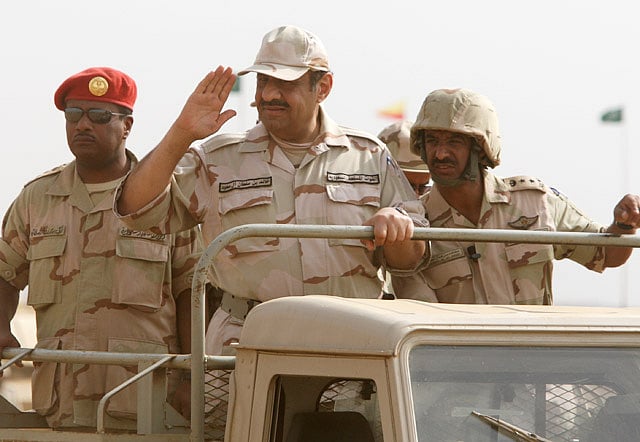
Although Saudi Arabia declared victory over Yemeni Al Houthi rebels along the border region, Saudi and Yemeni air strikes continued unabated, with no end in sight. Insurgents, who professed they were no longer inside Saudi territory, were still active in the northern provinces of Sa'ada and Malahidh, where heavy casualties added to growing tolls on both sides. Sana'a's contentions that government troops inflicted serious damage on Al Houthis and, perhaps, killed leading rebels like Saeed Ali Al Shihri as far back as December 2009, proved to be unsubstantiated. Given the lack of progress on the political front, will Yemen become a failed state?
In his latest dispatch from Yemen for the New York Times, where he disembarked expecting to be met by none other than "Osama Bin Laden himself," the widely read Thomas L. Friedman concluded that Yemen had "the resources to save itself," but that Yemenis needed "to be mobilised by better governance." "Without that," the modesty-stricken columnist opined, "the trend lines will eventually overwhelm everything and the Al Qaida virus, still controllable, will spread."
Presumably, Friedman was concerned that the Yemen-based wing of the ill-defined Al Qaida movement, would succeed in mobilising supporters on the Arabian Peninsula to wage holy war against apostate Muslims along with non-Muslims. It is a sad fact that Sana'a conducted, and continues to persecute, a poorly managed crackdown on militant forces, which further plunged that hapless country into a morass of tribal skirmishes. Years of neglect meant that a substantial portion of the population was surviving on less than $2 (Dh7.35) per day while corruption became a way of life for many.
Still, and luckily, Friedman realised that Sana'a was not Kabul and Yemen was not Afghanistan, or as he put so succinctly, "not yet." The capital city charmed the visitor, who was shocked to notice that men and women went about their lives in more or less non-distinct fashion, eager to add improvements whenever possible. What lurked everywhere, Friedman declared, was the Al Qaida "virus" that apparently spread en masse and which weakened the Yemeni "immune system." Because President Ali Abdullah Saleh governed over weak institutions, the columnist wrote, it was nearly impossible to "keep pace with the negative trends" pullulating throughout the country.
Slew of problems
This is, of course, ironic given Sana'a's reliance on the military to impose an iron will. In fact, corruption, nepotism, poverty, unemployment, along with a slew of serious problems ranging from water shortages to uncontrolled population growth to poor education, ravage Yemen.
Few would disagree that the country accumulated a slew of ills over the years, neglected its responsibilities and wasted substantial energy on interminable political disputes. How to reconcile conservative northerners with revolutionary southerners was an epochal dilemma without any answers, even if the quarrels centred over power-sharing rather than serious ideological differences. In the event, neglect literally festered into growing instability, which was conveniently exploited by outside forces as various secessionist movements as well as the latest rebellion illustrated.
Al Shihri, a Saudi veteran of Guantánamo prison, passed through a rehabilitation programme for former extremists in 2007, before resurfacing in Yemen. By threatening more death and destruction, Al Shihri has strengthened the likelihood of Yemen becoming a failed state.
It is now up to Riyadh and its Gulf Cooperation Council (GCC) partners to take matters into their own hands. As a follow-up to the January 28, 2010, London conference that promised serious financial aid, attention should shift from security matters to a massive investment project. Simply stated, it would be in the Saudi interest to try what has not been tried so far: tackle Yemen's bad governance with a special emphasis on economic matters.
Admittedly, this is a difficult perspective for government officials to fathom, but short-term security measures, to counter suspected Iranian support for Al Houthi separatists or unchecked Al Qaida recruitment efforts among the impoverished, will not resolve such an endemic problem. Rather, GCC states' interests would be better served if Yemen were perceived neither as a foe nor a burden, but a potential partner.
Al Houthi numbers are small but the estimated 25 million Yemenis represent real challenges that must be addressed one at a time. Al Shihri and other recruiters can mobilise unemployed Yemenis into assets that can be deployed on battlefronts. They succeed whenever Sana'a looks the other way, and while Riyadh's $1.25 billion (Dh4.59 billion) pledge in London was impressive, a whole lot more is needed. Yet, in the long run, investing in such schemes will be much cheaper than fighting a war. As Friedman himself noted, this is the realisation that is required if Al Qaida is to be prevented from transforming Yemen into a permanent battlefield.
Dr Joseph A. Kechichian is a commentator and author of several books on Gulf affairs.
Sign up for the Daily Briefing
Get the latest news and updates straight to your inbox
Network Links
GN StoreDownload our app
© Al Nisr Publishing LLC 2026. All rights reserved.