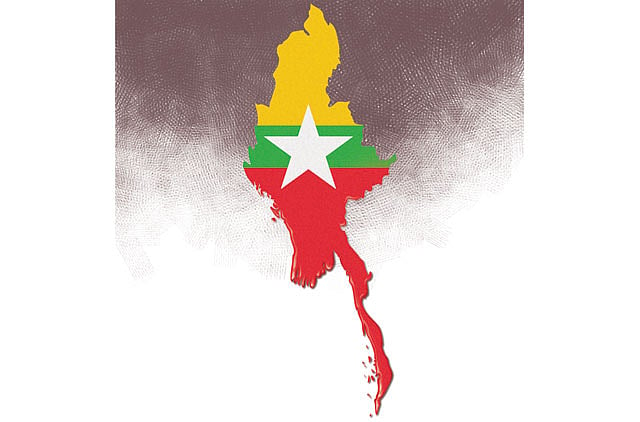
When the President of Myanmar, Thein Sein, met US President Barack Obama at the White House, he undoubtedly stressed how his government had taken steps towards democratic reform. Indeed, in recent years, Myanmar has released hundreds of religious and political prisoners. It has eased internet and media controls. It has held limited parliamentary elections.
However, the recent applause for reforms obscures a dark underbelly of sectarian violence and ethnic discrimination, fuelling human-rights atrocities and religious-freedom abuses, which threaten to tear the country asunder. These are the conclusions that the US Commission on International Religious Freedom, on which we serve, documented in its 2013 Annual Report, released on April 30.
In his meeting with Thein Sein, Obama could have emphasised Washington’s commitment to Myanmar’s progress, while stressing the imperative of countering discrimination and violence against ethnic minority Muslims and Christians. Such violations of human rights threaten to strangle reform in its cradle and religious freedom along with it.
Few suffer like the Rohingya Muslims, one of the world’s most persecuted people. Denied citizenship and discriminated against at every turn, they face continued violence in the country’s western Rakhine (Arakan) state. This violence is often instigated by monks and perpetrated by mobs and local militias, including police.
Based on sources within and outside Myanmar, our report confirms that over the past year, attackers have torched villages and killed more than 1,000 civilians, while driving more than 100,000 into squalid refugee camps, where they are routinely denied adequate food, medical aid and shelter from the oncoming monsoons. Women have reportedly been raped and used as sex slaves by the military and local militias and police have blocked aid to the destitute.
Christians, particularly the Kachin and Chin ethnic minorities, have also endured severe religious freedom abuses and societal discrimination, including restrictions on building houses of worship, destruction of religious venues and artefacts, bans on certain religious ceremonies and efforts to press their children to embrace Buddhism. In renewed violence in Kachin state in January, the military targeted Christians for rape and forced labour through kidnapping.
Indeed, across the country, the government has failed to halt the military’s depredations or hold individuals accountable for sectarian violence. It also continues to censor religious publications and ban the importing of Bibles and Qurans in indigenous languages.
The US remains deeply invested in reform in Myanmar. However, Washington’s involvement can be more than providing economic and political aid to Myanmar’s government. It can steer aid away from former military leaders and their supporters. It can prioritise efforts to build up ethnic minority regions, promote tolerance and support those working for a free, multi-ethnic country.
Washington surely can provide the country with benchmarks for progress. These should include the release of all prisoners of conscience. Also critical is an immediate ceasefire in the military’s fight against ethnic minorities, a citizenship solution for Rohingyas and an end to discriminatory policies against Muslims and Christians. With those steps must come accountability for their attackers as well. And Myanmar must also ensure that substantial humanitarian aid reaches the Rohingyas and other Muslims.
Finally, Washington can push Myanmar to make a commitment to hold free and fair elections in 2015.
Myanmar should know that the US and the world community are committed to helping its transition from being one of the world’s most tyrannical military regimes to joining the community of democracies. Myanmar has taken vital steps towards reform, but only if it acts decisively against ethnic and religious violence can it avoid a descent into a chaos that no generous aid packages can forestall.
Due to the continued violence targeting religious and ethnic minorities, our organisation, the US Commission on International Religious Freedom, recommends that the US maintain Myanmar’s status as a “country of particular concern,” as an egregious abuser of religious freedom and related rights. And the US should be prepared to re-impose already-lifted sanctions against Myanmar if conditions fail to improve.
In the end, Americans must not limit their view of Myanmar to the smiling and serene Nobel Prize Laureate Aung San Suu Kyi. They should also recognise the appalling mistreatment of its religious and ethnic minorities, especially during the past year. America should acknowledge the Rohingyas, who were slaughtered last July and October, the women raped and the Protestant churches destroyed in Kachin state in January. The US should not lose sight of the burning and killing of more Muslims in the cities of Meikhtila, Bago, and Yangon this March.
America should contrast the photos of brave Buddhist monks, protesting a dictatorial military in 2007, with the reports of many monks preaching hatred and wielding the sword against Muslims today. The US administration must let Myanmar know that it sees this fuller, more troubled picture and where it is heading.
And America must be fully prepared to back its concerns with tough action if Thein Sein’s government fails to follow through and protect human life, strengthen human rights and secure religious freedom.
— Christian Science Monitor
Rev. William Shaw serves as vice-chair of the US Commission on International Religious Freedom (USCIRF). M. Zuhdi Jasser is a USCIRF commissioner and Azizah al-Hibri is professor emerita of the University of Richmond School of Law and a former USCIRF commissioner.
Sign up for the Daily Briefing
Get the latest news and updates straight to your inbox
Network Links
GN StoreDownload our app
© Al Nisr Publishing LLC 2026. All rights reserved.