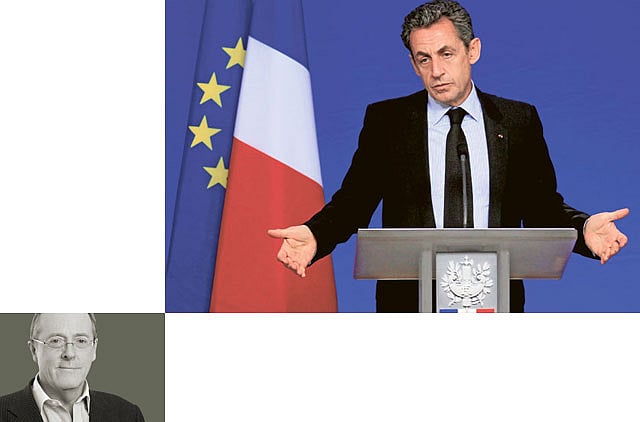
The French people will elect a new president in less than three months. Four main candidates have now emerged and should be officially authorised to run by mid-March. They are Socialist Francois Hollande (27.5 per cent first round/56 per cent second, as per latest opinion polls), the far ight National Front's Marine Le Pen (assuming she gets the necessary endorsements, 19 per cent first round), the centrist Francois Bayrou (15 per cent first round) — Nicolas Sarkozy (24 per cent first round/44 per cent second) is not yet a declared candidate. He wants to be seen as an active president who works until the last minute. Saving France, Europe and the world keeps him busy; he has no time to be distracted by a trivial activity such as a re-election campaign.
It makes everybody smile. The French know Sarkozy has been campaigning for months. A public announcement in a month's time will only allow him to fine-tune his last moves. The fight has thus begun between the two main contenders. Hollande held a first massive meeting on January 21 and a long TV debate on the January 26. Sarkozy was himself on TV (on not less than six channels) on January 29.
Besides, two unknown factors remain. Could Bayrou reach the second round? It seems unlikely, but there are still three months to go. Could Le Pen do it and eliminate Sarkozy? It would be useless anyhow as there is no chance that she can ever win the elections. Yet, the hypothesis should not be ignored. First, Le Pen has traditionally been underscored in opinion polls — people are reluctant to say they may vote for the far right. Second, one should not forget that Sarkozy was elected last time thanks to the National Front's votes and it will not repeat that this time. Thus, there is a kind of consensus on a Hollande-Sarkozy confrontation, which should lead them to review their respective programmes.
To cut a long story short, Hollande insists on redistribution, keeping buying power for the poorest, taxing higher revenues and capital; Sarkozy insists on lowering labour costs, reducing spending and deficits; nothing really new as far as these two blocs are concerned. Foreign policy is hardly mentioned (what about Afghanistan or Palestine?) apart from making a reference to Germany: for Sarkozy, as a never-ending motto whereby everything France should do "was already done long time ago by the Germans"; for Hollande, as a first appointment once he is elected, to explain to Chancellor Merkel that economic recovery needs growth.
The actual opposition, it seems, comes from elsewhere. Beyond the programmes, two styles and personalities are contrasting. Hollande has long been the ‘nice guy', enjoying the good side of life but lacking seriousness and government experience. What the people are now discovering is different: Hollande remains and insists on being considered as a ‘normal man' but at the same time, he starts actingpresidential.
Retirement issue
Sarkozy on the other hand is in a very awkward situation. The degree of rejection he has provoked is unbelievable (opinion polls after his Sunday show even put him at 42 per cent versus 58 per cent for Hollande in the second round). He is the first president of the Fifth Republic whose chances of his former voters voting for him again are as low as 60 per cent. Whatever he says or does is thus no longer taken into consideration by a significant number of his "natural" voters — not to mention the others. Fair or not, it looks like the French just want to get rid of him as if they could not stand him anymore.
Reasons for that have been widely reported: provocation, confrontation, communication. The retirement issue (and many others) is one example. Sarkozy was the first president to start reform on this issue. His achievement was a good start (quitting work when 62 instead of 60 — but still below the needed 65). Instead of keeping a low profile, he overreacted and claimed full victory — which convinced everybody that nothing had probably changed since the target had clearly not been fully reached. Therefore, Sarkozy's last exercise on TV could not but meet a similar level of frustration.
Will increasing by 30 per cent the construction rights of the owner of a small house in the periphery help settle the present economic crisis, notably when banks have stopped lending? Is switching the fiscal burden on labour costs from employers to consumers, as he also proposed, a decision to be taken three months before quitting office (knowing anyhow that ‘for computer reasons', it cannot be implemented before nine months)? Is this carpet bombing or a last attempt to play all his cards in one go, with his back to the wall? The French people will have their say. Three months may be a long period of time but the official declaration for candidacy will open another window for him. However, it will be the last one.
Luc Debieuvre is a French essayist and a lecturer at IRIS (Institut de Relations Internationales et Stratégiques) and the "FACO" Law University of Paris.
Sign up for the Daily Briefing
Get the latest news and updates straight to your inbox
Network Links
GN StoreDownload our app
© Al Nisr Publishing LLC 2026. All rights reserved.