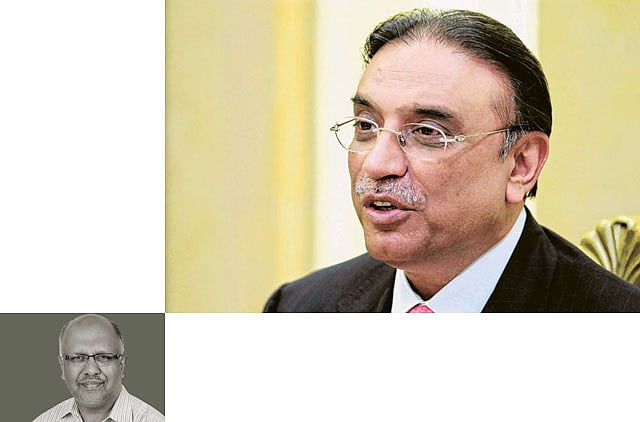
Pakistan’s upcoming political transition may be historic for some, but exactly what will drive this long-awaited moment in next month’s parliamentary elections remains an open-ended question. For the country’s politicians, notably President Asif Ali Zardari, there is a sense of pride driven by the upcoming change, involving the transfer of authority from one elected regime to another without the army’s involvement as a key arbiter.
But the Pakistan army’s direct or indirect absence from the political scene hardly matters for many others. At a time when Pakistan’s economy is in extreme disrepair and the last elected government overseen by Zardari miserably failed to tackle vast security challenges, the broad contours of Pakistan’s democracy clearly lie in tatters. Irrespective of the transition, Pakistan today is clearly much worse off than five years ago when the last elections took place.
The man of the moment may be Prime Minister Hazar Khan Khoso, chosen last month to oversee the transition during the interim period between two governments. In the past week, Khoso — a retired judge in his 80s — finally put together a cabinet. But a key decision on the naming a new finance minister was not taken.
The failure to make that choice has obviously sparked many rumours, including suggestions of ruling politicians in Islamabad turning down a respected economist for the job. For them, picking a credible figure ran the risk of endangering the promises of profligate spending during the election period made by former prime minister Raja Pervez Ashraf. While Pakistan’s beleaguered finances were already weak when the promises were made, they are now looking potentially precarious. Yet, going into the election campaign, Pakistan’s top politicians are far more obsessed with grabbing votes than setting the pace for a qualitatively improved environment for the country’s mainstream.
For more than one-third Pakistanis who live below the poverty line, the absence of a finance minister suggests a blatant disregard for their plight by the government. More vitally, many economists believe that the government has simply failed to find a pliable enough figure who will quietly preside over a continuing haemorrhage in Pakistan’s finances, till elections are out of the way. If so, that may further undermine what is already a very weak financial picture in the south Asian country. But with or without Khoso’s success in appointing a credible figure as his finance minister, Pakistan is likely to remain adrift.
Dangerous environment
In tandem with the economic challenge are security fears. Malek Habib Khan, an experienced police officer appointed as interior minister by Khoso, has unveiled a grim outlook in a presentation to his cabinet colleagues. According to senior Pakistani officials, Khan revealed the all too dangerous but real possibility of attempted assassinations in the run-up to the elections. This is in line with security alerts in recent weeks warning that the Taliban could attack politicians on the campaign trail.
For anyone familiar with Pakistan’s insecurity in the past decade, this is not surprising. The tragedy, however, is that in setting the pace for the elections, Islamabad’s ruling politicians have done little to forge a broader national consensus in support of the fight against militancy.
The record of the past five years presents little evidence of a concerted push to support a parliamentary debate followed by a formulation of a well-documented national security policy. Instead, the likes of Zardari and others from his Pakistan Peoples Party have mostly dwelled on their historical sacrifices for the cause of democracy.
As such, a breakdown in security will indicate a long-term policy failure. It is probably the heightened sense of uncertainty that has led Altaf Hussain, leader of the Muttahida Qaumi Movement in Karachi to publicly call for elections to be delayed by 15-30 days.
Hussain’s immediate qualm with the polls was indeed the controversy surrounding the scrutiny of nomination papers. One candidate was disqualified because of a newspaper column he wrote; the returning officer decided that it was against Pakistan’s ideology. Another was turned down because he was found to lack adequate knowledge of Islam. Many others have been blocked for reportedly presenting fake college degrees.
Though politicians for the moment are keen to take issue with the Election Commission of Pakistan, the broader point relates to Pakistan’s failure to mature as a true democracy in the past five years, where issues including qualifications of candidates should have been discussed. The celebrations ahead of next month’s polls may be all too premature in a country where the large mass of the population is still waiting to feel the benefits of change.
Farhan Bokhari is a Pakistan-based commentator who writes on political and economic matters.
Sign up for the Daily Briefing
Get the latest news and updates straight to your inbox
Network Links
GN StoreDownload our app
© Al Nisr Publishing LLC 2026. All rights reserved.