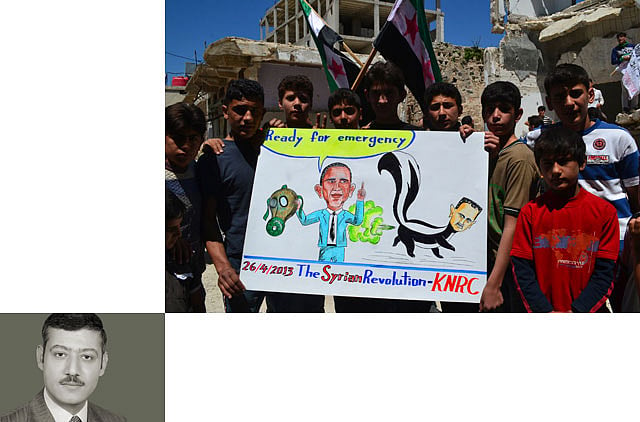
Over the past two years, since the beginning of the revolution, the Syrian opposition has proved to be one of the most divided and most ineffective political forces any revolution has produced. Apart from agreeing on the removal of the regime of President Bashar Al Assad, it is almost impossible to find another unifying theme for the myriad Syrian opposition groups. Even when they seem to agree on something, no matter how insignificant that may be, they would most often render that agreement null and void almost instantly. One important issue that has been generating so much controversy recently amongst opposition groups is the establishment of an interim government to administer areas that have been liberated from the regime.
Last March, the National Coalition for Syrian Revolutionary and Opposition Forces selected Gassan Hito, a Syrian-American businessman and a member of the coalition, as prime minister of the interim government. When the National Coalition was established in Doha in November 2012, one of its key tasks was to create an interim government to deal with post-regime problems. Given the differences within the coalition, however, the realisation of this objective was extremely difficult.
To start with, there was disagreement on the very idea of an interim government, with two main camps competing to impose their view on the coalition. The first was advocated by the former coalition leader Muath Al Khatib and supported by liberal and independent members. It called for the establishment of an “executive committee”, instead of a government, to oversee “liberated” areas. The committee would function under the supervision of the coalition’s political leadership. This camp also called for postponing the establishment of an interim government well until after a US-Russian agreement on the implementation of the Geneva Accord is reached. To this end, Al Khatib sent a letter to the coalition’s general assembly, urging them to rethink their position on the interim government because it could act as a catalyst for partition.
The second camp was supported by the National Council bloc within the coalition, particularly the “Muslim Brotherhood” element in it. It is led by Mustafa Sabbagh, representative of the Syrian Business Forum and Secretary General of the National Coalition — many consider him as the de-facto leader of the coalition. This group called for the immediate creation of an interim government, so that it could take advantage of the Arab foreign ministers council resolution to grant the Syrian opposition the right to represent Syria in the Doha Arab summit. This camp rejected the idea of waiting until a US-Russian agreement on Syria is reached, arguing that such an agreement is highly unlikely, given the Russian intransigence on fundamental issues such as the transfer of power and the establishment of a transitional government with full executive powers. These differences, one must say, are normal. They exist in any political institution. The problem is that they were turned into rivalries that almost tore the coalition apart at a time when dozens of ordinary Syrians were getting killed on a daily basis.
Disagreements on who should lead the interim government were also paramount. Defected prime minister Riad Hijab was initially proposed for the position, but key elements within the coalition, particularly the National Council, objected on the grounds that he was a former prime minister in the Bashar Al Assad regime. In many ways, the manner in which the issue was dealt with showed how narrow-minded the Syrian opposition was. Generally, defected elements are ignored and suppressed, either out of fear of the future role they may play or out of narrow personal considerations. This keeps happening at a time when the opposition continues to call upon the army and government officials to defect and join the people’s revolution. Clearly, a struggle for power is already underway within an opposition that is yet to seize power and bring down the regime.
Hijab eventually withdrew from the race, but 12 candidates remained — a huge number by any standard. Hito won the election, a narrow victory margin notwithstanding. In any democratic institution, the result must be respected. Instead, a dozen coalition members withdrew support in protest, including the coalition’s vice-president, Suhair Al Atasi. She made her way back a few hours later. Al Khatib himself decided to leave too. He presented his resignation a few days before the Arab League summit. Yet, he decided to stay on and lead Syria’s delegation to the summit. Al Khatib tendered his resignation again during the Turkey-Syria meeting two weeks ago, but seemed to have withdrawn it again later. In fact, nobody knows today if Al Khatib is in or out.
Having said that, one must truly wonder if the Syrian revolution will ever realise its objectives, given the sort of political leadership it claims to represent.
Dr Marwan Kabalan is the dean of the Faculty of International Relations and Diplomacy at the University of Kalamoon, Damascus.
Sign up for the Daily Briefing
Get the latest news and updates straight to your inbox
Network Links
GN StoreDownload our app
© Al Nisr Publishing LLC 2026. All rights reserved.