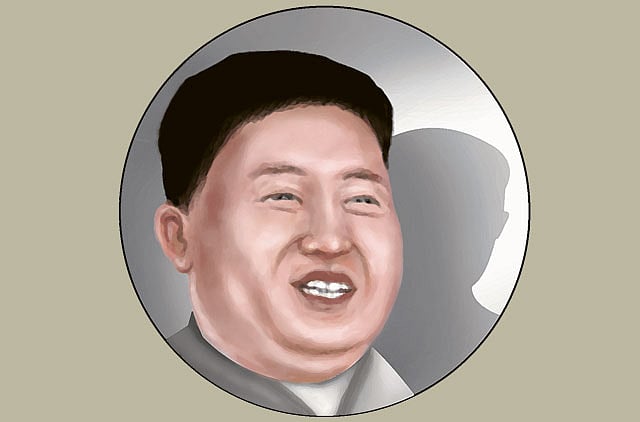
Like a candle in a howling gale, optimism about North Korea is hard to keep alight. The latest flicker of hope was snuffed out on March 16, when North Korea announced its plan to make the 100th birthday next month of its late but eternal president, Kim Il -sung, go with a bang. His grandson, the country's juvenile new leader, Kim Jong-un, intends to mark the centenary with the launch of a home-made satellite, the Kwangmyongsong-3.
This seems certain to scupper the agreement with the United States announced on February 29 that had spawned a fragile little hope: under the deal, North Korea would observe a moratorium on nuclear testing, uranium enrichment and missile launches, and allow inspectors from the United Nations' nuclear watchdog into the country to monitor this. For its part, America agreed to provide 240,000 tonnes of food aid (as a humanitarian gesture, it insisted, not a direct quid pro quo).
North Korea needs the food more than the satellite. Like his father, Kim Jong-il, whom he succeeded after his death in December, the young Kim seems less concerned about this than about the survival of the dynastic regime, to which nuclear weapons and ballistic-missile technology have become central.
A satellite is not a missile. The launches have different purposes — the former is meant to stay up orbiting the Earth; the point of a missile is to come back down. But so similar is the launch technology that the outside world, including America and the United Nations Security Council (UNSC), has in the past insisted that a ban on missile launches also covers satellites. One fear is that North Korea is intent on developing a missile capable of reaching America itself, though, so far, its tests have failed. North Korea, however, insists that satellites are different, and went to some lengths in its announcement to stress how it would abide by international agreements. And, as if to show that it intends to stick by the ‘Leap Day' deal, as it understands it, it has indeed invited inspectors from the International Atomic Energy Agency back into the country. It is inconceivable, however, that North Korea misunderstood the Americans' position on satellite launches.
Sure enough, America reacted swiftly and sharply. Whether ‘unlinked' or not, food aid is now unlikely. The US may argue that North Korea itself has made the connection. And if Kim has his grandfather's anniversary party to worry about, President Barack Obama has an election campaign, in which his Republican opponents will make the most of any perceived foreign-policy weakness. Japan and South Korea also soon condemned the planned launch. Japan said it might consider shooting the rocket down if it came close. Even China, the North's best friend, expressed "worry".
Leap Day deal
Though the regime has powerful domestic reasons for a satellite launch, abroad it will be self-defeating. The Leap Day agreement seemed to send a clear signal that Kim Jong-un intended to see through the easing of tensions with America that North Korea was negotiating in Kim Jong-il's last days. On the other hand, this type of mercurial diplomacy is just the thing Kim might have learned at his father's knee.
For ensuring the regime's survival, a little nuclear deterrent is seen as indispensable. Some analysts see events playing out in a familiar scenario. The ruse about a satellite might allow North Korea to portray the collapse of the Leap Day agreement at home as yet more duplicity from America, egged on by the North's despised foe, the South Korean government of Lee Myung-bak, who, to the North's fury, is playing host to a "nuclear security summit" in Seoul. Already, the North has thundered that any summit statement on its nuclear programme would be tantamount to a "declaration of war". After making its belligerent point, the prediction goes, North Korea would go back to talking, from, it hopes, a stronger bargaining position.
For Obama there is a new foreign-policy headache, further complicated by the continuing stand-off with Iran over its nuclear programme. For South Korea's Lee, there is a shadow over his summit, to be attended by leaders including Obama and China's president, Hu Jintao. And for China, there will be renewed pressure to try to rein in its cussedly awkward — but still apparently vital — ally.
As for North Koreans, the small elite will find it harder to raise the hard currency that keeps them in Mercedes cars. And the poor majority? They will have even less hope of the food that might relieve their hunger.
—
Sign up for the Daily Briefing
Get the latest news and updates straight to your inbox
Network Links
GN StoreDownload our app
© Al Nisr Publishing LLC 2026. All rights reserved.