Let’s talk politics: It’s what she’d have wanted. After a week filled with assessments of the tectonic shifts of the Thatcher era, let’s get down to the grubbier realities of the game Margaret Thatcher played so well. What will be the political fallout of this tribute week, which consisted not only of eulogy and reflection, but also grandstanding and positioning? And, though some will consider it unseemly to say out loud, who stands to benefit and to lose?
At first glance, this should be the Conservatives’ moment, the airwaves and front pages devoted to their most successful postwar leader, recalling the party’s glory days, listing its great achievements. On this measure, the period from last Monday until the funeral on Wednesday will be a 10-day, rolling party political broadcast. With local elections in the UK not much more than three weeks away, this surely will be a boon — Thatcher’s final act of service for the party that loved her.
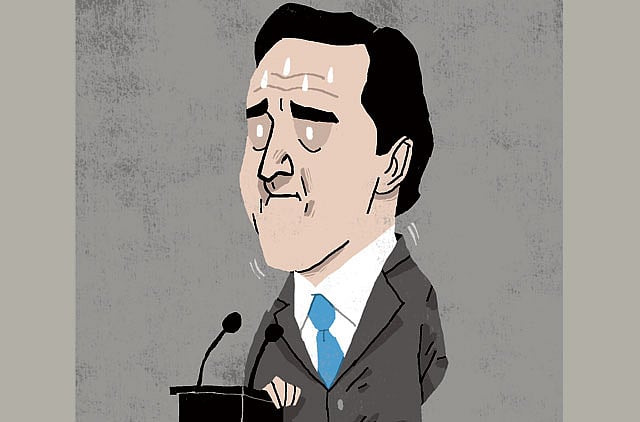
Except, one suspects, it is not the wider electorate that’s been preying on British Prime Minister David Cameron’s mind. His focus has seemed narrower and more defensive. Note his haste in tearing up a plan the British government had agreed to more than once, which said that if Thatcher died during a parliamentary recess, MPs would wait until their first day back to pay tribute.
In the event, Cameron surprised the Speaker of the House of Commons and, it is said, his own chief whip by insisting on a recall, a measure previously reserved for moments of national emergency.
Plenty in the British parliament read that as an act not of confidence, but of nervousness on Cameron’s part, as if the prime minister feared the fury of the Conservative newspapers — the London-based Mail, Telegraph and the Thatcher-worshipping Tory backbenches if he did not lay on every possible honour.
Rather than give his tormentors any chance to criticise him for insufficient grief, he has chosen the maximal option at each turn. Recall parliament or wait as planned? Recall. Forty-five minutes of House of Commons tributes, as granted to Winston Churchill, or the full seven and a half hours? The latter, please. A civilian funeral, or one with all the military, quasi-regal bells and whistles? The biggest we can get away with.
In this way, Cameron has seized upon Thatcher’s passing as a chance to do himself some good, or at least avoid trouble, with the Tory right wing.
Giving the warrior queen the works has proven an easy, cost-free way to throw some red meat in their direction. Short of a British veto in Brussels, there’s nothing they’d want more.
But it may not do Cameron much good. For he has invited a comparison which is not necessarily flattering. All these tributes to Thatcher’s strength and resolve include an unspoken contrast with him. And not always unspoken.
Witness the less-than-loyal tribute from Conor Burns, a Tory backbencher who recalled a cab driver declaring: “We haven’t had a good ‘un in No 10 since Mrs T” — an assessment that Burns said was shared by Thatcher herself.
Tories like winners — and they fear Cameron is not one. That’s why every reminder of Thatcher’s three election victories stings the prime minister, who has won none. He won’t have liked British business man and politician, Lord Ashcroft, noting that this week marked the anniversary of the last Tory victory, a full 21 years ago.
Tories miss Thatcher’s particular ability to appeal to the lower-income, aspirational voter who so often decides British elections. Former Labour party prime minister, Tony Blair, had some of that magic touch too. But Cameron does not. It’s not through lack of trying.
He’s made several attempts to connect with what polls say are that demographic’s concerns, most recently with speeches on immigration or welfare designed to look tough. He faithfully follows the script written for him by his hard-boiled campaign consultant Lynton Crosby. But it doesn’t budge the numbers.
Worse still, breathing down his neck is a politician who, while Cameron once cast himself as heir to Blair, has always wanted to play heir to Thatcher. Ukip’s (the right-wing populist UK Independence Party) leader, Nigel Farage, concluded his ‘Common Sense Tour’ on Friday, appealing to that same seam of patriotic, working class Toryism once mined so effectively by Thatcher. All these reminders of the former prime minister as an outsider who ran as a populist insurgent (sometimes even against her own government) are welcome for Farage. Facing a coalition government headed by a prime minister who attended the UK’s top fee paying independent school, Eton, he can make a decent claim that today an anti-establishment revolutionary like Thatcher would feel more at home in Ukip than in the Conservative party.
Not that Cameron should rush to wrench the Thatcher mantle back for himself. Blair’s former director of communications, Alastair Campbell, recalled the 2001 campaign in which Labour sunk Conservative leader William Hague by giving him Thatcher’s hair-do, suggesting her brand was still radioactive enough to repel voters. This is the other danger for Cameron. That by reawakening memories of the Thatcher past he is recontaminating the brand he worked so hard to detoxify.
Labour is hoping that the lovefest for their onetime nemesis will leave no lasting damage, that the issue will fade come polling day on May 2. Labour leader Ed Miliband won plaudits for navigating skilfully through what could have been perilous waters, his gracious House of Commons tribute acclaimed. A large number of Tory MPs came up to praise him afterwards.
Some worry that Miliband’s speech included no rebuke to Thatcherism on the frontal matter of the economy, choosing instead to fault the former PM on the less central issues of apartheid and Section 28 (a controversial act that banned ‘promotion of homosexuality’ in UK schools). The leader shrugs that off, confident that no one can be in any doubt of his determination to push back the post-Thatcher settlement. Nor does the Labour high command share the anxiety expressed by Blair that today’s Labour might be making the 1980s mistake of voicing public unease at government spending cuts without offering an alternative programme. They are confident that these are different times.
It is a curious thing. The resurgence of Thatcher in the public imagination, driven by a Conservative-led government, has left Labour relatively unruffled. Cameron is the one discomfited, damned if he is too much like her, damned if he does not resemble her enough. Not for the first time, the departure of Thatcher has caused the greatest trouble for her own party.
— Guardian News & Media Ltd
Sign up for the Daily Briefing
Get the latest news and updates straight to your inbox
Network Links
GN StoreDownload our app
© Al Nisr Publishing LLC 2026. All rights reserved.