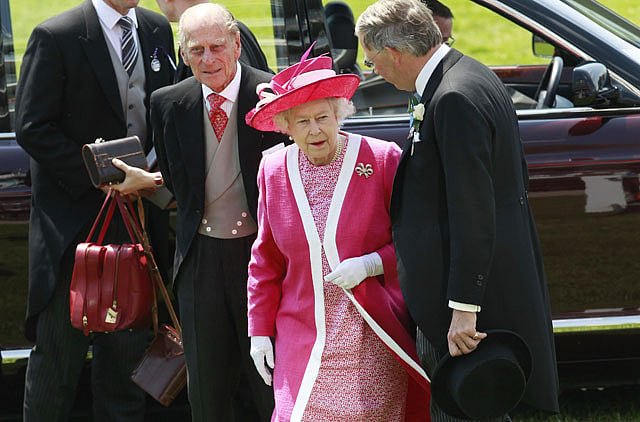
February 1952, was, like February 2012, a cold one. On the morning of the 6th, Sandringham was bleak and wintry, as George VI's valet desperately tried to wake him. A front-page piece in the Daily Telegraph painted a touching picture of a frozen rural Britain that had just lost its king.
Over on the other side of the world, the 25-year-old Princess Elizabeth had become a queen. The balmy Kenyan weather could hardly have been further removed from sub-zero Norfolk, but the mood was just as sad, as the Queen and the Duke of Edinburgh rushed to the airport.
"When the car, travelling at speed, passed near Nyeri," wrote another Daily Telegraph correspondent (they had no byline in those days), "the queen and the duke, despite the sadness of their journey, smiled and waved to small groups of people who, sighting the queen's standard gleaming in the evening sun, had stopped to watch them pass."
Back in London, members of both Houses of Parliament swore the Oath of Allegiance to the new queen. Much of Britain closed down. Racing was cancelled until after the funeral, and the rugby international between England and Ireland at Twickenham postponed. The FA Cup still went ahead, although a minute's silence was observed at all matches.
The Daily Telegraph was largely given over to royal news, its pages lined with thick black rules. The Bridge column was pulled, and Peterborough, the gossip column, was devoted to ‘King George VI's Records as a Sportsman — His Relentless Endeavour'. On the fashion page — next to an advert for a ‘knitted deerstalker for a little boy' — there were tips for mourning wear: ‘Typical of black suits being chosen for mourning, this one has soft revers folding back to show a waistcoat front'.
On the comment page, the poet Alfred Noyes contributed an elegy: ‘Quietly once again the moving hand has turned a page of history. Everywhere the imminent sense of death is on the land.'
Well, not everywhere. For many people, life continued much as before. In 1952, the country was still moving out of the shadow of war. Sugar, eggs, cheese and meat were still rationed.
Economic challenges
In the week after George VI's death, price controls were lifted from essentials. Britain had been left near-broke by the war and that titillating game — marvelling at old property prices — is particularly rewarding. In one advert, a house in Campden Hill Square, Kensington, is offered for £5,500 (Dh31,883). Last month, the square was declared the most expensive address in the country, with the double-fronted houses going for £5 million each.
The 1953 Coronation sparked a huge increase in television viewers: 56 per cent of the population, 20.4 million people, watched at least half an hour of the service.
Not that anyone with a set had much to watch. The schedule for February 8 was: 5.30-6.30pm Children's Television Film; 8pm Pride and Prejudice; 8.30pm Music Programme Serenade; 9.45pm Newsreel (repeat); Close. No wonder the cinema was so popular.
The radio schedule was bulkier, but curtailed by the king's death. In Family Britain 1951-57, the historian David Kynaston recalls Nella Last, a Cumbrian housewife, getting frustrated with the changes.
"Without being ‘gay'," she wrote in her diary, "I'm sure a ‘lighter' style of broadcast would not have been ‘disrespectful' to a man who loved Itma [It's That Man Again, starring Tommy Handley]. A few plays could have been included, whereas they left in the mawkish Mrs Dale's Diary, a real sick-maker if there was one!"
Richard Crossman, the Labour politician, was even less moved. "No one I have met [in the Commons] genuinely feels anything about this, except Clem Attlee," he wrote in his diary. Crossman was in the minority. The mood was better caught by the article in the Daily Telegraph by H.D. Ziman. "Today, with the imposing stretch of Victorian achievement behind us," he wrote, "the augury for a second Elizabethan era may seem even happier than in 1837."
Sixty years on, even the optimistic Ziman might be surprised by how long that second Elizabethan era has lasted — and what staggering changes in dress, attitudes and tastes the country has gone through.
Harry Mount's new book How England Made the English will be published by Viking in the spring.
Sign up for the Daily Briefing
Get the latest news and updates straight to your inbox
Network Links
GN StoreDownload our app
© Al Nisr Publishing LLC 2026. All rights reserved.