The dysfunctional state of Pakistan’s democracy has many obvious aspects. As the country prepares for what members of Pakistan’s ruling political structure consider a historical transition from one elected regime to another through popular vote later this year, the gaps in the ruling order are all too obvious.
One such gap was noted by Farooq Aqdas, a respected Pakistani journalist last week, when he claimed in a TV discussion, that there are some 100 members of the parliament or roughly just below one third of its strength, who have made no contribution to any discussions in the five years of their terms as elected representatives since 2008.
By pointing towards the blatant disregard by these members of parliament for their obligations to their constituents, Aqdas noted the degree to which Pakistan’s democracy remains under-nourished and under-performing.
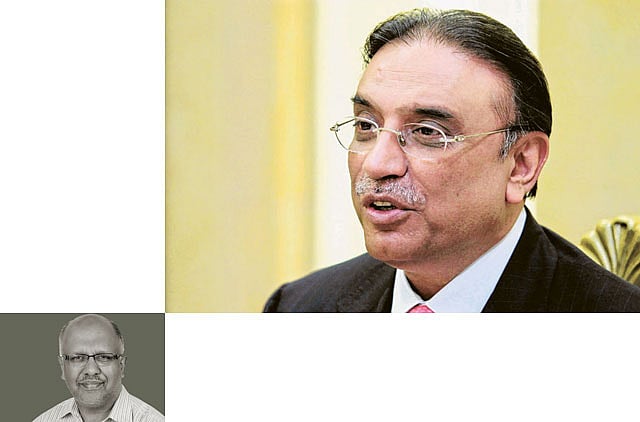
The claim comes in a week when President Asif Ali Zardari, according to a report in the Pakistani press, finally returned to Islamabad after spending 49 days away from the city — either on an overseas trip or staying put in Karachi.
Indeed, Zardari’s absence has amply proven his irrelevance in tackling the many acute challenges faced by Pakistan. Rather than being an important agent of progressive change, Zardari has time and again proved himself to be largely a non-player, visibly obsessed with overseeing an increasing crisis of governance and cronyism.
In this background, it is hardly surprising to see the claim aforementioned.
In addition to such dismal conditions inside the parliament, conditions outside the august house, across the political mainstream, are hardly surprising. During the past five years under Zardari’s watch, Pakistan has seen a deepening of an economic crisis. Meanwhile, the ability of the government to begin resolving any of the profound challenges faced by the nation has remained far from adequate.
The president’s latest prolonged absence from Islamabad, rumoured to have taken place under spiritual advice, says much about his lack of commitment to overseeing a credible reform of the government. While the buck may indeed just stop with him as the president of Pakistan, Zardari’s persona typifies a wider challenge. Left to the whims of it’s politicians, the country may indeed be in danger of continuing to slip on multiple fronts, notwithstanding its democratic framework.
Faced with this far-from-perfect outlook, many Pakistanis are anxiously looking to see if there is hope in the future or indeed that of their coming generations. However, a number of crisis in recent years have only reinforced the popular impression of a government that has no interest in overseeing Pakistan’s outlook improve radically.
The economic crisis alone is the consequence of several policy failures. One has indeed been the failure to address acute electricity shortages that have simply turned Pakistan into a potential economic basket case. The closure of many industries, especially in the textiles sector, which was once the country’s largest industrial employer, has meant that unemployment has risen rapidly. For the moment, there is no credible hope of the electricity-related crisis beginning to end any time soon.
Another policy failure has indeed been the government’s virtual inability to tackle an ever-yawning and fast-growing budget deficit, which has simply demolished the idea of prudent economic management. In large measure, this outcome is driven by the terrible reality of Pakistan’s failure to lift the number of its tax payers beyond the hopeless figure of just about 0.9 per cent of the country’s population.
The failure to tackle the economic challenge, in large part, is also driven by a continuing failure of the government to tackle the mounting losses surrounding large public sector corporations. Zardari’s Pakistan Peoples Party (PPP), which came to power in 2008, has seen many public sector corporations only run deeper into losses in comparison to their past record, adding to the strain on the national exchequer.
These bits of evidence must raise some very compelling questions about the virtual absence of tangible fruits of democracy reaching ordinary Pakistanis. Surrounded by increasingly dismal conditions, ordinary Pakistanis are indeed well within their rights to ask if a democracy in name has been able to meet their expectations. For many, the answer must be in the negative. Even surrounded by comforts in his ivory tower, Zardari will be ill-advised to ignore Pakistan’s increasing journey southwards, for the chicken will eventually come home to roost.
Farhan Bokhari is a Pakistan-based commentator who writes on political and economic matters.
Sign up for the Daily Briefing
Get the latest news and updates straight to your inbox
Network Links
GN StoreDownload our app
© Al Nisr Publishing LLC 2026. All rights reserved.