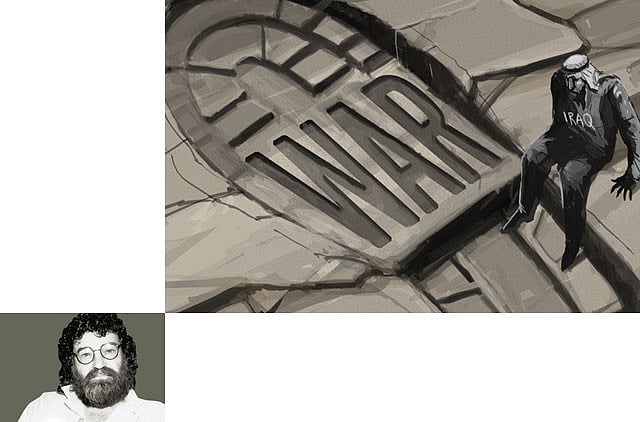
Going to war, especially when you don’t “know thine enemy”, can be a dicey business. It is in equal parts an art as well as a science. However, we know that art is in the subjective eye of the artist, while science, despite its claims that the objective world is measurable and verifiable, is a discipline that assures us of certainty where none exists. Once the war drums begin to beat, however, reason is thrown out of the window and the pursuit of national goals by force gets obsessive.
Ten years ago, on this day, March 19, 2003, the US, which, since the second half of the 20th century, has willy-nilly inherited Britain’s imperial prerogative to meddle with other countries’ political affairs, invaded Iraq. Though it dragged along a motely of its “coalition of the willing”, Washington did so with scant solid international support and on a flimsy ground — alleged stockpiles of “weapons of mass destruction” and a putative link between Saddam Hussain’s regime and Al Qaida.
When neither materialised, the US changed its tune by embracing an elusive euphemism: Nation-building, whose aim was to “introduce” Iraqis to democracy and to bring to their society the kind of constitutional and religious freedoms that they had missed out on under the totalitarian Baath party. Iraqis, it must be recalled, had not asked to be introduced to Thomas Jefferson — the principal author of America’s Declaration of Independence and the third president of the US — or to a foreign army.
For the US, the decision to go to war turned out, now when seen in the cold light of hindsight, to have been one of the most wildly profligate in its foreign policy — the mother of all misadventures, as it were, in its long history of adventurism, a reckless and flawed act soon short circuited by false intelligence and delusional expectations of how Iraqis would react to being an occupied people.
This failure of oversight did not stem solely from an overconfident Pentagon, an overly clueless White House and an overweening neoconservative elite with their own ancillary agenda. It came also from a national media that, instead of presenting the public with alternative sources of information in the run-up to the war, played the role of a lapdog rather than its traditional one as watchdog of government malfeasance.
So onward American soldiers went with grim fatalism to fight in an ancient land whose enigmatic culture they knew little about.
By the time it was all over in 2011, by the time the last Humvee had crossed the border from Iraq into Kuwait, by that time many a soldier had tasted too much of his own fear, roughly 4,500 troops were killed and 32,000 were wounded. The war had cost American tax payers an estimated $800 billion (Dh2.94 trillion). That, however, is a static figure. According to Joseph Stiglitz, winner of the Nobel Prize for Economics and author of The Three Trillion Dollar War, the cost is closer to $3 trillion, after you have factored in the large number of veterans suffering from some form of disability, including serious mental health disorders, such as post-traumatic stress, to whom compensation, pension disability benifits and medical care must be provided for decades to come — all adding up to the national debt burden.
As for Iraq, let us put it this way: The country suffered between 97,000 and 106,000 casualties and democracy still did not bloom there. However, more dismal than that is the state of the nation’s political transformation.
When American troops left Iraq well over a year ago, that merely meant the end of the war for the US — not for the Iraqis. On being sworn in as the new Prime Minister, Nouri Al Maliki, a Shiite, solemnly called on his people to unite and “not let sectarianism divide them”. Then he turned around and ignored the very advice he had given his people.
In Iraq, as we speak, thousands of Sunnis, who accuse their prime minister of consolidating power in his Shiite Islamic Dawa Party, take to the streets daily to protest not only sectarian discrimination, but Al Maliki’s orders to arrest their legislators and other political leaders. Car bombings and gun-battles are a norm and Iraq continues to stregthen its ties with Shiite Iran, knocking it off its axis as an Arab nation whose political destiny has historically been anchored in the Arab world.
The memory of the Irq war is already beginning to fade in the minds of Americans, in time to be subsumed by that larger tableau of wars their country, burdened by its role as a big power, has waged, often impetuously, since the second half of the 20th century. Iraqis, however, will continue to live with its consequences, for decades to come.
Fawaz Turki is a journalist, lecturer and author based in Washington. He is the author of The Disinherited: Journal of a Palestinian Exile.
Sign up for the Daily Briefing
Get the latest news and updates straight to your inbox
Network Links
GN StoreDownload our app
© Al Nisr Publishing LLC 2026. All rights reserved.