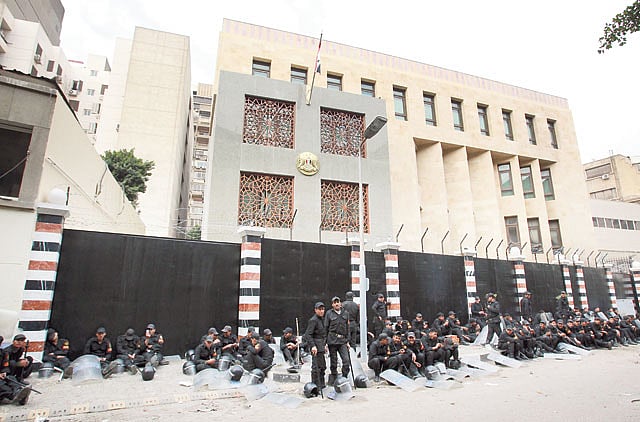
Several regional governments have recently accused civil society organisations of meddling and fomenting unrest, often aided by foreign sources of funding. The Egyptian government has ordered criminal investigations and, in some cases, banned more than 40 employees of various non-governmental organisations including Freedom House, the National Democratic Institute, and the International Republican Institute from exiting the country.
Fayza Abu Al Naga, the Egyptian minister of planning and international cooperation, has spear-headed this drive to blame civil society organisations for inciting unrest. She called Freedom House, a well-established research organisation, a "tool of the Jewish lobby"— a criticism certainly unfounded.
While the definition of a civil society organisation varies (not all are saving kittens and orphans) and types of civil society organisations might include minority interests, industry groups, commercial associations and political organisations, the general evidence supporting the benefits of their participation in a political system is quite strong.
Countries experiencing transitions from authoritarian regimes, seeking to create economic growth and working to integrate disenfranchised populations could do well to consider how the support of civil society might actually improve the ability to govern and prosper. Those who seek to blame civil society organisations for the failure of domestic political institutions to function might take a closer look at the evidence as well.
There is a correlation between more open societies (those with a consistent and impersonal rule of law, economic and political competition) and economic development. We don't know for certain, as political scientists, which one causes the other, but we do know that they work well together. A fundamental aspect of an open society is its ability to tolerate and even reap gains from the activities of social organisations.
In a recent book by the political economists Douglass North (winner of the 1993 Nobel prize in Economics), John Wallis and Barry Weingast, the authors assert that the combination of factors that allow open entry and competition in markets, the guarantee of impersonal political rights (meaning personal connections become less important than a standard rule of law applied to all), and the ability to create organisations to pursue economic opportunities and political participation both reduces violence and creates wealthier societies.
These wealthy, safer countries are able to sustain economic growth and experience less periods of economic recession or decline. They also tend to have bigger, more decentralised governments and widespread social organisations — in short, a vibrant civil society and government that works locally.
Political competition
The competition is not then between civil society and the state, but the ability of a state to incorporate and tolerate social organisations that also increase productivity and competition.
The state provides third party enforcement (rule of law, control of violence) and in return civil society gives the state organisations that support political parties, social welfare organisations off-setting the costs of state subsidies, and a reliable means of political competition that does not depend on the accommodation of the military.
Poorer countries (those with per capita incomes of less than $2,000 or Dh7,340 per year) had an average of 30 trade and business organisations and 2.8 organisations per million inhabitants. Richer countries (those with per capita income of more than $20,000 per year) had an average of 1,106 trade and business organisations and 64 organisations per million inhabitants.
There is a correlation between the number of organisations and the extent of economic development and political competition. For example, the US has approximately one formal not-for-profit organisation for every 160 people in the country; one formal business corporation for every 60 people; one formal-sector business organisation for every 13 people. Richer countries also have larger governments, and those that are more decentralised or divided into subnational governments (municipalities, school districts, states and counties) are more likely to have higher per capita incomes.
The evidence is that a competitive environment that welcomes a diverse group of organisations (social, religious, political, commercial) will provide a check on the activities of governments (use of violence, application of law, sharing of resources). Governments that provide rights to form organisations benefit from an environment in which tolerance, participation and civic ‘virtue' or social capital are all plenty.
These are the states that grow. Why fear civil society organisation then? If a government is not interested in competition, reining in the military, or creating dynamic economies that push the state for policies to increase growth, then such a political system is planning to fail, or looking for a scapegoat to blame when it goes down.
Karen E. Young is Assistant Professor of Political Science at the American University of Sharjah.
Sign up for the Daily Briefing
Get the latest news and updates straight to your inbox
Network Links
GN StoreDownload our app
© Al Nisr Publishing LLC 2026. All rights reserved.