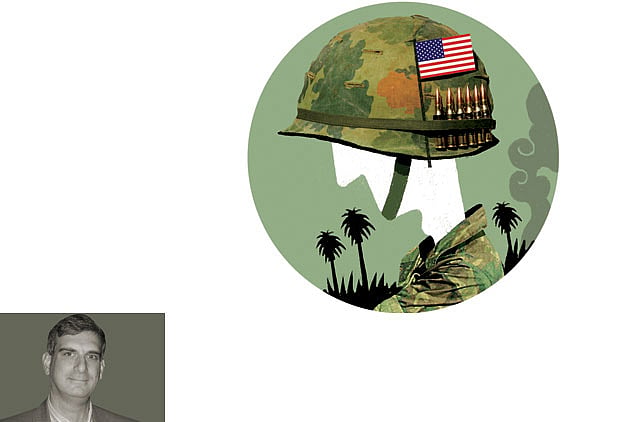
In the aftermath of the Gulf War, then US president George Bush famously said the US had vanquished not only Iraq but also the ‘Vietnam Syndrome' — the fear of unwinnable foreign wars that hovered over Washington's political and military class for a generation after the Fall of Saigon in 1975.
Two decades later, one can argue that a number of conflicts large and small have proven that statement to be premature (Somalia, the Balkans, Rwanda and America's second war in Iraq spring readily to mind). Vietnam may be, at best, a hazy memory for anyone under 50, but it remains the conflict that introduced the word ‘quagmire' into America's political vocabulary.
Listening to last week's debates over Libya and Afghanistan, it was obvious that memories of Southeast Asia are still a major factor in the way soldiers and politicians alike view today's conflicts in and around the Middle East.
On one side are the doubters — mostly, but not exclusively, Democrats — who say they no longer understand why Americans are fighting in Libya and Afghanistan and see few compelling reasons to stay. On the other are hawks — mostly, but not exclusively, Republicans — who believe any withdrawal on terms short of "victory" will represent a grave loss of face for the US and its military.
Of these two wars, Afghanistan is the far more vexing problem for President Barack Obama. The conflict there has become America's longest war. As the US has surged troops into the country over the last year the casualties have, inevitably, risen. Rising alongside them has been public attention to a war that only three or four years ago many Americans had forgotten they were still involved in.
The military says they have made progress in Afghanistan. That may be — probably is — true. But what does "progress" mean? One can argue, as many policy specialists do, that the Afghan war has always been about restoring some sense of order and civil government to a place where both have long been absent. The goal is to ensure that the country never again becomes the sort of terrorist safe-haven it was in the months and years leading up to the 9/11 attacks.
The problem is that for most ordinary Americans, Afghanistan has always been about capturing or killing the men responsible for those attacks. Such Americans cheer the death of Osama Bin Laden and, once they stop, ask how much sooner that means the troops will be coming home. When Obama ran for president he was always a bit evasive about this. He condemned the Iraq War, and promised to end it. He denounced the Bush administration's failure to focus on Afghanistan and promised to make that war a priority.
On one level he has fulfilled that promise: moving Afghanistan back to the centre of the US political debate, even as he quietly shuts down the still-unpopular war in Iraq. The result, in mid-2011, is a newly announced policy that satisfies no one.
Troop withdrawal
Last week, Obama announced the withdrawal of about 30,000 American troops over the course of the next year-and-a-bit.
That is more troops, leaving sooner, than the military wants, but not nearly enough (and not nearly fast enough) to satisfy critics, especially in his own party. To some the decision makes him look like a war-monger. To others, he appears to be repeating what conservatives still hold to be the great political sin of Vietnam: losing a war by failing to give the soldiers what they want.
Libya, in contrast, is an issue that has only been around for a few months but which already poses difficult problems, despite the fact that no American lives have (yet) been lost there.
Republicans, always eager for an issue on which to oppose Obama, along with Democrats who cannot believe that Americans are actually involved in yet another war, tried last week to invoke the War Powers Act — a Vietnam-era law that seeks to limit presidential ability to send troops into combat (only Congress has the power to declare war but, despite America's many modern conflicts, it has not formally done so since the Second World War).
The act was passed over Richard Nixon's veto and every president since, of both parties, has claimed it to be unconstitutional. But no president, nor any Congress, has sought to test the law in court. Fearing they might lose, both sides prefer the status quo in which presidents agree to abide by Congressional war stipulations, while not actually acknowledging that they are legally bound to do so.
All of which brings us back to that 40-year-old war that Americans were supposed to have been done with 20 years ago. Even a president, like Obama, who is too young to have much memory of Vietnam finds that it haunts his policy choices.
Gordon Robison teaches political science at the University of Vermont.
Sign up for the Daily Briefing
Get the latest news and updates straight to your inbox
Network Links
GN StoreDownload our app
© Al Nisr Publishing LLC 2026. All rights reserved.