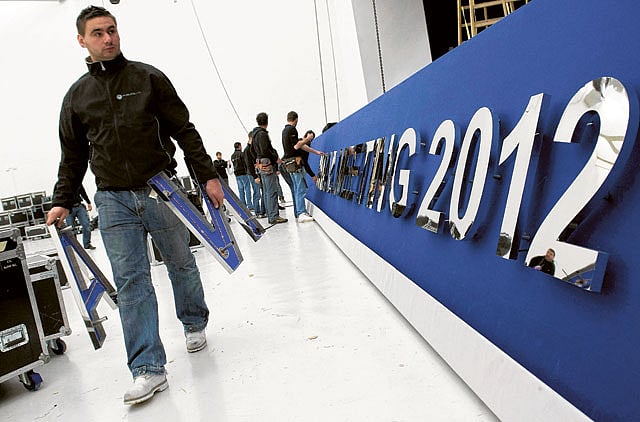
A grudging sense of optimism seemed to permeate the delegates to Davos as they got ready to leave on the last day with snow falling, making the pavements and roads very slippery.
Before the week in the Alps, the overwhelming story in much of the world focused on the chronic failure of the Europeans to get to grips with their currency crisis.
But the Europeans got a more global perspective by spending the week rubbing shoulders with business people and politicians from Asia, where the huge markets of China are still growing at around 9 per cent and India at just over 5 per cent.
Growth is out there if companies can be bothered to go and look for it, but that does mean redirecting their efforts away from Europe and the United Sates to look at new markets in Asia, Africa and Latin America.
This means activities like finding new logistical centres, working new trade routes and, most importantly, understanding what goods and services will do well in the new markets, but at least there is something to do, rather than wallowing around waiting for 27 frightened leaders and their delegations to arrive at agreement.
Finding answers
But there was good news even in Europe's own domestic agony, as a consensus seemed to form that the German-based strong euro is the likely outcome of all the horse trading going on at present.
It is important that this gives business planners something to hang on to, even if the next 12 months are full of deep uncertainties as the strong euro plan takes shape.
The full fiscal federation that German Chancellor Angela Merkel is insisting on will come with substantial political difficulties.
She is calling for a powerful European Central Bank, with the authority to issue its own bonds, and the member states' budget deficits to be enshrined in law and enforceable by the European Courts, and a member of the European Commission lined up to enforce at a more political level.
Even British Prime Minister David Cameron supported the right of EU member states to form a closer Eurozone as long as Britain was left out of it. There may have been some coded messages in his speech, which has been variously reported as both a challenge and support to Merkel.
A straight reading of what he actually said was that he supported the Single Market, and supports the euro if other member states want it. This approach was far more conciliatory then his inflammatory stance at the Brussels summit when he walked out of the euro plans.
Reshape capitalism
The hardest theme to pin down at Davos this year was that of reshaping capitalism. There is emerging agreement that the commercial excesses of the 1990s and 2000s should not be repeated.
The business leaders and politicians do not need the regiments of Occupy to remind them of this, but they do need to take account of the political heat being generated by popular fury against the bankers.
The real answer is not the simplistic ‘bash the bankers' idea, as is articulated by many politicians who seek popular support by hitting at high salaries and bonuses, taxing financial services harder, and finding better regulation of the banks.
British Labour leader Ed Milliband gave a very clear summary of this minimalist position when he gave a disappointing address to a session.
The real challenge is how to move a social conscience or activities in society on to the balance sheet as a gain. The purpose of a company should not just be return on equity, regardless of the social good, but to deliver some kind of social element without treating it as a voluntary bolt-on extra to the core business, and dismissing it as a cost without gain.
Era of talent
As French President Sarkozy said at last year's Davos, "We have to get to where the economy is for the people, rather than the people being for the economy." This theme will run and run, with no obvious resolution in sight, but the journey may be as important as the destination.
Klaus Schwab, exec-utive chairman of the World Economic Forum, weighed in on this debate when he argued that the era of capital had finished, and the era of talent and retaining good people had started.
His point was that simply access to capital and achieving a return is not enough to ensure success in the long term. In today's market, that requires a company being able to find, hire and keep the best talent it can.
Sign up for the Daily Briefing
Get the latest news and updates straight to your inbox
Network Links
GN StoreDownload our app
© Al Nisr Publishing LLC 2026. All rights reserved.