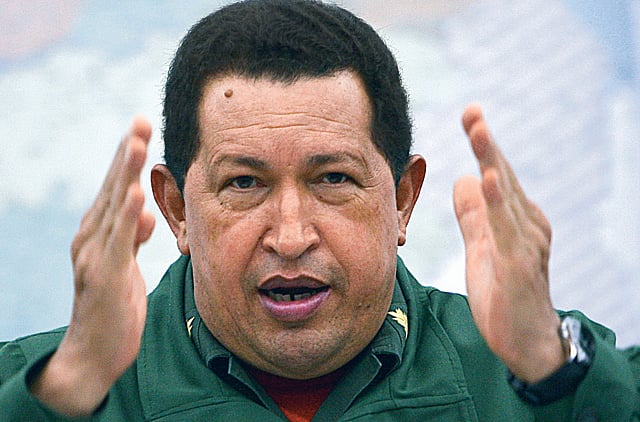
While two wars in southwest Asia and a dangerous confrontation with Iran dominate US President Barack Obama's foreign policy worry list, oil-rich Venezuela, much closer to home, is becoming more than a minor irritant.
To date, the Obama administration has dismissed Venezuela's President Hugo Chavez as a pesky, leftist loudmouth, whose verbal eruptions against the US pose no threat. But a new era of ‘Cubanisation' in Venezuela should warn of a crackdown against Chavez's domestic opponents and a stepped-up drive for socialist revolution across Latin America.
Chavez has been importing ‘advisers' from Cuba. There are now some 30,000 of them, many of them intelligence, security, and political affairs officers, as well as medical personnel.
Chavez's recent installation of Cuban Vice-President Ramiro Valdes in a key advisory role in Venezuela is seen by his opponents as a sinister move toward greater ‘Cubanisation' and Castro-style communism.
Valdes is also Cuba's communications minister and ranks third in the Cuban hierarchy. His job in Venezuela is supposedly to handle an electricity crisis — though his qualifications are suspect.
In recent years, Chavez has established alliances with nations that could be counted on to tweak Washington. Russia has engaged in military exercises with Venezuela and signed an agreement to supply up to $2 billion (Dh7.34 billion) worth of weaponry.
China is buying more than 330,000 barrels of oil daily from Venezuela and has signed an investment agreement to develop more. China also has just completed a $400 million communications satellite for Venezuela.
Iran has been Venezuela's most ingratiating suitor. The two nations have signed dozens of agreements in recent years to boost infrastructure, energy, and manufacturing in the South American country.
Chavez has visited Tehran often, pledging cooperation with Iran in opposing ‘US imperialism', liberating countries from the ‘imperialist yoke', and furthering ‘Bolivarian socialist principles' in Latin America. Chavez has consistently endorsed Iran's nuclear programme.
Close ties
At home, Chavez lauds Fidel Castro as a political blood brother, and communist Cuba as an example for all of Latin America.
His governance has become increasingly authoritarian, detailed in a blistering report by the Inter-American Commission on Human Rights.
It highlights how Chavez has undermined judicial independence, intimidated or silenced opposition media, hobbled elected opposition figures, and criminalised dissidents and human rights groups.
Last week, a Spanish judge accused Venezuela of colluding with terrorist groups including the Basque ETA rebels and the Colombian FARC.
Once lauded by his people as a reformer, Chavez is now the target of angry street rallies, especially as he has rather blatantly plotted to stay president for life.
Cuba depends on Venezuela's cheap oil (the US is also a major buyer) and would be disadvantaged if the Chavez regime fell. Havana may be alarmed by the fissures in Chavez's support and probably welcomed the opportunity to position Valdes in Caracas to bolster Chavez.
Winds of change
Cuba's leaders may also have some concerns about their own country's political stability. Cuban dissidents say word has been passed up the military command that the ailing Fidel Castro may not outlast this year.
His succession is by no means certain. Fidel's brother Raul, currently managing the country while his brother is incapacitated, is credited with being a better administrator than Fidel, but lacks Fidel's charisma.
The Obama administration, beset by major problems at home and challenges abroad, may have thought it could delay confronting lesser problems in Latin America. This may prove to have been an unwise calculation.
Obama: Don't be surprised by that 3am call.
(John Hughes, a former editor of the Monitor, writes a biweekly column.)
Sign up for the Daily Briefing
Get the latest news and updates straight to your inbox
Network Links
GN StoreDownload our app
© Al Nisr Publishing LLC 2026. All rights reserved.