When the North Atlantic Treaty Organisation (Nato) was created on April 4, 1949, its purpose was to provide collective security to member-states that could not defend themselves against putative attacks by external parties. Nato quickly evolved into an alliance against a Stalinist Soviet Union as Belgium, the Netherlands, Luxembourg, France and the United Kingdom — the original ‘western European’ countries that opposed the Berlin blockade — welcomed Washington’s call to add the US, Canada, Portugal, Italy, Norway, Denmark and Iceland to the nascent institution.
Over the years, and especially after the dissolution of the USSR, Nato expanded its membership to cover 28 states across North America and Europe, the newest of which, Albania and Croatia, joined in April 2009. Notwithstanding lofty claims, Nato’s real purpose was to impose political and military order by bypassing Moscow’s veto power at the UN Security Council, which explained its out-of-area engagements.
To be sure, Nato proved to be an effective alliance for 63 years as it prevented military clashes on the European continent, though recent deployments in Afghanistan and Libya revealed a far more selective interpretation of its objectives. Was this the harbinger of international order for the balance of the 21st century?
In the aftermath of the Second World War, Nato commanders wasted little time, as challenged leaders pretended to use resources efficiently throughout the Cold War. Ironically, the organisation’s first out-of-area involvement was on the Korean Peninsula (1950-53), when the US mobilised its allies to fight in the war that divided the Korean nation.
Myriad nations
Within two years and in response, Moscow hoarded putative partners in ‘Eastern Europe’ under the Warsaw Treaty Organisation of Friendship, Cooperation, and Mutual Assistance (1955–1991), which grouped one of the most dysfunctional group of countries ever assembled: Bulgaria, Hungary, East Germany, Poland, Romania, Czechoslovakia as well as the Soviet Union composed of myriad nations with little in common save for the quest to aspire for Soviet grandeur.
Still, the Korean War polarised leading nation-states, set in motion the ‘us vs them’ outlook, and provided the onus for imaginative programmes that galvanised peoples into skewed visions. A ‘Red vs Blue’ nomenclature emerged — long before pusillanimous US officials introduced coloured coded alerts after 9/11 — which refined time-tested ‘Cowboy vs Indian’ mentalities.
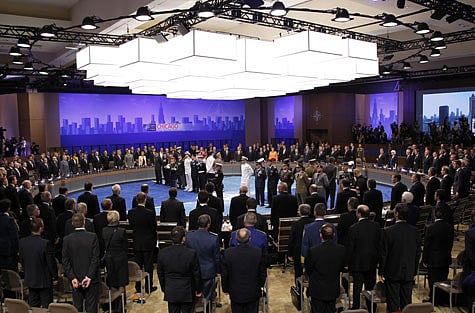
Of course, in the aftermath of 9/11, the US mobilised Nato to destroy the Taliban in Afghanistan, but that was a moment of pure revenge. Regrettably, that objective was not achieved, even if President Barack Obama emphasised a few days ago in Chicago that Nato “forces broke the Taliban’s momentum”. This was no evidence of victory as world leaders agreed to end their decade-long war by the summer of 2014. Miraculously, Obama informed everyone that the time was ripe for the “Afghan people to take responsibility for their own security and for the United States-led international troops to stand-down”. Of course, winding down the war in Afghanistan could be called a “major step”, though it did not mean that the war in that hapless country ended.
As the 2011 engagement in Libya further attested, Afghanistan was not a unique phenomenon for Nato, and while the Muammar Gaddafi dictatorship was mercifully toppled, the War for Libya left an unresolved legacy for Tripoli. Serious problems lingered even if Nato forces excelled in effective military engagements. Truth be told, aerial bombardments neglected to extend the kind of political assistance that was sorely required, to restore law and order. It was as if commanders tested their latest weapons, oblivious to ‘the-day-after’ necessities, which affected the lives of ordinary peoples.
Few in the Arab world failed to notice how selective Nato leaders were, as most watched tragedies unfold in Yemen and now in Syria, advancing partisan explanations for refusing to help those who needed assistance. Many concluded that Nato troops were exclusively engaged to ensure western hegemony rather than help those who craved freedom and democratisation.
In a moment of rare honesty, Nato’s first secretary-general, the British Indian Army officer who served as chief military assistant to Winston Churchill, Lord Hastings Lionel Ismay declared in 1949 that the group’s original goal was “to keep the Russians out, the Americans in, and the Germans down”. Sixty-three years later, one questions whether this statement should be updated thus: “To keep the Russians out, the Americans in, and everyone else down.” Inasmuch as Afghanistan and Libya are good examples of selective interventions, Nato’s intrinsic values can no longer be viewed as benefiting peace, save for a piece of one country or the resources of another.
At a time when Nato expanded its Partnership for Peace to 22 countries, with another 15 involved in institutionalised dialogue programmes, one wondered whether the organisation was as relevant today as it once may have been. To be sure, there was more to Nato than its involvements in Afghanistan and Libya, just to cite these two examples, but one was flabbergasted when trillions of dollars were spent on sophisticated weapons that provided little security. Without denigrating the need for defensive militaries, which were absolutely necessary to protect societies from predators, was the answer for ultra-competitive political and economic edges nestled in global domination?
For Arab societies living through fresh ‘Springs’, the Nato model was peripheral at best and just like Charles de Gaulle, who opted to develop an independent French nuclear deterrent because he doubted that Washington would sacrifice New York to save Paris, emerging nation-states were advised to rely on themselves, and trust their citizens, to ensure their own long-term securities.
Dr Joseph A. Kechichian is the author of the forthcoming Legal and Political Reforms in Saudi Arabia (Routledge, 2012).
Sign up for the Daily Briefing
Get the latest news and updates straight to your inbox
Network Links
GN StoreDownload our app
© Al Nisr Publishing LLC 2026. All rights reserved.