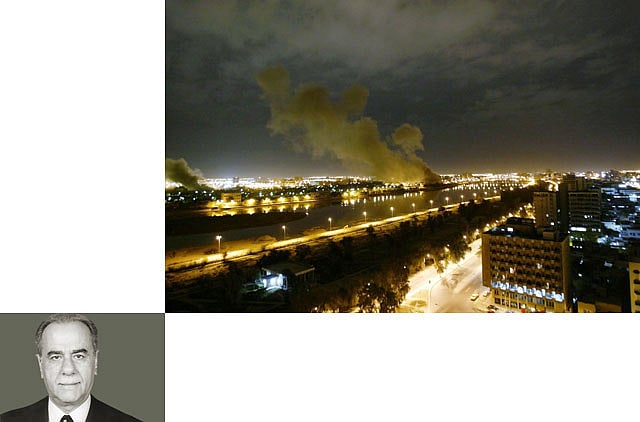
March 20, 2003, is considered an important landmark — not just in Iraq’s history, but also in the history of the Arab World and the Middle East.
On the date, US military troops invaded Iraq as a continuation of the campaign it had started in the Balkans to get rid of the systems allied to the Soviet Union.
The invasion was justified to achieve two goals: The first was the international concern aimed at confiscating weapons of mass destruction, which the US believed Iraq owned. The second goal was to fulfil Iraqi aspirations in getting rid of the existing dictatorship and setting up a democratic system instead, where human beings are respected and their rights observed according to western standards. The US military intervention in Iraq came as a methodical extension of the traditional US foreign policy, periodically maintained by different administrations in the White House since the end of the Second World War.
In view of this policy, the US has not left any location around the globe without interfering in it. It also considered the downfall of the Soviet Union as a golden opportunity to manufacture issues round the world.
In occupying Iraq, the US blasted the regional system prevailing in the area to put together a substitute as part of its strategy to re-structure the new world order of the post-Cold War era.
The US military operations went on for a limited duration. On May, 1, 2003, former US president George W. Bush announced from the aircraft carrier, USS Abraham Lincoln: “Mission accomplished”.
Today, ten years after the invasion, we are witnessing the repercussions in every corner of Iraq, which may continue for decades to come.
One cannot help but wonder what the word “mission” meant for Bush. The US was capable of occupying Iraq easily and that is exactly what happened after Iraq’s military capabilities were destroyed along with its infrastructure during the 1991 war. The economic embargo that was imposed on Iraq for 13 years destroyed what was left of the infrastructure, but did the US succeed in building a democratic state in Iraq over the ruins of the regime it toppled, as it had promised?
Away from the ethics that were stepped over by the US and its allies in invading Iraq, it is difficult to say that the invasion resulted in a state, let alone it being democratic. Iraq has not regained its sovereignty which it lost since it was placed under the UN Charter’s Chapter Seven after the invasion of Kuwait in 1990.
Iraq today is not a state, it is a mere structure controlled by sectarian lords and blocs who are ready to war against each other when the red lines set to protect their interests are crossed. This has been made legal with America’s blessing.
The US, on the other hand, has not been able to make Iraqi politicians, who came in with the invading forces, to end practices that violate human rights that prevailed during the era of the former regime.
The Human Rights Organisation, on the other hand, repeats in every annual report — the last of which was published in 2012 — that human rights violations are still ongoing in Iraqi prisons and detention centres to date.
If we look at America’s undeclared agenda for the occupation of Iraq, we will find that its implementation did not materialise. Clearly, the “mission” declared by Bush was not accomplished. The US forces in Iraq started fighting another war which cost it too many casualties.
Moreover, the US was unable to create new interest balances as a substitute to the balances that were blasted by its invading forces. The countries threatening US interests thus are now able to shape the political routes in the region. In addition, the US was unable to find allies it could depend on in Iraq, as the political parties leading the political process in the country are closer to Tehran than they are to Washington.
Over the past ten years, a question repeatedly asked in western circles, and in the US and UK in particular, is about the validity of the decision of toppling the political regime in Iraq, sacrificing more than 5,000 US soldiers and resulting in more than 10,000 soldiers being handicapped. The question also entails the validation of spending tens of billions of dollars to execute an operation based on inadequate justification, which have truly effected the credibility and international reputation of both the US and UK.
Understandably, there is no convincing answer to this question. When we compare similar events in history, we need a decade or more to be able to pass a fair and objective judgement regarding what happened.
Furthermore, what has happened in Iraq is not secluded from the other upheavals which came about after the Arab Spring and ended the long stagnation in the political life of the people.
President Barack Obama’s administration is completing the targets set by the former Bush administration and does not differ from it in any way. The Obama administration continues to support the changes taking place in the region post-Arab Spring despite the uncertainty these movements hold in the future.
The difference in the policy of the two administrations is that the current Obama administration is more careful because it is trying its best to distance itself from direct intervention. The reasons behind this weariness are largely related to Obama’s principals. Other reasons are grounded in political and economic factors.
Obama’s objection to the war decision on Iraq, when he was a member of the US Senate, was one reason which helped him gain ground in the election to the White House. The decline and deficiency of the US economy since 2008 also became a hurdle in the face of any decision that may become a burden on the economy, pushing it towards additional deficiencies.
Dr Mohammad Akef Jamal is an Iraqi writer based in Dubai.
Sign up for the Daily Briefing
Get the latest news and updates straight to your inbox
Network Links
GN StoreDownload our app
© Al Nisr Publishing LLC 2026. All rights reserved.