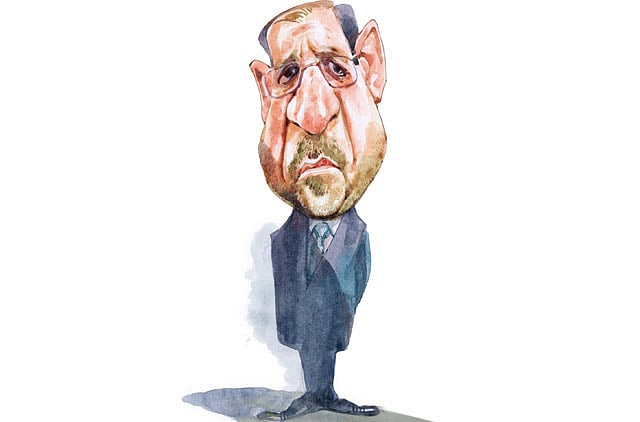
Wait and see what kind of a country will emerge if we one day come to power in Iraq!" A middle-aged man muttered these words to a group of Iraqis 10 years ago at an old Damascus coffee shop called Al Rawda.
The café, the oldest in the Syrian capital, is famous for being frequented by artists, leftists, politicians and Iraqi exiles. At one point in 1959, Saddam Hussain was a frequent customer. So was his successor, current President Jalal Talabani, in the 1990s.
I asked one of the waiters, "Who is this ambitious gentleman who wants to replace Saddam?" "He is an Iraqi politician," the old man whispered, "… not very famous … I don't know what his family name is, but they call him Jawad".
In 2005 that very same man prophetically came to power in Baghdad and today Nouri Al Maliki is struggling to keep his job as prime minister ahead of the March 7, 2010 elections. Iraqis are divided on how to rate him. Some see Al Maliki as a staunch nationalist, others write him off as a sectarian. Briefly in late 2008 and early 2009, Al Maliki seemed to be getting the upper hand in Baghdad, having managed to restore law and order to the streets of the Iraqi capital. Three massive terrorist attacks in August, October, and December 2009, however, erased whatever popularity Al Maliki had accumulated. The attacks were a disaster for the prime minister, who rather than blame them on his shortcomings and those of his security services pointed fingers at Damascus. He accused his former hosts, the Syrians, of harbouring Iraqi Baathists who were responsible for the August attack.
There are several theories as to who wants Al Maliki to survive and who wants to see him removed from power. Obviously, the Syrians were insulted by his accusations regarding the August attack, as they have supported him since he came to power. The Saudis are also unimpressed with him, because Al Maliki has refused to bring their proxy, the Iraqi Accordance Front, back into his Cabinet after they walked out on him in the summer of 2007. He has also refused to disarm Shiite militias that waged a bloody war against Sunnis in 2007, and ignored demands for an amnesty to set Sunni dissidents free.
Contrary to what many people may think, the Syrians and Saudis have much the same agenda in Iraq. Unlike the Iranians, they do not want religiously aligned Shiite politicians like Al Maliki running Baghdad. Instead, they want Iraqi unity. Meanwhile, some of Iran's proxies are toying with the idea of creating an autonomous Shiite district in the south, similar to the Kurdish one in the north.
Al Maliki is worried by the warming of ties between the Syrians and Saudis, seeing that this poses a direct threat to his government. The two countries combined hold sway over the Sunnis who need little encouragement to turn against the prime minister in March. Had the Iranians been firmly behind him, he would have cared little about Sunni anger and Syrian-Saudi rapprochement. But it now seems that Iran, too, is reconsidering its backing for the prime minister. The Iranians are not pleased with Al Maliki trying, in mid-2009, to open up to other Arab countries. During the January 2009 provincial elections, Al Maliki tried to market himself as a leader for both Sunnis and Shiites, steering clear of religious overtones. He received Arab ambassadors in Baghdad, for example, signalling that he was slowly moving away from Iran. He did nothing to bolster Iran's ally, the Supreme Iraqi Islamic Council (SIIC), which lost eight of the 11 provinces it had controlled since 2005. Now he has refused to join the Iran-backed Iraqi National Alliance, which includes Shiite heavyweights like the SIIC, the Sadrists, and former prime minister Ibrahim Al Jaafari, preferring to run as part of an independent coalition, the State of Law Alliance, which includes Sunni figures from the Abu Risheh clan, which is close to the US. The Iranians, clearly displeased by his political manoeuvring, ventured deep into Iraqi territory last month, making claims to oil fields. This made the prime minister look helpless and weak before his own constituency.
Times have changed
Al Maliki cannot go on ignoring countries that back him, be it Syria or Iran. Nor can he function if heavyweights in the region, such as Saudi Arabia, do not support him because of his sectarian agenda and weak leadership. Previously, the support of US president George W. Bush was all that he needed. Now, with Barack Obama in the White House, that support is no longer there and the US is preparing to disengage and withdraw from Iraq. The US is now dealing with the war-torn country on a strategic, macro level, rather than a macro one, and refuses to meddle in Iraq's domestic issues.
With no Tehran, Riyadh, Damascus or Washington behind him and a popularity level that has declined to comically low levels thanks to consecutive terrorist attacks, it is doubtful that Al Maliki will survive the elections in March.
Sami Moubayed is editor-in-chief of Forward Magazine in Syria.
Sign up for the Daily Briefing
Get the latest news and updates straight to your inbox
Network Links
GN StoreDownload our app
© Al Nisr Publishing LLC 2026. All rights reserved.