Pakistan expects to make history in a week from now. The parliamentary election will mark the first time that a government has completed its full tenure and then gone through an election campaign leading to the successful formation of a new parliament — all without obvious or discreet manoeuvring by influential army generals and their coterie of handpicked politicians.
The election campaign leading to the May 11 election has been marred by bloodshed on an unprecedented scale. In parts of the country, notably areas of the northern Khyber-Pakhtunkhwa province and Karachi, Taliban zealots have distributed pamphlets urging people to stay at home on polling day, effectively boycotting a so-called western styled democracy. Given the terrible history of the Taliban targeting those who disagree with them, the message behind the pamphlets is crisp and clear.
On other fronts, many were disturbed when politicians tainted by corruption were eventually cleared to contest the election. At the same time, Pakistan’s former president General Pervez Musharraf, who recently returned from exile, was barred from contesting for life — in a further ruling after Musharraf appealed the initial rejection of his candidature — by a Pakistani judge. Musharraf’s supporters have alleged vendetta by a section of the judiciary given the former military ruler’s decision to target senior judges while he was in power.
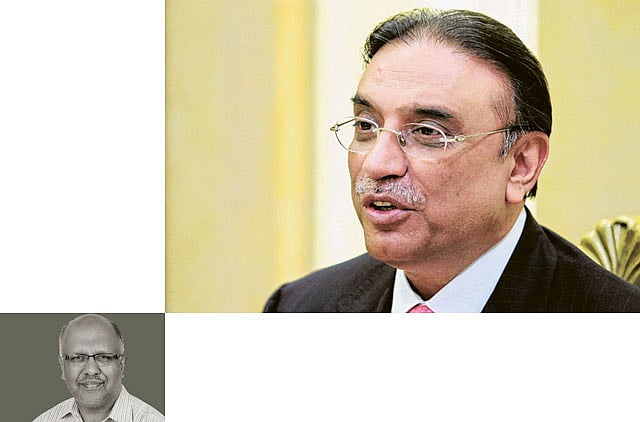
These events are taking place in a country where much has gone horribly wrong in the past five years since President Asif Ali Zardari, the widower of slain prime minister Benazir Bhutto, came to power. Bhutto’s assassination in December 2007 triggered widespread violent protests and worries over the derailing of the democratic process. But after days of ugly riots after Bhutto’s death, the country embarked on the road to democracy.
On Friday, Pakistanis were reminded once again of Bhutto’s tragic end when Chaudhary Zulfikar Ali, the public prosecutor handling her case, was killed by unknown gunmen in Islamabad. His assassination follows the killings of two other lawyers in cold blood. These killings reinforce the impression of a country in deepening distress.
While Bhutto’s Pakistan Peoples Party (PPP) came to power in 2008, her legacy appears to have been squandered by the party she bravely led and a party that has overseen the erosion of Pakistan’s outlook during its tenure.
Yet, for all its faults, there cannot be a substitute to representative democracy in Pakistan. To begin with, Pakistan’s diversity in terms of its ethnic and linguistic character from region to region make it essential for the country to be led by its elected representatives. A degree of consensus is essential to govern one of the world’s more difficult nations. In the past, influential army generals have overseen considerable improvements in the short term. But their achievements were quickly lost after a transition to civilian rule. This pattern is likely to continue in the foreseeable future given that sustaining success stories under a tightly knit ruling order has been nothing short of a monumental challenge.
A newly elected government will neither have the comfort to rejoice nor the breathing space to settle down. The new government will need to immediately pull up its sleeves and address difficult issues, notably security conditions and an increasingly fragile economy.
No one should expect the transition to be easy. The fallout from the disorder in Pakistan over the past five years will not be easy to overcome. The mere fact that there are parts of Pakistan which remain without electricity for up to 20 hours a day presents a monumental challenge for the new decision-makers. There are vast parts of Pakistan where the government has lost control and practically abdicated responsibility to local warlords and tribal chiefs.
It is the beauty of democracy that the PPP under Zardari’s leadership may not return to power. In contrast, the election is likely to be a close contest between former prime minister Nawaz Sharif, who leads the Pakistan Muslim League-Nawaz (PML-N) and Imran Khan, the cricket star turned philanthropist and politician, who leads the Pakistan Tehreek-e-Insaaf (PTI) Party.
While some look at a rout of the PPP as a setback to liberal values, given the party’s historical association with liberal causes, there are two equally relevant points worth noting. One, the PPP’s performance in the past five years has severely undermined its credibility. Second, the new ruling order must be accepted as part of a naturally evolving democratic framework and allowed to complete its full term.
Ultimately, Pakistanis must learn to change governments through the ballot box, not through force. While the bloodshed during the election campaign has caused much consternation, there is a long-term prospect which needs to be understood. For Pakistan, next Saturday’s elections mark nothing less than a milestone in its history.
Farhan Bokhari is a Pakistan-based commentator who writes on political and economic matters.
Sign up for the Daily Briefing
Get the latest news and updates straight to your inbox
Network Links
GN StoreDownload our app
© Al Nisr Publishing LLC 2026. All rights reserved.