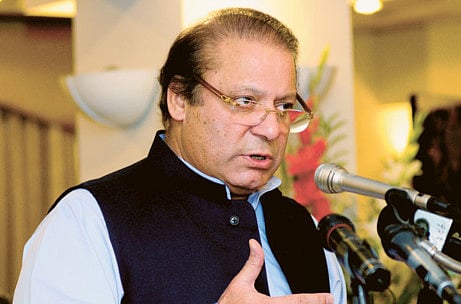
Change your thoughts and you change your world. So, has Pakistan’s moment of change, its moment of reckoning finally arrived? Look at the final score of the momentous elections last week and you have your answer. Of course, the incoming Prime Minister, Nawaz Sharif, is hardly a fresh face in the rough and tumble of Pakistani politics. This will be his record third term.
However, between the last term of the Pakistan Muslim League-Nawaz (PML-N) leader — that ended abruptly in a disaster, that many feel he brought upon himself, leading to a long exile — and his third term, the world has moved on. It is a different Pakistan in an excitable neighbourhood. It is not the same country that Sharif left behind when he was forced out of power, and the country by General Pervez Musharraf in a counter coup. Sharif himself has undergone a metamorphosis and it goes beyond his smart outfits and coiffure.
People who have watched the former prime minister, one of the country’s richest men, for years insist he has changed. He appears more mellowed and mature. Some years ago, when I interviewed him at his daughter’s home in Dubai, while he was still in exile, he had talked of learning from the past and working for a fresh start for Pakistan.
As Sharif puts together his third term team, one only hopes he has those lessons in sight. More important, one hopes he is able to deliver on his lofty promises to justify the historic mandate for a new beginning that this groundbreaking election has delivered. For this is a country impatient for change. Pakistan’s new leader just cannot afford to fail.
It is a brave new country or ‘ek naya Pakistan,’ as his opponent and Pakistan Tehreek-e-Insaf (PTI) chief Imran Khan would call it. After decades of bankrupt leadership, wrong policies, repeated betrayals and abuse of power at the hands of self-anointed messiahs, Pakistan is yearning for a fresh start. And it will not tolerate anyone who stands between them and a new dawn of hope.
Imran promised to deliver that change. And like millions of Pakistanis — and Indians — one excitedly hoped that the cricket legend would indeed romp home to victory defying all odds, just as he had lifted the coveted cricket World Cup in 1992. Imran has a massive fan following across cricket-crazy South Asia. Even people like me, who are not mad about the sport, loved to watch when the majestic Pathan played with his boys, commanding the field like a general. Clearly, life is more complex than sports. The news that the ‘Lion of Lahore’, as Imran was called during his cricketing days, has lost this match to ‘Sher-e-Punjab’, as Sharif’s supporters call him, was crushing for his supporters whose ranks have swelled in the past couple of years.
Somehow, the outcome did not come as a surprise though. Imran and the sweeping, total change that he championed were too radical for the forces backing the status quo. It is an idea whose time has yet to come. By taking on the existing political order, as well as talking tough on America’s war in Pakistan’s skies, Imran had set the cat among the pigeons.
Unlike conventional politicians, Imran rarely watches his words and speaks from his heart. Another issue has been his excessive confidence in his own capabilities. One winced every time he talked of forming the next government and heading it. It was as if he had already won the vote. This self-belief earned him the World Cup. Politics, though, is a different ball game.
However, has Imran really failed? The answer will be a resounding ‘no’. With his message of hope and ‘yes-we-can change’, he did not merely capture the imagination of the nation’s youth — an estimated 103 million Pakistanis, 63 per cent, of the population, are under the age of 25 — he gave a new direction to the country’s politics.
Everywhere he went, a sea of humanity greeted him. Pakistan’s young democracy has never witnessed such overwhelming euphoria, cutting across all age groups and regions. A septuagenarian friend of mine, who participated in this election for the first time since he left Pakistan in 1975 to work in the UAE, excitedly called up from Karachi to say he had voted for Imran’s party. And he was not alone. The PTI has registered its presence in the nation’s largest city and Sindh by winning the National Assembly constituency 250.
The assassination of senior PTI leader, Zahra Shahid, in Karachi on Saturday, ahead of a crucial re-poll, shows that the Muttahida Qaumi Movement (MQM) already feels threatened in its home turf. However, the PTI’s best show has been in Khyber Pakhtoonkhwa, wiping out the Awami National Party (ANP) in its bastion, clearly a people’s mandate for Imran’s principled stand on US drone attacks.
It is a shame that this wave of support for the party did not translate into a strong enough tsunami to help it in the National Assembly. After years of economic and political chaos, Pakistan chose to go with Sharif’s reassuring experience, rather than try Imran’s innocence. The voter has not entirely rejected the PTI either. From zero in the National Assembly, the PTI has emerged as a strong third force, a game changer, in the largely two-party national politics. Imran may have changed the profile and character of Pakistani politics — forever. Some even see the echoes of an Arab Spring. Pakistan will never be the same again.
This was a clear vote for change. And clearly Pakistan’s new leader seems to realise and understand that. In his post-poll statements, Sharif has demonstrated maturity and leadership on the overwhelming challenges facing the nation and on relations with India and America.
Throughout his electoral campaign, he reached out to the next door neighbour, talking of a fresh start and picking up from where he had left off in 1999, soon after hosting Indian prime minister Atal Bihari Vajpayee, in Lahore. Indeed, as far as India is concerned, Sharif and Imran have been on the same page, calling for a paradigm shift in the South Asian twins’ relations.
Sharif’s victory has been widely welcomed in India. In his interviews to Indian media, the incoming leader invited himself to India, prompting a quick invite from Prime Minister Manmohan Singh — a fellow Punjabi born in Gah on the Pakistani side of Punjab before partition.
This augurs well for multitudes on either side of the divide. Especially for people like me in between who have loved ones on both sides yearning for healthier relations between the neighbours. After all, as Sharif reminded the Indian journalists, the two countries have so much in common — from culture, language, movies, music and art to food, faith and sports. It is not just Pakistan that has been craving for change. The toxic world of India-Pakistan relations also awaits winds of change. It is time to move on.
Aijaz Zaka Syed is a Gulf based commentator. You can follow him on Twitter at www.twitter.com/aijazzakasyed
Sign up for the Daily Briefing
Get the latest news and updates straight to your inbox
Network Links
GN StoreDownload our app
© Al Nisr Publishing LLC 2026. All rights reserved.