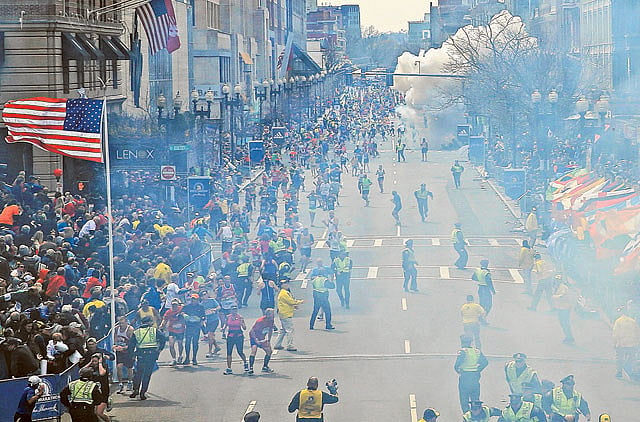
The symbolism encoded in the Boston Marathon bombings is both stark and piercing, though it is doubtful that the cowards who planned them were sophisticated enough to have been aware of it.
As in the case of the terrorist assault on the World Trade Centre on 9/11, the intended victims of the Boston Marathon were innocent civilians, ordinary men and women, going about their day. Yet, the symbolism in both cases exhibited the same sinister cunning: The perpetrators were hitting, respectively, at the western world’s business prowess and at its cultural history.
Business, of course, has been the capitalist world’s business, its mainstay, since the demise of feudalism. And the marathon is an event anchored in the western intellectual tradition, going back to the Battle of Marathon in 490 BC when, as legend has it, the messenger Pheidippides ran the entire distance of 26.4 miles (42.4km) from the battlefield to announce to the Athenian assembly — before he collapsed and died — that the Athenian army had won the battle against the Persians.
At least 500 marathons are held each year throughout the Euro-American world, though competitors are recreational, rather than professional athletes. In Boston, the marathon brought thousands of runners together each year, black and white, young and old, immigrant and native and those from Beacon Hill, where the affluent lace-curtain Irish Americans lived, and those from Southie, where their working class counterparts lived — all there together to have a good time and celebrate the advent of spring — the athletes bringing with them, as all long-distance runners do, their solitary thoughts on the 16.4-mile run and the crowds bringing with them their children to watch and cheer.
Gruesome wounds
At the time of writing, the police were still hunting for one of the two suspects while the second one arrested on Thursday night died in hospital. Earlier, the FBI had released CCTV footage of two suspects it wants to investigate in connection with the bombings.
The attack may have been the result of a sinister plot but it is prudent not to speculate. Let us not forget what happened soon after the attack on the Alfred P. Murrow Federal Building in Oklahoma City that killed 168 people in April 1995, when suspicion immediately — almost instinctively — turned to the Middle East and the prominent anchorwoman at CBS News, Connie Chung, went out on a limb with the announcement that “it was confirmed” Arabs were behind the attack.
And a hapless Arab-American passenger travelling on an international flight that left Oklahoma City the day of the bombing, whose only crime was that he had an ethnic name, was intercepted in London by the FBI and flown back to the US for interrogation.
However, whoever did it beware. Boston is an Irish city and, buddy, you do not mess with the fighting Irish. You do not mess with their marathon, their St Patrick’s Day Parade, their New England Patriots, even their intercollegiate Notre Dame and certainly you do not mess with their women and children. If you think you can, revisit Clint Eastwood’s iconic movie, Mystic River, a poignant filmic presentation evocative of what these folks could do to you if they get angry or, God forbid, enraged at you for a perceived injustice.
I know. I lived in Boston in the 1970s where most of my friends came from South Boston (Southie to the locals). All sweet as honey.
Stepping on the toes
All mysteriously indifferent to their lowly class background. All evincing that delightful colloquial paraphrase in their verbal canvas that the Irish are known for. All fun to shoot the breeze with, as you internalised their rhetoric (born out of their historical archetype in the Old Country of struggle, pain and subjugation) with its tricks of irony and bursts of lyrical elan. Till you stepped on their toes.
As the Irish American writer, Dennis Lahane, a Boston native, wrote in an oped piece in the New York Times last Wednesday: “The little man or men who did this will, I have faith, be arrested, jailed and forgotten. Whatever hate movement they belong to will ultimately go the way of the anarchist assassination movements of the early 20th century or the Symbionese Liberation Army in the 1970s. Those killed and maimed, starting with eight-year-old Martin Richard of my neighbourhood, Dorchester, and his injured sister and mother, will be remembered. The community will eulogise the dead and provide care and solace to the injured. And, no, we will never forget. But what we will cling tightest to is what the city was built on — resilience, respect and an adoration for civility and intellect.”
That can be said as much about Boston as about American society as a whole.
Fawaz Turki is a journalist, lecturer and author based in Washington. He is the author of The Disinherited: Journal of a Palestinian Exile.
Sign up for the Daily Briefing
Get the latest news and updates straight to your inbox
Network Links
GN StoreDownload our app
© Al Nisr Publishing LLC 2026. All rights reserved.