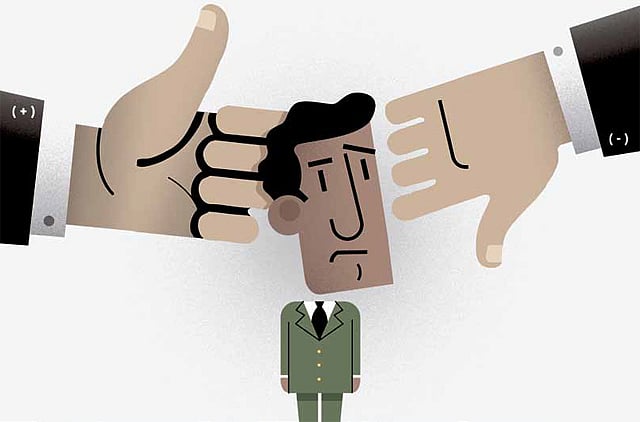
16:06 Gulf News: In the absence of criticism, people will simply continue believing their delusions.
16:07 Dr John Mathew: Criticising will not solve the problem as the first question to be asked is, ‘does he or she have the talent, in its innate sense, required for the job?’ And then, it’s about nurturing that talent.
16:08 Arushi Madan: Criticism is good for us. It is like a bitter medicine that tastes bad but does us good. I feel we should encourage constructive criticism. Such criticism fosters true talent. It is an important part of our self-improvement process, because it is others who can point out the mistakes and shortcomings that we can’t see because we lack objectivity.
16:09 Sumera Malik: No, I disagree with the statement. Criticism has its first impact on the negative side. Why criticise others when each person has the right to explore their own set of capabilities in their own special way? They know themselves better and only they can reach a conclusion on their true potential. Criticism isn’t the solution to the problem. In fact, I think, criticism can make people feel worse. It could make them feel degraded and at the same time have a negative impact on their self esteem. There are better options such as an indirect way of communication or personally explaining and polite ways through which one may not get hurt.
16:10 Jerry Selayro: I think it also depends on the culture we are in. For example, Asians generally respect older people and a young person criticising older men and women is taboo. We are not allowed to do that. Sometimes people feel they are excellent at what they do and criticism is not a part of the process - whether constructive or otherwise.
16:17 Dr. John Mathew: In an organisational environment, there is a limit to constructive criticism. An organisation can’t spend five years giving constructive criticism to a poor performer.
16:18 Wilcor David: Criticising can be done by anyone. It’s inevitable. As a person who always believes that everything should be done diplomatically, I agree that criticism can do good. It’s all up to the person who’s taking the criticism – whether they take it positively and use it in their lives.
16:25 Gulf News: The instinct for self-preservation discourages people from seeking honest feedback.
16:26 Shalini Menezes: I feel that more than criticism, constructive evaluation is key. We are all human beings — a very imperfect race trying to find perfection everywhere.
16:28 Arushi Madan: Nobody is perfect. There is always room for improvement but how do you know where you are lacking? It can be done only through self-evaluation or constructive feedback. I support criticism for positive reasons. It makes us better than we were earlier.
16:28 Jerry Selayro: I completely agree with the second statement. Most of us, if not all, do not like to hear negative things. Especially if we feel we are already at the top of our game. I believe it is part of the human psyche that we respond negatively to criticism.
16:28 Dr. John Mathew: From a leadership perspective, some of the most successful leaders are people who have been open to feedback and the concept of continuous self-development.
16:29 Ishfaq Mir: I agree. Some criticism is definitely necessary as one needs to know where to limit oneself and how. It prevents us from being boisterous and from being inconsiderate towards others. Also, it is necessary to know how our actions affect others and once we are criticised and once it comes to our notice that some people do not like our work, we may strive next time to please them, too. In other words, criticism can even help us improve. On the other hand, if we always receive appreciation, then we tend to lay back and not put in our best efforts since we are already convinced that everybody likes us or our work.
16:31 Sumera Malik: A society can truly achieve its potential if everyone believes and trusts their own strengths and I think appreciation is far more important than criticism. It helps people feel good about themselves and motivates them to become better. Society should introduce certain programmes that help people in becoming better in what they do in their daily lives.
16:32 Dr. John Mathew: Apart from self-preservation in the short-term, what people who end up avoiding feedback get as a gift is failure in the long term. Even the best of organisations rely on customer feedback because that’s what keeps them going on and on. The day they feel they are the best and avoid feedback, they fall faster than they had risen.
16:34 Shalini Menezes: The world out there is either waiting to pounce and trample on you or help you grow. We have to use our sixth sense and understand the underlying meaning and then realise that we are unique, and blessed with our talents, which we have to learn to utilise and make ourselves proud.
16:35 Gulf News: People need to believe they are special for them to reach their true potential.
16:37 Dr. John Mathew: I disagree. I refer to an important element of non-talent. Marcus Buckingham and Curt Coffman in their book ‘First, Break all the Rules’ say that a non-talent becomes a weakness when you find yourself in a role where success depends on your excelling in an area that is a non-talent. A waiter in a restaurant becomes more successful if he can remember that long five-page menu containing 100 items. However, non-talent would mean he is unable to do that, while for his guests, this would be a basic expectation. Just believing he or she is special won’t guarantee success in the role he is in.
16:39 Ishfaq Mir: I disagree with this statement. You don’t have to feel special in order to do your best. You should, in fact, believe in your regular self and in your average abilities. The real beauty is not in a fancy technique you use or only in some special skills. It is how you utilise your normal self in creating something unique. You may find many people having similar abilities, thus making it normal, but in depth, we notice that how they utilise those abilities is different from each other and that is what really matters. It is the way you approach things that creates the difference.
16:42 Sumera Malik: I still stick with the statement that every one of us is different in every single way. People have different approaches to different situations. When we criticise, the only thing we think of is looking at the flaws of others but we forget that the person we are criticising does have some common sense. It can effect them emotionally and hurt their feelings. If they feel and believe that they are capable of achieving certain goals, only then can they achieve it.
16:48 Shalini Menezes: All of us are special and people need to understand that to discover themselves and understand their hidden potential. When faced with criticism that is too hard to hear, try something different — be strong and learn to fight tears with happy moments. We are emotional, but need to be strong. Critics are definitely needed at times to find our hidden selves; they sometimes don the hat of a mentor.
16:49 Gulf News: Encouraging a culture of criticism will only create demotivated individuals.
16:49 Arushi Madan: No. Winston Churchill had rightly said about criticism: “Criticism may not be agreeable, but it is necessary. It fulfils the same function as pain in the human body. It calls attention to an unhealthy state of things.” Encouraging criticism would create many more well-shaped personalities with strong attributes, tolerance and the ability to accept shortcomings and failures.
16:51 Dr. John Mathew: I agree with the statement. All too often, people’s natural talents go untapped. And this is because from the cradle to the cubicle, we devote more time to fixing our shortcomings through regular criticism than to developing our strengths.
16:52 Hannah John: But receiving criticism can give us a clearer sense of self-awareness. The outside perspective can sometimes be the golden ticket to realising our own strengths and weaknesses.
16:52 Shalini Menezes: Criticism, if hostile and harmful, will harm the talent that we otherwise would love to showcase. Sometimes peer pressure is critical. Learn to build on comments as they know the side that we are yet to find. Frank A. Clark, an American writer, said: “Criticism, like rain, should be gentle enough to nourish a man’s growth without destroying his roots”. This is what I call constructive and not detrimental.
16:54 Ishfaq Mir: I disagree with the statement. Criticism helps the person improve. It shouldn’t be taken too seriously, in that you give up on something or you get depressed over it. It should be taken as a challenge. Demotivation? Well, in my opinion, criticism is a motivational tool; since it urges us to do better next time and hence prove that we don’t limit our efforts to appreciation! And lastly, we all know the pleasure of proving our critics wrong. So, how can it be demotivating?
16:54 Jerry Selayro: Depending on the credibility of the person criticising, I believe this indeed creates demotivated people around us. Sometimes people tend to criticise because they just want to. Not all people who criticise someone tend to view it in a positive way. Some just want to put you down. In the Philippines, we call it ‘Crab Mentality’ — people tend to pull you down when you improve your life.
16:55 Sumera Malik: Yes, I agree that encouraging a culture of criticism will only create demotivated individuals. I am saying this because I think mankind has been blessed with common sense. What is wrong and what is right is for us to differentiate. Pointing out others’ mistakes won’t necessarily push them forward to become better, even if the criticism is genuine. What will help is the way one behaves or speaks with others. Having a friendly approach can have a very positive impact, instead of plain criticism.
- Compiled by Huda Tabrez/
Community Web Editor
Sign up for the Daily Briefing
Get the latest news and updates straight to your inbox
Network Links
GN StoreDownload our app
© Al Nisr Publishing LLC 2026. All rights reserved.