Racing to save homeless children in Nepal
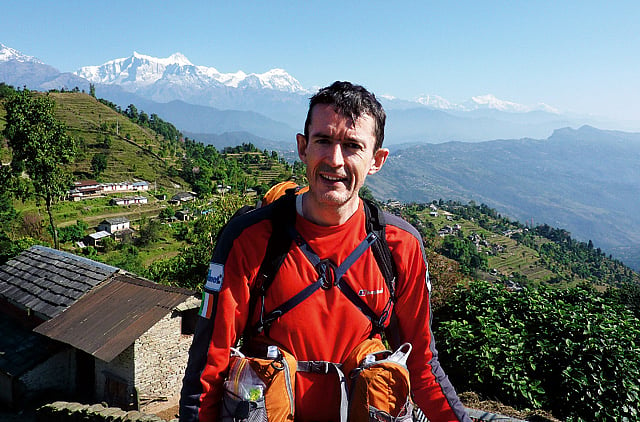
Michael Nugent spent seven days trekking in the Himalayas to raise funds for street children in Nepal
A little child, dirty, homeless and hungry, sleeps under a bench on a cold pavement in a shanty town in Nepal. The ten-year-old is shivering not just with the cold but also with the fear that he could be abused by other homeless people in the sly shadows of the night. He cries in his sleep but nobody listens. There is no motherly hand to lull him back to slumber. Even if he is lucky to wake up the next morning, it is unlikely he will find a morsel to eat on the squalid street that he calls home.
"It is truly heart-rending," says Michael Nugent, seated on a plush sofa in the Mövenpick Hotel, Deira. His voice is soft as he speaks about the plight of the street children he recently encountered in Nepal. Today he looks around at the lavish trappings of the gleaming hotel he manages and recalls the week he recently spent trekking 250km along the treacherous slopes of the Annapurna Range of the Himalayas. He took on this challenge to help give children an education, health care, protection and some hope. "And I will do it all over again,'' he says.
It all began when a colleague suggested he sign up for Racing the Planet: Nepal 2011, a week-long, self-supported, endurance race held last November in Pokhara, a 40-minute flight from Nepal's capital Kathmandu. Michael agreed knowing he'd face some of the world's toughest terrain and temperatures as low as -10˚C.
Michael was determined to raise money for Nepal's Child Welfare Scheme (CWS), an organisation that provides street children with education, health care and basic opportunities to help reintegrate them into society.
"Out of every 100 children in Nepal, 42 live below the poverty line, 48 will be malnourished and seven will die before they are five," says the 50-year-old general manager.
"As the father of two healthy daughters, I didn't need to be asked twice to take the opportunity to make a small difference in the lives of these Nepalese youngsters," he says.
Michael was among the 220 people from 38 countries who signed up for Racing the Planet: Nepal to generate funds for CWS.
From the start, Michael knew that the event was not going to be just "a stroll in the hills". The preparation called for scaling Jebel Hafeet or what Michael refers to as "Dubai's own Alps". He trekked up and down "umpteen times" in the desert sun. It also meant waking up at 4am every day carrying a rucksack and running 10km from his home in Umm Suqeim to Dubai Marina, sometimes sprinting up and down 50 floors at the Grosvenor House five times.
‘You just get on with it'
Even before he stepped foot in Nepal, Michael had raised Dh33,000 for CWS from supporters who sponsored his mountain mission. Except for the tents and hot water provided by the organisers, Michael paid for everything from his plane tickets and fees to food and equipment. "I wanted to ensure every penny went to the scheme to support the kids," he says.
On the trip Michael shared a tent with seven strangers, sleeping by rivers and paddy fields. He started at 7am each day, carrying a 14kg backpack with brief stops at checkpoints.
"As a first-timer, I plodded on. That's life, you get on with it," he says. The toughest day of the event was The Long March, an 81km stretch. "We would do 3,050m of ascent and 2,800m of descent only to find there was another hill waiting. That day, we were on our feet for 23 hours," says Michael.
"If you think of it, the street kids have nothing. You know you have food and a tent but these kids don't even know if they are going to eat the next day. What we endured was nothing compared to them. If that doesn't motivate you to go on, what does?"
What surprised Michael was his mental might. "It's mind over matter really," he says of his marathon hike in the hills. "When the body is sore and your feet give up, with mental strength you can still push on especially when you know that what you are doing is also helping a good cause."
The experience has been truly life-changing. "It was tremendous meeting some fantastic competitors and sleeping under a canopy of stars sharing amazing stories," says Michael.
Of the 220 competitors, only 167 made it to the end. Michael was among them. "The competitors ranged from working professionals to elite racing athletes - including Ryan Sandes, the South African who won - and they were all so inspiring.
"The scenery we saw and the welcome we received from every farm, village and child we passed will stay with me. What we saw up those hills was positivity. There would be schoolchildren coming along beside us and greeting us with a ‘namaste' and women carrying loads on their heads twice the size of our rucksacks. At every checkpoint we were greeted with big smiles," says Michael.
Giving people tools to help themselves
Founded in Pokhara, Nepal, by Douglas Maclagan, CWS works with organisations supporting work with disadvantaged and marginalised children, young people and their communities.
"Douglas always says they are not there to give the kids handouts," says Michael. "He says ‘we are not here to teach them to fish, but to teach them to make a fishing rod'," he adds. "CWS is an amazing support system and last year, it touched an estimated 200,000 Nepalese." Douglas praises Michael's race involvement as "an exceptional effort" that's "really very motivating".
CWS encourages support from individuals, groups and organisations who share their mission of supporting disadvantaged and vulnerable children and young people in Nepal. People can raise funds, volunteer or simply make a donation.
Mövenpick Hotels and Resorts has been associated with CWS for the last five years, providing some of the charity's young hospitality students opportunities at its hotels in the Middle East. Amar Nepali, who works as a room attendant at Mövenpick Hotel Deira, says he is "very happy" to be working "in a hotel in Dubai".
Craig Cochran, vice-president of human resources for Mövenpick Hotels and Resorts in the Middle East and Asia, says partnerships with organisations such as CWS are part of their overall commitment to being a sustainable and responsible company.
Michael says other staff are just as motivated as he is. Salvatore Silvestrino, the hotel's executive chef, who took part in a World Chefs Tour Against Hunger challenge in August to raise funds for children in South Africa, says his boss leads by example. "He's an inspiring people-person and to him, not everything is about money, which helps us think out of the box."
Ready to do it again
CWS is involved in plenty of projects that help improve the condition of street children in Nepal. For instance, the ten-year-old who was found shivering on the streets of Kathmandu was rescued and rehabilitated through the organisation's Jyoti Street Project. The boy is just one of several children who, after spending a lot of time in the day centre and night shelter, is now a member of the kitchen club, preparing food for cooking. He is also a regular student in some informal education classes and even has an account with the Children's Development Bank.
"I do respect that not everyone would want to run on a mountain but this is right for me," says Michael.
"I have already decided I will take part in the Atacama race in 2013 and support CWS. Once is not enough - and what a way to see the world!"
Making a difference
Racing the Planet events are rough country footraces in off-track locations. The annual events comprise the ‘4 Deserts', a series of 250km footraces in the Atacama Desert of Chile, the Gobi Desert of China, the Sahara Desert of Egypt and Antarctica, and a 250km roving footrace in a new location each year. This year, the famed roving footrace, of which Michael was a part, was held from 20-26 November near Pokhara, Nepal, coursing through villages, valleys and farms around the treacherous foothills of the Annapoorna Range of the Himalayas. Past race locations have included Vietnam, Namibia and Australia, with the next one in Jordan in May 2012. The roving race is similar to the Tour de France, except it's done on foot and self-supported.
Racing the Planet events are rough country foot races in off-track locations. The annual events comprise the ‘4 Deserts', a series of 250km races in the Atacama Desert of Chile, the Gobi Desert of China, the Sahara Desert of Egypt and Antarctica, and a 250km roving race in a new location each year. Last year, the race that Michael took part in was held from November 20 to 26 near Pokhara, Nepal. The race took competitors through villages, valleys and farms around the foothills of the Annapurna Range of the Himalayas. Past races have taken place in Vietnam, Namibia and Australia. The next one will take place in Jordan this May. The roving race is similar to the Tour de France except that it's done on foot and is self-supported.
Making a difference
Who: Michael Nugent
What: Participated in Racing the Planet: Nepal 2011 to raise funds for CWS, a charity working to improve the lives of Nepalese street children
How: Trekking 250km across the Annapurna Range of the Himalayas
For details, visit www.cwshk.org
Sign up for the Daily Briefing
Get the latest news and updates straight to your inbox
Network Links
GN StoreDownload our app
© Al Nisr Publishing LLC 2026. All rights reserved.