Globe Foundation CEO is helping to save the planet
John D Weibe believes that environmental problems are business opportunities
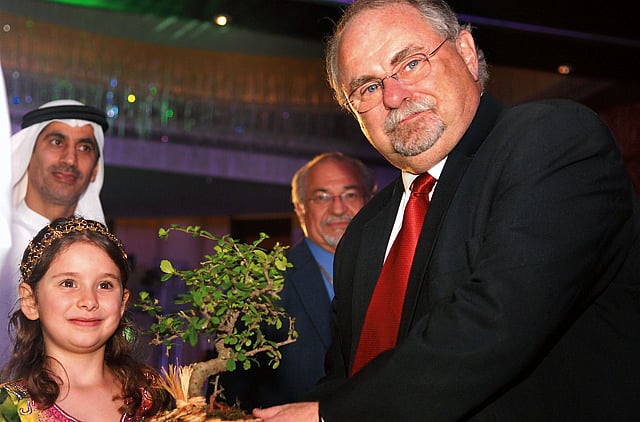
John D Wiebe is a simple man, although his list of accomplishments is anything but simple. From his time as president and CEO of the Asia Pacific Foundation of Canada, to his membership of the National Roundtable on the Environment and the Economy, his achievements are an ongoing list of pivotal roles and board-level involvement in numerous environmental, economic and educational initiatives around the world. All of which have paved the way to his current role as president and CEO of the Globe Foundation, a not-for-profit organisation dedicated to finding practical business-oriented solutions to the world's environmental problems.
The reason I say he is simple is that, despite such a staggering range of credentials, his manner is no-frills, his perspective sharp and to the point. Ask him what his company, the Globe Foundation does and he will say, "We try to make the world a little better place to live in."
What he does not mention is the many ways in which the Foundation works - helping companies and individuals around the world to realise the value of economically viable environmental business opportunities through research, consultancy, project management, conferences, events, and awards. "From urban sustainability to climate change, we're helping to change the world by degrees," says Wiebe.
Wiebe has a simple dictum: environmental problems are business opportunities. "We operate on the premise that companies that can provide clean technologies and solutions will prosper," he says. This was the message he sought to convey at the EPIC Dubai Sustainable Living Expo - held in conjunction with the Globe Foundation - in Dubai this year.
Work
Whenever I look back at my work as an environmental consultant I think about Earth Day. Throughout its 41-year history, Earth Day has been a rallying point for millions of personal acts intended to help save the environment. It has sparked marches, demonstrations and parades, contests and car washes and, with the aid of the internet and social media tools, it has become a global moment in time to signal the importance of living more sustainably.
It has shown that for one brief shining moment, we can come together in a common cause to make a difference, to show that change is indeed possible.
But this has been an issue from the beginning - how to make the promises made on that day realities that can shape every day.
Many have sought to make Earth Day a vehicle to make lasting changes - a day of commitment that leads to meaningful results across the full spectrum of our society, in terms of how we live, what we eat, how we move about, and how to give back to the earth more than what we take from it. It is a tall order and clearly there are no easy answers or quick fixes, or ten easy steps to a better world. If it were that easy, we would have done it already.
So, that is what gave birth to the work we do at the Globe Foundation: how do we make it Earth Day every day? One way is to hold individuals, institutions, businesses and governments to account for the commitments they make on that one day, to follow them through and make them real. This is not to suggest that such changes have not happened - they have, and many progressive businesses are indeed changing their ways of operating in order to cut wastage and lower energy use, becoming more ecologically balanced.
But in truth, without ongoing supervision, those commitments can easily give way to ‘business as usual'. This is where our Globe Foundation is trying to make a difference.
The strand that runs through my life is working at problems in a different way, finding positive solutions rather than looking at the negatives. The words that resonate through my life are, ‘Why can't we find a better way of doing this?' This started from my childhood, imbibed from my family.
Prior to starting the Globe Foundation I ran The Asia Pacific Foundation of Canada, an independent, not-for-profit think-tank on Canada's relations with Asia. It was around this time that the Brundtland Commission, established by the UN in 1983 to help nations establish policies for sustainable development, and formally known as the World Commission on Environment and Development (WCED), came out with its report. The report's most significant insight? That the environment and the economy should not be separated; that you could protect the environment and still have a flourishing economy.
To me that was an important message. Out of it came our idea that problems can become business opportunities and that was the way to solve them. A group of like-minded people helped me initially and we established the Globe Foundation in 1993 in Vancouver.
Since 1993, these emerging truths have guided and shaped our activities as we promote and frame sustainability as a sound business strategy. Each of the areas in which the Globe Foundation operates revolves around amplifying the concept that protecting the environment will result in a better bottom line for business. All of our activities, from our events series to our consulting and communication products, seek to mobilise these ideas - this makes us the first entity to focus on developing the ‘business' of the environment - not only in Canada, but around the world.
With our basic activities taking off, we launched the Globe Foundation (Europe) Ltd. in Ireland in 1995. This entity provides environmental management and pollution prevention consulting and training services to companies, governments and universities.
We later established the popular Globe-Net news site, Canada's premier online guide to the business of the environment. The annual Globe Awards for Environmental Excellence were launched in 2002 to recognise the creativity, initiative and leadership of Canadian enterprises towards environmental excellence.
What we are looking forward to is for corporations to ensure that their products are environmentally friendly and, on the consumers' side, to see that they know how and where to look for such products.
We are concerned with the whole gamut of product categories and types, from automobiles to organic food. We showcase products and we do analysis and research in our labs in order to find out ways to get the products to the people. We do a variety of activities that may help the seller, but we are not brokers. We are promoters of technology.
We will analyse a business and formulate a plan of action to make a business sustainable in a way that adds to its bottom line.
Play
If you are in love with your work, then it is equal to play. I am so busy travelling for my work that I hardly find time for any of the other things you would classify as ‘play'.
I used to be a very sporty person as a kid. I used to play baseball, soccer, almost all sports. Now I am an inveterate golfer. I will go golfing wherever I can. That's my main hobby now. The other one is photography. I don't have much time for that any more though. I don't find time to read for pleasure or to listen to music.
One thing I am still able to do is travel. I loved travelling as a young man and before joining graduate school I travelled the world for a couple of years. I visited about 50 countries across Europe, eastern Europe, Africa, and the Middle East.
That gave me an insight into the different cultures of the world, and also a little bit into the problems of the world.
The trips changed me indelibly. I realised that beneath our skins everybody is alike, irrespective of our nationality - we all have the same dreams and desires. The world is really one place. That's part of the reason I think we would all like to in some way save the planet, treat the environment better.
My father was my biggest influence when I was growing up, as were my teachers. My father was a teacher too - an engineering professor. He taught me a lot about questioning conventions and also about tolerance, to look at issues positively rather than negatively. My teachers taught me to focus and I had very good science teachers because they inspired me to choose it as a career. I originally wanted to be a medical doctor when I was a child. I used to read medical journals rather than story books! They used to fascinate me. But eventually the fascination must have given way because I lost interest in becoming a doctor.
It is possible that the environment in which I grew up inspired me in my choice of career. The one lesson that I learnt as a child that has definitely stayed with me all my life is the dictum ‘do unto others as you would have them do unto you'. The interaction between people is what fascinates me.
Some people will tell you that the most important thing is who you know and what you study. But to me the most important skill to have is application: you should know how to apply what you have learnt. This means that if you are exposed to hardship early on in life, it sets the pace for the rest of your life to move on and develop more smoothly; life is fuller and achievements become more meaningful. I believe in fairness as a core value and I expect the same from others. I value relationships, whether personal or professional, and I'll fight to see them survive.
The next big lesson came from my two children. It was parenthood that taught me the true nature of responsibility - that it never ends! It's rather like my commitment to the world - what we are doing is for our children and then for their children, and so on. The responsibility has no end in sight. But at the same time I don't believe in trying to realise my dreams through my children. They have to follow their own dreams. My duty is to provide the best opportunities for them, but it is up to them to achieve them.
Dream
My dream is to see a world without poverty and pollution. I have a tendency perhaps to be a day dreamer. I used to dream of becoming a great surgeon when I was a child. Now, I dream of a cleaner, better world but, unlike then, now I am trying to make it a reality. And a dream for me personally, is to retire and play golf!
But seriously, my dream is to spread our work culture across the world. The Globe Foundation's philosophy for consumers is that you can essentially ‘buy' a better future. Let's face it, we are not going to stop consuming tomorrow because the future is threatened. But we need to understand what our choices are and we have to think about how we exercise our choices, especially in what we buy.
Inside info: For more information on the activities of The Globe Foundation, visit: http://www.globe.ca
Sign up for the Daily Briefing
Get the latest news and updates straight to your inbox
Network Links
GN StoreDownload our app
© Al Nisr Publishing LLC 2026. All rights reserved.