Celebrating a woman's worth
A travelling textile exhibition at the Bastakiya Art Fair, gives an insight into the lives of female artisans in Pakistan
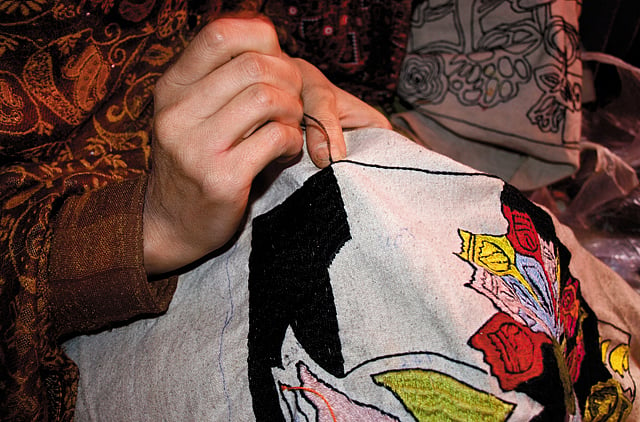
In the sun-dappled courtyard of a home high up in the Chitral Valley, in the Hindukush region of the Northwest Frontier Province of Pakistan, a group of women sit on charpoys and chat as their hands dexterously work needles and threads in and out of large swathes of cloth to create shapes, pictures and embroidered patterns. The air is cold but crisp and the rise and fall of their murmured conversation tinkles in the atmosphere as though a bubbling brook is flowing by.
It's a motley group: genial mothers-in-law, industrious wives, smiling mothers, chattering sisters… Children run amok between the charpoys as admonishments mingle with the chatter. Through all this, the needles and threads keep moving in and out of the cloth, bright silken strands that sometimes catch a ray of wan sunshine to reveal a colour that was just a shade different a second ago.
It is not the most weather-cosseted place, this region. The winters are harsh and long, summers are brief but severe and the rest of the months just have to be endured. Life is tough as the amenities are basic. This mountainous region is cut off from the rest of Pakistan for nearly a quarter of the year as the Lowari pass gets clogged with snow. It is as if they could be the only people on the planet. But these women have sprung from the womb of the mountains so they know the pulse of the place.
It beats strong, day in and day out, even as the vagaries of weather and the daily chore of making a living from the essentials can sometimes threaten to drain them of their energies. But they do not baulk.
Births, weddings, ceremonies and festivities are all a part of their yearly share of experiencing life in a region only the most sturdy adventure lovers attempt to visit.
As is true of all remote places on this planet, in Chitral too life goes on.
But with a slight difference. It gets an embroidered edge, literally. What these women are doing in the courtyard is not simply passing time. They are using the time, culled from a day that demands other important chores like cooking, raising kids, and being the nurturers and nourishers of their families, to tell their stories to the world that has yet to truly peep into theirs. Stories not told verbally but on pieces of cloth large and small, using simple stitches and basic colours of threads, which run through the cloth the way a string of words run on to become a paragraph that is a part of story. It is as though by transferring their everyday stories of living onto cloth, they are also coming together to be tied in a common thread of existence.
The casual chitchat is sometimes just that. It could be about the next meal to be cooked. Or it could be a seamless discussion about how to execute a certain twist in the tale using a particular stitch. What colour of thread should be used if a bird has to be flying as opposed to it sitting on a courtyard wall? It's a layered narrative that takes up this time, and eventually, when they disband and return to their individual homes, some of those layers will have been half told, the loose threads waiting for another session to be all tied up. In due course, the world gets a story on a piece of cloth, a story that is simple yet beguiling, beautiful and moving, the whole picture worth taking in fully, allowing you to mind travel to a mountainous region and gain a glimpse of the people and their lives there.
This then is the ‘Gup Shup' concept in the Chitral valley in Pakistan. The term in Urdu means ‘idle chit chat'. It could be over endless cups of tea and spicy, freshly fried samosas. But gup shup also enjoys dimensions of poetic languidity, a time redolent of lazy summers, of bone-warming sun soaks in stern winters, or in other seasons. An anywhere, anytime indulgence when the mind feels the need to stop its anxious chatter and switch to a more relaxed vocabulary of happy trivia and candyfloss imaginings.
This glimpse of Gup Shup in the form of a travelling exhibition of 23 contemporary hand-embroidered textiles, each embroidered version a story in itself, not only highlights the creativity of the women of Chitral, it also brings the world into their homes and their homes into the world.
Gup Shup is currently on at Al Jadeed art pavilion during the Bastakiya Art Fair from March 15-20, in tandem with the Art Dubai week.
The genesis of an art piece
Each piece came into being after being painstakingly storyboarded by the women working on it through a series of techniques. Pot swap, for instance, is a busy embroidery of Zaibounda's kitchen, a place bustling with aromas and flavours, crowded with a variety of pots, pans and jars, perhaps the place where she spends the most time cooking for her family, especially during Ramadan. Her mother makes the best rice in the neighbourhood, her sister-in-law makes the best pakoras (savouries) and Zaibounda's kallee soup can heal the sick. The children of the neighbourhood have a busy time scampering from house to house sampling and thoroughly enjoying the food and exchanging it for a mouth-watering preparation from their own homes. There is an old saying in the Chitral mountains that goes: ‘Never return a pot empty'. Which explains the tradition of returning the gift of food by giving the gift giver a home-made dishin return.
A kitchen redolent of the smell of spices and memories was for Zaibounda a perfect story to tell through embroidery. Her eye for detail resulted in a stunningly executed piece that fetched $2,200 by an American woman in Islamabad on the night of the opening of the exhibition at the National Art Gallery. Precious money she used to fulfil her long-cherished dream of enrolling her eldest son, Sajid, in a local Chitral college. She paid Rs25,000 for his first annual fee at college. Speaking to Friday from her home, she feels the experience had boosted her confidence to definitive highs. "Now, I can support my children, myself and even my husband too - now I am a supervisor at the neighbourhood collective. I actually earn more than him. Today I am in a position to be a decision-maker in my home. And I enjoyed the whole creative process so much! I want the people of Dubai to appreciate our work and buy our pieces because it is my dream to be able to earn enough to put my other children, Shiraz and Aarzoo, through school and college too!"
Zaibounda is just one among the 33 women who worked on the Gup Shup project.
But the story of Gup Shup has a preface. It is the brainchild of two women, Cathy Braid and Rolla Khadduri. Braid, an Australian designer who trained at the prestigious Central St Martins in London, arrived more than six years ago in Chitral, working with around 500 talented native women for a women's accessory label, Polly & Me.
Khadduri, with a Masters from Harvard University, had left her home country Lebanon, to work in the international development area in Pakistan and Afghanistan four years ago. When chance introduced them to each other, they mutually came to a realisation - they needed to go beyond their respective jobs and work with the rural women in Chitral.
The idea of Gup Shup was born.
Says Braid, "I have been working with the women of Chitral for a long time and was amazed from the start by their extraordinary level of embroidery skills." The women had been working on textiles based on Braid's ideas and designs. "I wanted to see what would happen if the women had an opportunity to be more self-expressionistic about their own lives. It is amazing to see what they created with the simplest of equipment and their immediate surrounding as inspiration."
Khadduri, who is now Dubai-based, says, "I have always aspired to pursue objectives of empowerment and improved decision making that most development projects are about. But, in Chitral, I wanted to do something more. I wanted to give the women space to tell the world their own stories in their own words."
With a little bit of coaxing, the women found their confidence. "Their work makes us challenge our own preconceived notions of who they are, what their life is about."
According to both Braid and Khadduri, the exhibition aims to depict the universality of women's lives everywhere. The Mother and Milk piece - for sale at Al Jadeed pavilion - describes the tempestuousness of the mother/daughter relationship. In the Prayers piece, the women open up and share their short and long-term aspirations, many of which are similar to those of women in any part of the world, irrespective of their financial status. The Daily Chores series illustrates the everyday activities of the women who run their homes.
The pieces called Mehndi (Henna) and Harvest talk about the bitter-sweetness of life, dreams and marriage. Although there are variations within cultures, the concerns the women have and the emotions they describe reveal that we in reality share more similarities than differences, says Braid.
The method
Each piece was worked on either individually by one artisan, a couple or even a few, especially the larger, more intricate ones. Before each piece was created, Braid and Khadduri ran a series of collaborative workshops with the women. These workshops used different motivators to bring out art responses in the women. Techniques of drawing, collage and digital photography were used to storyboard. Some of the motivators were:
1. Creative packaging of the everyday products available in the market. Their attractive packaging such as that of a tetra pack of a popular brand of milk was placed in an arrangement that resembled an Andy Warhol-like composition and was the inspiration behind the Mother and milk piece.
2. Calligraphy or script: women loved to write their names and this become the foundation for the What's in a name piece
3. Child portraits.
4. Daily chores.
5. Childhood mischief.
6. Story-telling through a collage of memories.
Every technique became a powerful catalyst, helping women to draw out long-simmering memories. For instance, in the Childhood Mischief series, the women were initially meant to go down memory lane and share their childhood events. However, during the workshop, they discovered it was difficult for women to draw upon such a motif by accessing an image from the mind as many of their memories had faded with time.
In another instance, Khadduri and Braid decided on the bazaar as a topic. They took photographs of the bazaar in various moods and during the workshop, as the women looked at the digital images, it helped trigger memories - of a time when they were allowed to go to the bazaar (usually before they turned 12).
They then indulged in a bazaar-mapping exercise. This brought in another cascade of memories. Different stories and experiences were narrated to the group. As the narrations continued, the women got out of the bazaar and began talking at length about the pranks they played as children and called this series Tsakiyo Masti or Childhood Mischief.
Drawing upon memories
Once the process of detailed recall was over, the women sat down for storyboarding, dividing their memories into scenes and working out the visuals for each scene with crayons and oil pastels. They were asked to work on the houses, alleys, people, seasons that made the backgrounds stand out in each scene, detailing each one. Once the scenes were worked out, the women drew out the characters of the story such as the ice-cream man, the grandmother and so on. The storyboarding done, the picture fell into place in their minds. The sequence of images was a natural progression. The colours and choice of stitch work almost chose themselves to depict each element in the picture.
Child portraits were used as a technique in yet another workshop. Both Khadduri and Braid felt that portraits were prominent in art history and would enable the women to capture the emotions in their private space.
In order to give them more confidence in their drawing skills, a digital photography workshop was first organised. The women suggested photographing little children in the neighbourhood.
A variety of shots composing close-ups and long distance images were taken by two girls Qaseeda and Nasreen of their nephew Faham. They studied the play of light on his features and also taught other women the importance of distance and different perspectives on the same subject.
Once pictures were done, these were printed and photocopies were created and the women were taught to create collages. The collages were then traced by the women and even as they worked they chatted a lot. It was clear that although most of the women in this group were unmarried, they loved to mother the children they had photographed.
Khadduri who recorded the chatter throughout the art workshop noticed how the women fed, clothed and bathed the children they had photographed.
A child always had many ‘mothers' in a large household. Nasreen and Qaseeda especially were attached to their nephew, Faham, who was taught to write his name in English by his aunt Nasreen.
Their nephew always talked about being a pilot and flying planes and that is how their work, I want to be a pilot was created.
An empowering experience
The entire experience of creating these pieces has empowered the women, most of whom are between the ages of 15 and 32, the majority unmarried. Braid had initially worked with eight neighbourhood collectives in the area where women would come and work together on various other projects, including the Polly & Me fashion label.
The 500 women of Chitral attached to the neighbourhood collectives have an opportunity to congregate and work in their free time. Those who are unable to frequent these centres carry their work home and find time in between chores to complete their assignments. A women's cooperative, Mogh, has been formed which liaises with Braid and Khadduri. The cooperative finances the cost of threads, sewing needles and the sheets to embroider on. After the sale of a piece, the cost of these raw materials is deducted and the restis handed over to the women as their earnings.
Part of the money the women earn is deposited with Mogh so other women can be trained in skills of banking and planning investments with their profits.
One of the most memorable experiences for some of the women was when they travelled to Islamabad where the exhibition opened on International Women's Day last year at the capital's National Art Gallery. So overwhelming was the response that nearly a third of the pieces found buyers on the spot.
For many women of Chitral, it was the first time they were stepping out of their home territory.
The experience changed their lives forever:
Chustana gushes about the response of the people, "When the doors of the exhibition hall opened and people walked in, it was an unforgettable experience."
She is using the money from the sale of her work to complete her graduation. One day, she hopes to open her own shop.
Says Zaibounda, "Our prayers are always with Cathy and Rolla; all this would not have been possible without their sincere efforts.
"I still recall the moment when I stepped out of the National Art Gallery hall, of having been recognised for my work."
The motifs created through Gup Shup are now being transferred from textile to tote bags so that the sustainability of this exhibition is furthered as the women continue to create products with an international appeal and are assured a regular income.
Finally, what Gup Shup has proved is that no matter where you live on this planet, even if technology has not reached you, you can communicate with the rest of the world and tell people your story. Every story is a communication in waiting and in the case of the women in Chitral, it was a matter of finding a needle and some thread to tell it.
Giving wings to dreams
In the Chitral society, kids usually have extended homes and families, and a child has many ‘mothers' in a large household. Nasreen and Qaseeda especially were attached to their nephew Faham. Faham always talked about being a pilot and flying planes and that is how their work, ‘I want to be a pilot' (opposite page top) came into being. It is now on display at the Bastakiya Art Fair. Faham lost his father last year and his aunts have pledged to use the proceeds from the sale of this artwork to put him through school and college and realise his dream of being a pilot.
The other venture
While Gup Shup is a venture where the entire sale proceeds go to the artists, Braid's other ongoing enterprise Polly & Me is a commercial venture. Braid began this fashion label with a social conscience in 2007 with her sister Ange Braid, who has experience in marketing products. The fashion label markets products created by the women and one of their most popular products is the current Gup Shup range of bags which are also on sale at Showcase Gallery on Jumeirah Beach Road, and XVA Gallery in Bastakiya. For more details write to rolla@pollyandme.com. The exhibition is on at the Jadeed Art Pavilion in the Bastakiya Art Fair to complement Art Dubai from March 15-20. The Hashoo Foundation - a development organisation based in Pakistan that supports social enterprise, particularly among women - has been a supporter of Gup Shup from the start, and is partially sponsoring the costs of bringing the exhibition to Dubai.
Sign up for the Daily Briefing
Get the latest news and updates straight to your inbox
Network Links
GN StoreDownload our app
© Al Nisr Publishing LLC 2026. All rights reserved.