Food as a tool to keep culture alive
Anissa Helou, the author of seven cook books, looks at the intrinsic goodness of Middle Eastern cuisine
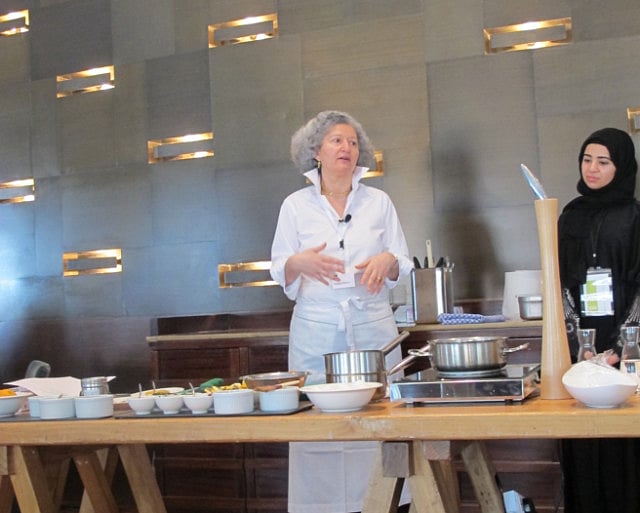
Though she has been living away from her homeland in the Middle East for so long, Anissa Helou proves her deep knowledge of the region’s cuisine in her extensive writing.
Anissa, who was born to a Syrian father and a Lebanese mother, has been living in London for nearly 40 years now, but in a career spanning more than two decades, she had learnt a lot about different regions, cultures, traditions and cuisines, including the Middle Eastern, where she says the local dishes are intrinsically healthy.
“We are definitely naturally healthy; we don’t even need to make an effort to be healthy. Olive oil as a fat is healthier ... You consume a lot of a lot of vegetables [ and] meat is always an accessory.” Even when it is used with kebbe, grilled dishes, vegetables or yoghurt, it is used as a smaller element, Anissa says.
While agreeing that the love of food is universal, she is quick to point out that it is also an important part of cultures and constitutes a “common language” among people.
“Food is very much part of culture and it is very rare to find a man or woman who is not interested in what is happening in the kitchen, or what is being put on the table. So it is an immediate connector that changes from country to country,” Anissa says.
Talking to people from different countries, she says, instantly shows the differences in preparing, serving and eating food, despite the fact that some dishes are common.
“So not only am I learning about the people, the country, the culture and the traditions, I am also learning a lot of new ways of using the same ingredients, because they are more or less shared across the Mediterranean region.”
These include fresh herbs, olive oil, lemon juice, vegetables, pulses, rice, grains and spices.
However, within Arab cuisine, there is more than one strand, namely, the Middle Eastern, the Persian and the Moroccan. And parts of Europe such as Italy, Greece and Turkey, where the Mediterranean touches, it also passes certain approaches to food, such as love for freshness, use of olive oil, vegetables and pulses, she notes.
“The Mediterranean was the centre of the world for a long time, so all around it, you have common ingredients, common produce and if not the same way of preparing it, familiar ways, or familiar dishes,” she says. “And then you go to Asia. It is a completely different world, the spicing, the preparations. We don’t have any wok cooking, for instance. So, in China, there was no connection whatsoever. I loved the food, though I am not going to cook it because it is completely alien to me and I have to learn a whole new language and method and ingredients. I don’t even remember a lot of the ingredients because they are so unfamiliar.”
Yet Arabs and Chinese share one common trait: they like their own food, and it is their favourite, she said. “They will eat other food of course, and also women work now, but it is understood that the food served at homes, and not ready-made meals, is good food .... [For example] In England, a lot of people buy ready-cooked meals, and they don’t know what’s in those meals. So not only we do preserve our traditions but we also preserve our sensible way of eating, which is by preparing fresh food at home,” Anissa says.
Anissa’s seventh cookery book is coming out this summer. Her journey with writing came “completely by chance” in the early 1990s. At that time, she was interested in writing a book about art collection. She got herself a literary agent, who introduced her to a Lebanese friend. The conversation turned to Lebanese cookery books.
“And I just blurted: ‘You know, I should write a book on Lebanese food.’ Then my agent said they have a publisher who is looking for an author for a Lebanese cookery book.”
That was the beginning of a long research and a successful career. It took some six months to finish the proposal and nearly two years to finish Lebanese Cuisine, which was published in 1994 and went on to be shortlisted for the Andre Simon Book Awards.
“I decided that there were two main reasons behind Lebanese Cuisine. One was to record my mother’s recipes, because she is a marvellous cook, and the other was to pass on the information to all those young Lebanese people who are displaced by war, who didn’t have the chance that I had, of being with my mother, my grandmother, my aunts, and seeing everything being done at home, in the mountains.”
Sign up for the Daily Briefing
Get the latest news and updates straight to your inbox
Network Links
GN StoreDownload our app
© Al Nisr Publishing LLC 2026. All rights reserved.