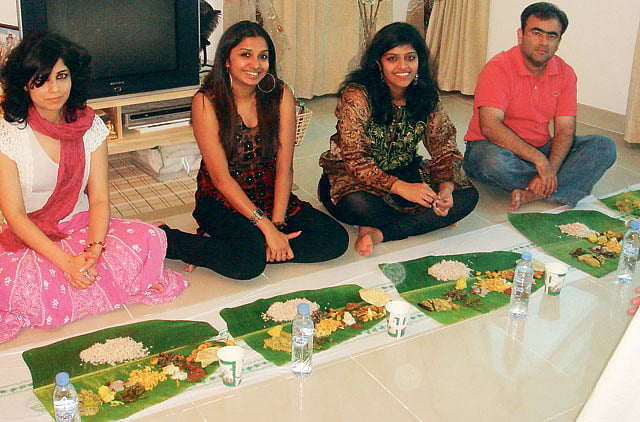
The concept of eating a dozen or so dishes — all vegetarian and served at the same time — off a green banana leaf, using only the right hand, while seated on the floor with both legs tucked under each other, may seem esoteric even in exotic India.
It is a fact though, that the further away Indians live from the state of Kerala, the stronger the possibility that they have not seen, tasted, or participated in her traditional meal, the sadya.
It was logical therefore, that everyone expected a young South African in her late twenties to be surprised at her first sadya. But what proved truly surprising is that of the 18 Keralites gathered at an Onam meal hosted in a private home in Dubai, not one could provide all the answers to her questions — or correct and complete ones at that.
Mamoroka Magagane wanted to know the name of every dish, why it was given a particular position, what governed serving and eating patterns, how the dishes were to be eaten, and a lot more. The motley crew of authentic Malayalis at hand — including knowledgeable Nairs, Nambiars and Namboodiris — had much to say on the matter, but even they knew they didn’t know enough. And such is the sadya’s plight today — renowned among many who are rather remiss in knowing what its symbolism is, what its statutes are.
In a basic description, a sadya is a vegetarian meal that has come to epitomise Kerala’s festive cuisine. It is as grand as befits a king — the legendary Mahabali who is said to visit households during Onam, and it is as diverse as the myriad regions and cultural traditions of the state. But although its origins draw from a Hindu legend, it is commonplace for Thiruvalla Christians, Malabar Muslims and Kochi Jews — each with their own distinct festive menus — to cook, serve or eat a sadya at weddings, festivals, ceremonies or wakes.
In a basic dissection, a sadya can be classified as nalu kootan or ettu kootan, with four or eight dishes respectively. These set number of thottu kootan (semi-dry curries) are in addition to numerous ozhichu kootan (pouring curries) and other accompaniments eaten with rice, compulsori\ly followed by dessert — all served on a large banana leaf, placed on the floor.
The artist and writer Vijayan Kanampilly has done Malayalis an essential favour by dedicating a section to the sadya in his book, The Essential Kerala Cookbookital. In ‘Menu for a Monarch’ he says that every variation of the sadya is drawn from the onasadya, and describes both basics and variations of the traditional feast, although his version is specific to central Kerala.
Kanampilly’s guidelines start with using the thick spine of the banana leaf as a central line for placement of different dishes. Before the sadya starts, a pinch of salt, pickles and chutneys are placed on the extreme left — below the line, and pappadams, upperies, and bananas — above the line. All the thottu kootan are served above the line in a neat row, with the first one at least seven centimetres to the right of the pappadam, and with a space between each. The only exception is kalan, which has to be placed three centimetres below the line to prevent the sweet-sour dish from mixing with the others.
Rice is always served after guests are seated, in batches, with a series of different ozhichu kootan — according to regional styles — like ishtoo, parippu, pulissery, pulinkari, sambar and rasam. Guests can eat according to personal preferences but ideal proceedings are from left to right to mark the progression of spices.
The sweet note at the end of the meal is the payasam or pradhaman, which is often eaten with mashed banana and crushed pappadam.
The ettu kootan sadya comes with two variations of desserts — one based on sugar and milk, and the other on jaggery (unrefined cane sugar) and coconut milk. The sadya is such an essential part of Kerala’s ten-day festival that an old Malayali adage says a man must be willing to sell his mortgaged house to consume the onasadya. And the payasam is such a staple of the sadya that it is made in Malayali households around the world, even when the full meal is not.
Modern variations of the sadya include plastic leaves, leaves cut out to fit inside sturdy steel plates, and sadyas set atop dining tables. But food is still served in a set order, and it is eaten with the right hand, using the fingers and half the palm.
Today’s Malayalis may not know the specifics of the sadya, but this small fact does nothing to deter them from eating it, serving it, or introducing it to non-Keralites and even non-Indians.
Like many others, that group of 18 Malayalis may not have known how to answer all of Mamoroko Magagane’s questions about their festive foods, but they did teach her a thing or two on how to enjoy it. Aping all the others to mark immense satisfaction, the South African was last seen licking every inch of her fingers after the last drop of payasam was polished off, with her leaf left neatly folded on the floor.
The sadya checklist
Erissery — A combination of pumpkins and red beans or yam and raw banana
Pulisseri — Mangoes or vegetables cooked in yoghurt
Kalan — Plantains or vegetables cooked in buttermilk
Olan — Soft vegetables cooked with pulses
Mulakoshyam — Similar to Olan
Thoran — Finely diced dry vegetable dish
Koottukari — Vegetables cooked with gram or chick peas
Aviyal — Mixed vegetables with coconut
Sambhar — Mixed vegetables cooked with lentils and tamarind
Pachchadi — Fruits cooked with yoghurt, tempered with mustard seeds
Kichchadi — Vegetables cooked with yoghurt, and crushed mustard seeds
Rasam — Sour soup made of tomatoes, lemons or tamarind
Payasam — Sweet dish made of milk and sugar, or coconut milk and jaggery
Prathaman — Sweet dish made with boiled, dried and re-cooked rice flakes
Chukku vellum — Digestive drink made of dried ginger
Jeera vellum — Digestive drink made of cumin
Upperi — Deep fried plantain or vegetable chips or crisps
Achaar — Pickles made from mango, ginger, lemon, or grapefruit
Pappadam — Large deep fried crisps made from gram, chickpea or other flours
Pazham — Banana varieties known as Rasakadali, Poovan, Palayankodan or Cherupazham
The avial chronicles
Legend says that when Bhima, one of the mighty Pandava brothers in the Mahabharata, had to adopt the guise of a cook in exile, he chopped up various vegetables, boiled them and served it with a generous sprinkling of coconut — simple because he did not know how to cook. Another colourful story is attributed to the chef of the maharajah of Travancore who ran out of recipe ideas and used one of each vegetable in his pantry in an experiment. Apparently the maharajah loved the dish so much that he rewarded the chef, and the dish became a daily feature. In its most basic guise, aviyal can be prepared in less than half an hour, with almost any vegetables at hand.
Ingredients:
- 250 grams of mixed vegetables, cut into
- 2-cm stick shapes
- 1 tsp turmeric powder (optional)
- 2 tsp cumin seeds
- 1/2 cup grated coconut
- 2-3 green chillies
- 8-10 curry leaves (optional)
- 3-4 tbsp yoghurt
- 2 tbsp coconut oil
Method:
Boil vegetables with turmeric and salt until just done but still crisp. Vegetables that cook faster must be added later. Grind coconut, cumin and chillies to a rough paste. Beat yoghurt until smooth. Drain vegetables and place in wide pan on a mild heat. Add coconut mixture, beaten curds, curry leaves and coconut oil and mix gently. Simmer for a few minutes until well coated, and serve hot with rice.
All about Onam
Onam became Kerala’s state festival in 1961. The ten-day festival is celebrated at the start of Chingam — the first month of Malayalam calendar and August or September in the Gregorian calendar. There is a folklore behind Onam.
Long, long ago during the reign of a powerful and benevolent demon king Mahabali (also known as Maveli), people in Kerala enjoyed unprecedented prosperity. But Mahabali exhibited one weakness — a dominant ego. This was exploited by gods who, threatened by his popularity, used it to end his reign.
Lord Vishnu (the ‘preserver’ form of the Hindu trinity) transformed himself into a dwarf called Vamana and approached Mahabali, and asked for alms. The emperor’s kingly ego was tricked to believe that God had asked him for a favour. He decided to grant Vamana whatever he wanted — three paces of land.
Vamana suddenly grew bigger, beyond the skies and covered the sky with his first step, the second step straddled the netherworld. Realising that his third step would seize the earth, Mahabali offered his head as the last step. Vamana’s third step pushed Mahabali to the netherworld. However, Mahabali was granted one last wish — that once a year, during Onam, he could visit his loyal subjects.
Sign up for the Daily Briefing
Get the latest news and updates straight to your inbox
Network Links
GN StoreDownload our app
© Al Nisr Publishing LLC 2026. All rights reserved.