Utopia deconstructed for new realities
Gil Heitor Cortesão’s paintings strive to achieve the vision of urban housing that eluded architects of the 1950s and 1960s
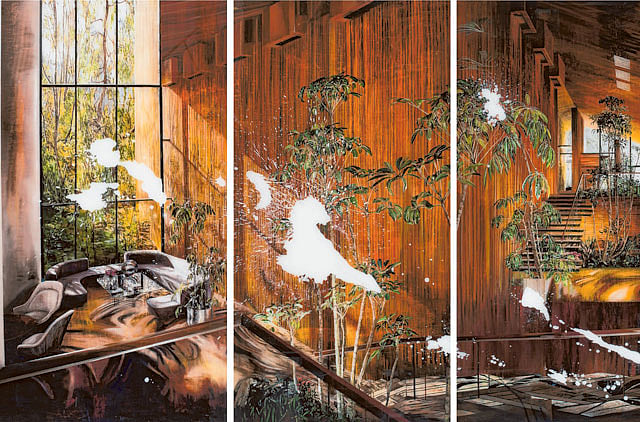
Portuguese artist Gil Heitor Cortesão’s work is inspired by the architecture and urban landscapes of the 1950s and 1960s. His paintings are based on photographs of interiors from that era, but he has re-imagined those spaces to create a new narrative that is tinged with nostalgia and the possibilities of the future.
Cortesão’s second solo show in Dubai, “Coming Home”, features a series of interior landscapes in his signature style of reverse painting on Plexiglas. The paintings are essentially a memorial to modernity created by deconstructing the modernist Utopia of the last century to reconstruct new realities. And the surrealistic spaces depicted by the artist invite viewers to step into an imaginary world.
“I am fascinated by the interiors of the 1960s because they have an atmosphere that reminds me of my childhood. The architects of that time had a Utopian vision of creating new types of urban housing, a new kind of society and a new world. But that vision was never fully realised. So although the spaces that I paint existed during my childhood, they belong to a forgotten past. They were once considered modern and futuristic but are now old-fashioned or even obsolete. I see these spaces as a reminder of people’s belief that things will change, and I keep wondering if that change is still possible and if that incomplete idyllic dream can still be fulfilled,” says the artist.
“There is also an inherent irony in the fact that I am painting 20th-century architecture, because at that time many people believed that architecture was the most complete and ultimate art form as opposed to traditional painting,” he adds.
For Cortesão, the starting point of every painting is a picture of an interior from the 1950s and 1960s. He looks for the pictures in magazines and on the internet, and the ones he selects are usually images of spaces designed by iconic architects of that period and shot by famous photographers. “I look at thousands of pictures and choose images that stimulate my imagination. I play with the images, changing the dimensions of the spaces and adding and removing various elements. My aim is to create a space where viewers can project themselves and experience it in their own individual way. As my show’s title, ‘Coming Home’, suggests, these spaces offer the feeling of returning to a familiar and comfortable place. Yet they are also mysterious and disturbing,” he says.
The first painting in this series, “Platform”, features a foundation slab of a building, surrounded by greenery. The artist perceives the stone as a symbol of the architectural ideas and ideals of the 1950s that were never fulfilled and have been abandoned. And the surrounding greenery expresses the need for integrating nature into urban landscapes. The other paintings in the series feature a variety of different interiors, such as the living rooms of various homes, a ship’s cabin, a private film theatre and a cosy den with a library. The spaces are frozen in time but the artist has used swirls and splashes of paint and the illusion of light streaming in to infuse them with warmth and movement.
Although there are no people in the rooms, one can sense their presence. The chairs in the rooms, ranging from plush chaise lounges and richly upholstered sofas to cosy armchairs and simple garden chairs, say something about the people who might have inhabited these spaces. The soft colour palette and the composition of the paintings give viewers a sense of looking into the past. And in some of the paintings the artist has framed the spaces inside a circle to enhance the voyeuristic feeling of peeping into a private inner space.
At the same time the empty spaces invite viewers to step in and explore. Cortesão has used devices such as a spiral staircase and deliberate blurring of some areas to encourage viewers to use their imagination to go beyond what is visible in the paintings.
Creating these detailed interiors is a complex process, because Cortesão’s technique of reverse painting on Plexiglas involves building up the scene layer by layer, beginning with the last layer. “This process mirrors my theme because it involves deconstruction of the scene into layers and a careful reconstruction. Also because the painting is on the back of the glass, there is a sense of illusion and a duality between what you can see and what you imagine might exist in the layers behind,” he says.
A predominant feature of Cortesão’s paintings is the greenery in the spaces. The artist has expressed his desire to integrate nature into urban living by putting in lots of overgrown plants in the rooms and plenty of greenery outside the windows. In one piece, titled “Hideout”, he has challenged 20th-century architectural ideas, whose prime focus was on buildings, by almost concealing the house behind the trees and shrubs.
A few other paintings also feature outdoor scenes, and one piece, titled “Wonderland”, also features people. It depicts a group of elegantly dressed people sitting around a circular swimming pool in what may be an exclusive hotel or club. A closer look reveals that the two halves of the painting are mirror images, but with a few deliberate differences.
“This painting is based on a 1950s photograph depicting the lifestyle of the rich and famous. By playing with the mirror image to form these ghost versions of the people, I have created a sense of duality. The quirky image makes an ironic comment on the social inequality between the guests and the waiters serving them and the different environments they exist in, highlighting the fact that the idealistic dreams of the 1950s were flawed,” Cortesão says.
The most recent painting in this series does not feature any architecture. Titled, “Detour”, it shows a small pathway leading into a forest. “Maybe this pathway is leading away from a house or towards it. I have left it to the imagination of my viewers to decide whether the structure exists, where it is and what it looks like. It is up to them to rediscover and reconstruct the space in their imagination,” the artist says.
Jyoti Kalsi is an arts enthusiast based in Dubai.
Coming Home will run at Carbon 12 gallery, Alserkal Avenue, until November 1.
Sign up for the Daily Briefing
Get the latest news and updates straight to your inbox
Network Links
GN StoreDownload our app
© Al Nisr Publishing LLC 2026. All rights reserved.