Present and correct in watching China
The shifting of the world's economic centre of gravity to the East is becoming a cliche, but is no less important for that
China is not so much flavour of the month at the moment as favour of the decade, perhaps of the century. It seems to be the ‘special' on everyone's menu, the main item on the potential feast that is Asia's likely contribution to world economic recovery. Not only that, but it can be the focus too of financial leadership in the years ahead, with liquidity surging, enormous foreign exchange reserves at its disposal, and scope seemingly for boundless development and investment opportunity.
Whether it's Davos or Jeddah, international gatherings cannot miss the point: the West's aged, developed economic model has broken its back under the weight of wilfully accumulated debt, whereas the East's vitality is still developing youthfully and apace, in China's case embracing some kind of balanced approach between state guidance and private enterprise, uncannily capturing the spirit of the age even intellectually let alone in practical terms.
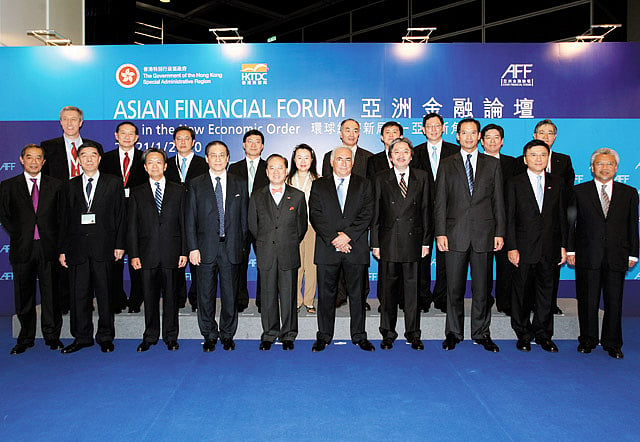
So it's only fair, then, to share the flavour of proceedings at last month's Asian Financial Forum (AFF), held in Hong Kong, a real deal in terms of setting out the issues for all the talking and decision-making ahead. Those issues, after all, are going to take plenty of time to work out.
It was noticeable that Chinese officials adopted a distinctly assertive delivery style at the podium. That was perhaps a matter of culture or training, but in any case displayed no sense of reservation. Also, one speaker mentioned even faster ‘development' to come, which may or may not be same as ‘growth', but is nevertheless indicative of the official intent to keep building one way or another.
The writing, then, whether we choose to take an interest or not, is on the Chinese wall between the past and the future. It would seem important ultimately to any audience, but the relative absence of Gulf participants and attendees at the event is another reason to spread the word here: in a globalised world, diversifying assets and business into an ostensibly sustainable growth story has to be worthwhile.
Maybe that remains a moot point: how sustainable and lengthy is the upward trend? For those interested in the quicker buck, and prepared to accept the risk-reward trade-off which appeared, falsely, to have been suspended in many parts of the globe (especially in property and construction), the chances in China must be tempting if not compelling.
Hong Kong's chief executive Donald Tsang, setting the conference tone, touched on not only the appeal but also the danger on the table when he cited the Asian Development Bank's latest growth forecasts for the 14 emerging East Asian economies including China at 6.8 per cent in 2010, while acknowledging that the gargantuan sums spent globally to shield countries from recession could lead to problems, presumably resulting from monetary and fiscal excess. There have been enough murmurs already about another asset bubble forming.
Dominique Strauss Kahn, managing director of the International Monetary Fund, said he "didn't anticipate that" as such, but was prepared to identify capital flows that might suddenly stop and reverse, and escalating risk appetite that might impact on exchange rates and financial stability across the Asian region. In a double-edged remark, perhaps merely precautionary, he referred to the IMF "looking forward to the next crisis". He noted that "Asian banks have been rather resilient" in the maelstrom of the past couple of years, but effectively turned that observation, like the allusion to Asia's leadership of (multi-speed) economic upturn, into the basis for the continent's newfound "responsibility". China, in other words, is strong enough not only to lead but to bear a burden.
Rebalancing challenge
Clearly, China itself has to be part of identifying the solutions to the evident issues of ‘coordination', notably at G20 level, in a lopsided environment of Western deficits and Eastern surpluses, with the so-called rebalancing challenge also within Chinese borders away from exports towards domestic demand. Certainly, the pledge on that has been plainly uttered; delivery is due.
Is there any doubt as to the task? The IMF would say not. According to Eswar Prasad, professor at Cornell University, writing in the December 2009 edition of Finance and Development, "Asia's export-oriented growth strategy played a role in the global imbalances that have characterised the international economy in recent years and played some role — though how much is hotly debated — in contributing to the global economic crisis … These imbalances remain troubling because if a disorderly adjustment does take place, through a sharp fall in the value of the dollar or a prolonged contraction in economic activity in industrial countries, it will be very costly and disruptive to the world economy."
At the AFF, Lee Jong-Wha, chief economist of the Asian Development Bank, was similarly cautious about the prospect, echoing the several speakers who referred to neither Asia nor the world yet being "out of the woods". The ‘trees' in the way, then, presenting "still substantial risk", were all around, which may be paraphrased as: the uncertainties associated with Western world growth, policy errors, the need for efficient resource allocation in wholesale investment into real sectors, how to promote private sector demand, capital inflows again, how to recycle savings, and global coordination of strategies.
As if that weren't enough caution in the face of China's rampaging performance, Stephen Roach, Chairman, Morgan Stanley Asia, known as a maverick commentator, warned against any sense of collective complacency. "It's not going to be easy for Asia or China", he intoned; "the jury is out on whether this is Asia's moment" given its export dependence and weakness of the US consumer.
The facts were that while 2009 was a very strong year, beneath the surface of China's 7.7 per cent GDP growth rate, 95 per cent of that was accounted for by artificial stimulus, towards investment. That isn't sustainable, given investment at 45 per cent of GDP already, consumption being only 35 per cent (compared to the typical 60-70 per cent in the West), although next year's 12th five-year plan can be expected to seek to adjust that ratio.
Moreover, overseas protectionism is a possibility, with mid-term US elections and political pressure upon the Obama administration, so that frustration may be taken out on China's exported self-projection.
Others preferred to examine the trees more closely rather than worry so much about the wood or any perspective thereon. On the ground in China, the business to be done is not only clear in terms of development catch-up but well supported by established infrastructure. Sir David Brewer, Chairman, China-Britain Business Council, effectively banged this partial drum, noting from experience that "every major city has a financial ‘street', with its [growth-multiplying] ‘cluster' effect; every one has a good airport, with rail improving fast too". The reference had a sting in its tail: "not so in India," he added — though some would see that as an obvious opportunity too.
Knowing the traditional restraints associated with investment in China, not least bureaucratic, others averred that the opportunities, though undoubted, were for the persistent rather than the faint-hearted.
Hong Kong's chance
Meanwhile, Hong Kong itself has a particular role to play, as China's international financial centre in the constitutionally-enshrined arrangement of ‘one country, two systems'.
The ‘internationalisation' of the yuan renminbi is an important tale to tell, in the context of doubts about the US dollar and the general shift of economic gravity from West to East.
With very limited further development potential of its own, Hong Kong has the chance to build on its historic critical mass as both financial centre and commercial entrepot, and operate as a familiar, well-attuned intermediary between China and the world.
Indeed, the Special Administrative region, as it is known, is unabashed in seeking to leverage off the China story.
"Hong Kong has become the most popular place to take advantage of Chinese growth, because of complete capital freedom, while the regulatory structure is globally acceptable," said Lawrence Fok, Executive Vice-President, Hong Kong Exchanges and Clearing. In fact, strategically as an exchange, it is as well to stick with the ‘growth of mainland China' strategy as to seek tie-ups with other exchanges, despite being the world's second-largest international exchange by market cap, he argued.
The financial dimension and Hong Kong's position as conduit has a number of strands. Chief executive Donald Tsang spoke of the wealth management function for Chinese investors overseas. Similarly, Professor K. C. Chan, Secretary for Financial Services and the Treasury, talked about helping Chinese companies to venture abroad, and, as regards the regional economy, in a private meeting, pointed to further integration in the South China Pearl River Delta region (i.e. the hinterland beyond Hong Kong into mainland China).
Hong Kong's markets have tended mainly to be equity-oriented, related to mainland China, but could now diversify, building on existing strength in asset management, with some serious effort in bonds too, at least in pursuit of making a yield curve, Professor Chan explained. Derivatives were already strong, he claimed, while Islamic business is also being built, with efforts to be tax-friendly to Islamic investors, as a matter of market completeness.
But it is the currency factor which catches the imagination, given the global relevance of the rise (as economic competitors far and wide would welcome) of the renminbi.
"Hong Kong will be a testing ground for renminbi products," said Chan. A pilot scheme to use the renminbi in trade settlement is already under way, renminbi deposits will grow, and there have been some small renminbi bond issues already.
He wouldn't say whether that business itself would lead to upward renminbi pressure; it was "just a part of the process of liberalisation". But others on the conference platform took an easily accessible, holistic view: there will, logically, be demand for renminbi assets.
Cao Yuanzheng, Chief Economist, BOC International, made it plain enough: the renminbi — though its dissemination through Hong Kong would be controlled in scale and speed — would become more commonly used around the world, and therefore "more powerful".
So, what about the end-game, namely full renminbi convertibility, implying capital freedom?
The consensus was that that was not really possible while the imperative of ‘stability' prevailed. It would be gradual, taking time, which means the freedom to share in China's economic spoils would — no one would be surprised to hear — be somewhat circumscribed for years to come.
That recalcitrance helps the dollar keep its hegemony, for now, and therefore actually helps keep some semblance of order in a world reeling from readjustments now and pending.
The last word there might rest with Stephen Roach of Morgan Stanley. While others clamour for the renminbi's revaluation, China needs a relatively stable exchange rate while its banking system remains embryonic, he asserted. Moreover, exchange-rate flexibility in the West had not helped solve that region's imbalances!
In any case, reserve-currency status should be based on democracy, he continued, warming to the theme. And, as a parting shot, political reform would follow economic reform… in a Chinese way.
Given like words of wisdom — as ominous and enduring as the assembled journalistic throng was eager and impatient to scribble the latest offhand asides about credit growth aggregates and the percentage chance of double-dip recession.
Hong Kong and the Chinese way
• Hong Kong became a Special Administrative Region (SAR) of the People's Republic of China in 1997. Under the terms of China's 11th five-year programme, Hong Kong is designated the country's international finance, trade and logistics centre. In 2008 Time magazine hailed it as one of three cities (besides London and New York) "driving the global economy".
• As a global banking centre, Hong Kong hosts nearly 70 of the world's top 100 banks, and has the largest foreign banking presence in China. It is home to one of the region's largest stock markets and foreign exchange markets, and is the largest source of overseas direct investment on the Chinese mainland. It is the only financial centre in Asia equipped to handle real-time and end-of-day processing for Hong Kong dollar, US dollar, euro and renminbi transactions. The total size of its fund management industry was more than $740 billion (Dh2,718 billion) at end-2008. With a figure of $81 billion, Hong Kong came fourth in the rankings of centres raising equity funds during last year.
• Renminbi business in Hong Kong was launched in 2004, and has been expanded steadily since then. With the pilot scheme for renminbi trade settlement commencing operation last year, banks participating in renminbi business can now offer a range of renminbi services, including deposit-taking, currency exchange, remittances, credit card, use of cheques, trade finance and renminbi bonds-related services. Renminbi deposits totalled 60 billion yuan by November 2009. There have been 13 renminbi bond issues to date.
• Despite its small population and area, Hong Kong is the world's 13th
• Hong Kong advocates and practises free trade, with no discrimination against overseas investors, freedom of capital movement, transparent regulations, and low and predictable taxation. Its legal system is largely based on the British system. The rule of law, upheld by an independent judiciary, is a cornerstone of its success, providing legal protection for business contracts and intellectual property rights.
• Rapid economic development in China has created a fast-expanding market for goods and services, and a sophisticated production base for manufacturers and retailers. China is not one market but a series of regional markets. Currently, most foreign companies, looking for a low-risk entry strategy into China, concentrate on the Pearl River Delta region (PRD), on the southern tip of the Chinese mainland, which combines the advantages of Hong Kong with quality manufacturing and a growing consumer market.
• Jointly organised by the Hong Kong Special Administrative Region government and the Hong Kong Trade Development Council (HKTDC), the Asian Financial Forum brings together more than 1,000 financial players and leaders from around the world to discuss developments and opportunities in the Asian region.
Sign up for the Daily Briefing
Get the latest news and updates straight to your inbox
Network Links
GN StoreDownload our app
© Al Nisr Publishing LLC 2026. All rights reserved.