Invisible connections
Hesam Rahmanian’s latest show challenges commonly held beliefs about power, life and death
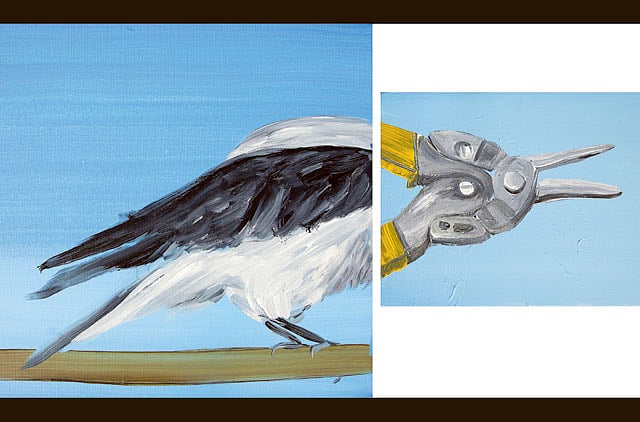
Bullfights, animal slaughter and political arenas are recurring themes in Dubai-based Iranian artist Hesam Rahmanian’s paintings. The title of his latest exhibition, “Now the Dove and the Leopard Wrestle at Five in the Afternoon”, also comes from a poem about the death of a bullfighter written by Spanish poet Federico Garcia Lorca. But the show is not about bullfighting. It is about the life, death and regeneration.
“I love pets, and during childhood I had lots of birds and other animals such as rabbits, turtles and snakes in the house. When any of these creatures died, I would bury them in the garden under a tree. I always chose a tree that had failed to bear fruits or flowers and found that it would soon start blooming and producing plenty of fruit. This childhood observation of the magical cycle of life, death and regeneration and the mystical relationship between the death of one element in nature and the revival of another seemingly unconnected element is the inspiration behind my latest work. Through this work I want to explore the process that leads to creation, death and revival,” the artist says.
The exhibition features acrylic paintings arranged as diptychs, triptychs and larger assemblages, collage works on paper, and a video. An interesting feature of the show is that even the process by which Rahmanian has created these artworks reflects the theme of death and resuscitation. The artworks are as surrealistic as the title of the show. They invite viewers to explore the relationships between diverse unconnected elements and between the pieces and the process by which they were created.
For instance, a collage, titled “Dream”, comprises several paintings and a video spread across an entire wall of the gallery. The video (presented in a bird-house-shaped box) is a documentation of the events following the death of the artist’s parrot last year. It shows him burying the parrot in a pot containing a tree with no flowers, and ends with a shot of the same tree blooming with flowers six months later. The assortment of paintings includes canvases of different sizes featuring subjects that include birds, trees, a fisherman, a ladder, clouds, a fried egg and a portrait of the artist with his back to the viewers.
The artworks seem to have no connection with each other, but there is an unseen relationship that exists between them and links them to the theme of the show. In his studio, the artist has been working on a huge painting on a tarpaulin covering a wall of the room. He also incorporated into this piece some old, discarded paintings that did not fit into any specific theme. Although the tarpaulin is not displayed in the gallery, Rahmanian has placed the canvases exactly in the same locations they occupied on it. Thus, although each of the artworks has its own story and has no direct connection with the other pieces on the wall, the unseen tarpaulin binds them together, giving them a new life and meaning. “The paintings represent images we see in our dreams that seem random, but are deeply connected with our lives and subconscious thoughts and feelings. I want to invite viewers to create their own stories about these images and conjure their own logic for the relationship between them,” Rahmanian says.
Similarly, Rahmanian has also mixed and matched new and old paintings of different subjects and sizes to create a set of interesting diptychs. A painting of a headless crow is aligned with a smaller canvas depicting a pair of pliers, making them look like the crow’s head and beak, and thereby imparting life to an inanimate object. Other similarly connected pieces include a flower forming the hair of a woman, a hat on a hanger completing the headless body of a cow and a clothes peg coming to life as the head of a dog. The artist is also displaying some collages created from pieces cut out from earlier paintings. “In life things are created and destroyed and the destruction of one element could lead to the creation of something else. Similarly, I created these paintings, discarded them and then brought them to life again in a different form,” he says.
In his collages on paper, he has taken the process of art creation even closer to his theme of life, death and regeneration, by using the leftover dried paint scraped from his palette to create new works. The multicoloured peelings of paint have been presented as birds, butterflies, a chameleon, an octopus and various human figures. “Often I can see these shapes in the dried paint, but sometimes I also play with the globs of colour to appropriate them for my collages. Through this process I have given a new life to dead paint, which would have otherwise been thrown away,” the artist says.
The show also includes two assemblages featuring portraits of some of the most powerful leaders in the world as viewed from behind. By including a painting of the backside of a zebra in this collage, Rahmanian once again challenges viewers to think about the connections between these images and the concept of power itself, underlining the essence of the show — which is the breaking-down of dearly held ideas, beliefs and concerns and the reconstruction of something new.
Jyoti Kalsi is an arts enthusiast based in Dubai.
The show will run at Gallery Isabelle van den Eynde until February 28.
Sign up for the Daily Briefing
Get the latest news and updates straight to your inbox
Network Links
GN StoreDownload our app
© Al Nisr Publishing LLC 2026. All rights reserved.