The Simpsons years
Matt Groening sits atop a much loved billion-dollar industry
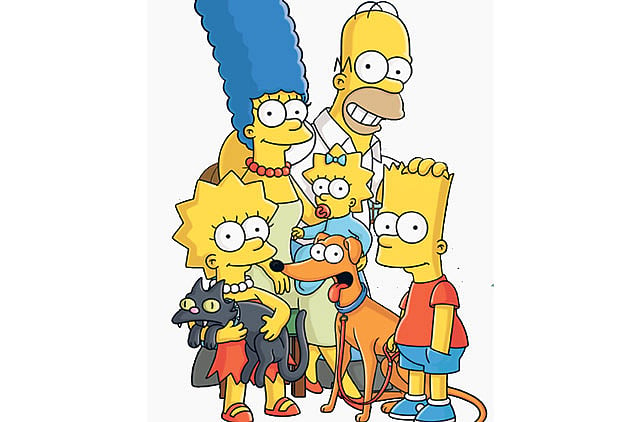
Once, a long time ago now, a couple called Homer and Marge had a son. Later on, this boy would be joined by two sisters, Lisa and Maggie. But first of all Homer and Marge had to decide what name to give their new son. So they ran through a list, drew up their favourites and eventually plumped for Matt.
Fifty-five years on, Matt Groening is in Cannes to receive a clutch of awards to mark The Simpsons' 20th anniversary.
Cannes has gone Simpsons-mad for the occasion. The hotel that Groening is staying in is bathed in a sulphurous yellow glow at night — the same colour as the family's skin — while huge posters of Homer, Maggie, Bart et cetera stare down from billboards all over town.
Groening himself is an unlikely looking focus for all this attention. A burly man in baggy jeans and short-sleeved shirt with curtains of greying hair on either side of his face, he gazes around, blinking uncertainly behind his round glasses.
He appears to be a little dazed by all the attention and also genuinely thrilled by it. For the past 20 years, Groening has scarcely paused to drink in the plaudits. Along with the team of 50 or so people that produces The Simpsons, he's kept his head down, working obsessively away.
But in that 20 years, something extraordinary has happened. What started life as a doodle on an office pad, a fictionalised version of Groening's own family, has turned into the most identifiable family in the world. It's also become the longest-running comedy in television history. Everyone from Beijing to Baton Rouge has succumbed to The Simpsons' magic.
Back when he made those first tentative sketches, Groening was Bart he only stopped short of calling the character Matt because he thought it would be unduly egotistical. Instead, he plumped for an anagram of brat. Now, two decades on, he's found himself turning into Homer not just the character, but also to some extent Homer Groening, his father, also a cartoonist.
If this wasn't complicated enough, Matt Groening has a son called Homer, although Homer Groening junior now prefers to be known as Will.
When, in 1985, Groening was first asked to come up with ideas for little cartoon interludes on The Tracy Ullman Show, the initial proposal was that Groening should produce an animated version of Life in Hell, his newspaper strip about a group of morosely dysfunctional rabbits.
While he sat waiting to go into a meeting with the show's producer, James L. Brooks, Groening suddenly became worried he might lose the copyright to Life in Hell if he turned it into a cartoon. It would be much safer, he figured, if he came up with something else.
The beginning
So he took out his pen and started frantically sketching away. By the time the meeting started a few minutes later, The Simpsons had taken rudimentary shape. As the slots he had to fill were only 15 seconds long, they didn't offer much opportunity for creative experimentation at least they didn't appear to. But Groening didn't just have an exuberantly rich imagination; he had grand ambitions to match. "I always had this fantasy that the cartoons in my head would be liked by other people," he says carefully parting his curtains of hair. "At the same time, I was this underground cartoonist whose career thus far offered absolutely no clues that anything like that was going to happen."
Shortly before that first meeting, Groening had been reading a magazine article about the three most iconic images of the 20th century. One was the CBS logo, another was Hitler's moustache and the third was Mickey Mouse. "When I came up with The Simpsons, that was a very deliberate attempt to follow in the footsteps of Walt Disney. For instance, I made Bart like Mickey Mouse in the sense that he would always be recognisable in silhouette. It was the same thing with the yellow skin. That wasn't my idea one of the early animators did it.
"At first, I didn't like the idea, but then it occurred to me that if anyone happened to be idly watching the television and they caught a glimpse of this very distinctive yellow, they'd know exactly what they were looking at."
From the start, Groening was adamant that this was to be a world with clearly defined parameters. "Yes, crazy things could happen to the characters, but they had to react in the same way that a person would react in such a situation. When they hurt themselves, they really feel pain. This was my golden rule."
To everyone's surprise his 15-second slots for Tracy Ullman proved hugely popular when they started airing in 1987.
The fledgling Fox Broadcasting Company decided to commission a Christmas show and on December 17 1989, The Simpsons appeared in their first half-hour special, Simpson's Roasting on an Open Fire.
It didn't take long before The Simpsons became a colossal hit. "The first time it really struck me was when I was building this house. I visited it one day and there was this Bart Simpson graffiti on the side except that nobody knew I was the owner of the house. There was Bart graffiti springing up everywhere."
Groening lives well, if not lavishly, in Venice Beach, Los Angeles, a short drive away from The Simpsons' production office. He has presided over almost 450 shows so far and still has a few ambitions left unfulfilled. "My ultimate goal is to offend every country in the world."
Sometime in the next few years The Simpsons will take a final bow, although he insists he can't yet see the end in sight. When Bart skateboards off into the sunset for the last time, Groening says he'll feel sad, even bereft, but he won't repine for long — he'll just get stuck into something else instead. "I don't know what else to do with myself. That's the truth." Groening leans forward, looking at my tape-recorder. He shakes his head. Then he pulls out his wallet and gives me his card. "If you need anything else, let me know," he says. "I used to be you, you see."
The "Shamsoons"
The Simpsons got a little local flavour in 2005 when MBC decided to adapt the hit US series for UAE audiences, calling the series Al Shamshoon and dubbing the series in Arabic. Homer became Omar, Marge became Mona and Bart became Badr.
And that is not all. Homer (Omar's) favourite beverage went from being Duff to cola, Moe's bar ceased to exist, and any scenes with pork in were deleted or adapted. Donuts turned into Arabic pastries. But, to the relief of audiences, Omar's (Homer's) still used his famous catchphrase, DOH!
The Simpsons season three and four executive producer Al Jean slammed the adaptation, saying it was not The Simpsons if Homer was not a beer-drinking "pig".
Voices for the characters were provided by leading actors including Egyptian film star Mohammad Heneidi as Omar. The Simpsons' hometown of Springfield became Rabeea (Arabic for Spring) and was made to look like an American town with a major Arab population. The series did not fare well and only 34 of the 52 Arabic episodes aired. The show is now simply subtitled into Arabic for local viewers.
- Staff Report
Sign up for the Daily Briefing
Get the latest news and updates straight to your inbox
Network Links
GN StoreDownload our app
© Al Nisr Publishing LLC 2026. All rights reserved.