Seen, yet distant
An unusually private woman with extraordinary public duties
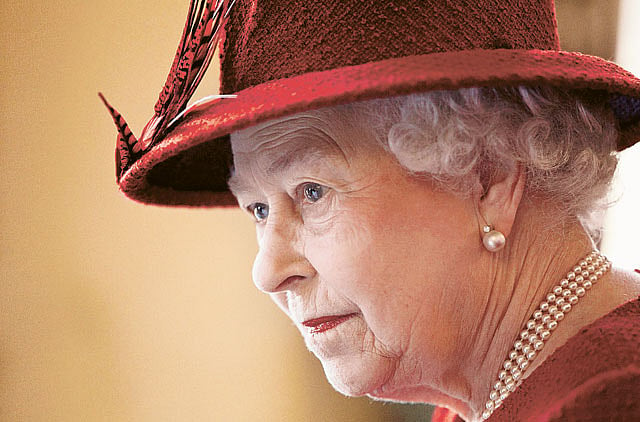
Being on show is a serious business for Queen Elizabeth II who acceded to the throne 60 years ago last month. On royal tours and walkabouts, she is careful to choose bright colours and small-brimmed hats, glides through crowds "like a liner" and seemingly never tires. "Oh look! She's keeled over again," the queen once noted at a stifling-hot palace reception, spotting her then prime minister, Margaret Thatcher, pale and slumped in a chair.
On several occasions she has been urged to retreat behind more obtrusive layers of security. Each time she has refused with something between a joke and a motto for her six decades on the throne, telling aides: "I have to be seen to be believed."
Yet for the 85-year-old monarch, belief requires distance, too. Younger generations of royals have kissed and told. But the queen has never given an interview. Though some of her 12 British prime ministers were convinced they forged a special bond during weekly audiences with their sovereign, her personal politics remain unknown.
Over the years, various aristocrats, cousins and horse-racing grandees have been more or less plausibly identified as her friends. Even among such intimates, boundaries are observed, for fear of crossing an unseen line and triggering a stare of blank, silent rebuke.
"She is never — you know — not the Queen," advises an unnamed friend, quoted in the opening lines of a new biography by the BBC's senior political interviewer, Andrew Marr.
Yet as a constitutional monarch, ruling with the tacit consent of the majority, she is not the only judge of the trade-off between necessary display and indispensable discretion. The public have a say as well. Some of the queen's closest brushes with disaster have involved a lack of visibility, most painfully in 1997 when she remained in Scotland with the royal family after the death of Diana, Princess of Wales. She only returned to London after pleas from her new, young prime minister, Tony Blair.
The double nature of the queen — an unusually private woman with extraordinary public duties — poses a test for all who try to write about her. Including Marr's book, five new biographies have been prepared for 2012, the queen's diamond-jubilee year. The authors boast of watching the queen at work, interviewing officials from the royal household and of trawling through archives. They quote family members, friends and people with a claim to know the queen.
Sarah Bradford and Robert Lacey are veteran royal historians whose 2012 biographies draw on previously published work. With the frankness of an old pro, at one point Bradford names different schools of royal-watching. There is the "work of the Queen" genre, as pioneered by the 1969 television film Royal Family, which showed the monarch working through boxes of state papers, preparing state visits or relaxing with her family. Alas, she explains, once the public had seen inside royal drawing rooms, they soon wanted to peer into the bedroom. Thus arose the "royal soap opera" genre.
Bradford takes readers on a brisk, assured canter through the familiar landmarks of both genres, adding a dose of history as she goes. Lacey, who has been writing about the queen for nearly 40 years, advertises his slim volume as a "pleasant afternoon's reading", which it is not. At once knowledgeable and jaundiced, Lacey seems slightly sick of his royal subjects, as do the unnamed courtiers and insiders whom he quotes.
Marr, a former political editor of the BBC and author of some shrewd books on modern Britain, sets himself a more ambitious task: to explain what the queen's role and position tell us about her subjects. It is an admiring portrait, of an unfashionably dutiful monarch who in her weekly audiences offers prime ministers what he calls "a kind of higher therapy" — a chance to share anxieties or explanations which will never leak, with someone who has read almost every state secret of the past 60 years (and so has heard worse before). He describes the queen and her strong sense of vocation, as a monarch "God-called" to give her life to her people as a sacrifice. Only by understanding that calling, he writes, can the queen be understood.
In perhaps a claim too far, Marr emphasises the comfort offered by the queen as a symbol of the continuing British state. By representing those who did not vote for the current government or did not vote at all, she strengthens democracy, he suggests. It is a clever thought, but may overstate the degree to which most Britons suffer from constitutional angst.
But a symbol she certainly is. And in modern Britain — a restless, exhibitionist place — Marr's Queen Elizabeth stands out for her discretion, and for understanding that symbols are "better off keeping mostly quiet". There is a lesson there for her heir, the Prince of Wales, Marr suggests sharply. Marr palpably likes the queen, whether for touring the country to greet and thank people mostly ignored by "London power brokers", or for relaxing when her work is done with "a glass of something cheerful". Yet liking is not really the point. In Marr's words, there is only a little space, though "an interesting space", between the queen and the woman who lives her life. Her calling gives her meaning. She "is what she does".
Marr's sober conclusion feels right. To adapt the queen's one-liner: for all that the spectacle and unattainable glamour of royalty still fascinates, for Britain's jubilee monarch the show is a means to an end. Being seen is about being believed.
The Diamond Queen: Elizabeth II and Her PeopleBy Andrew Marr, Macmillan, 400 pages, £25
Queen Elizabeth II: Her Life in Our TimesBy Sarah Bradford, Viking, 305 pages, £20
A Brief Life of the QueenBy Robert Lacey, Duckworth Overlook, 166 pages, £9.99
Sign up for the Daily Briefing
Get the latest news and updates straight to your inbox
Network Links
GN StoreDownload our app
© Al Nisr Publishing LLC 2026. All rights reserved.