Nicholas Kristof: A campaigner of change
Nicholas Kristof feels the abuse of women is an outrage on par with slavery and genocide
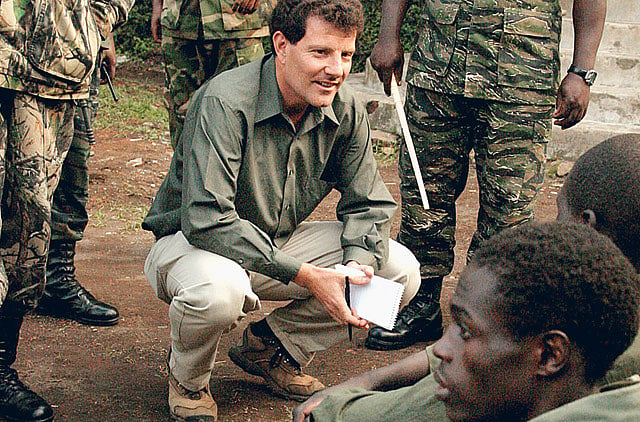
Nicholas Kristof is not the kind of person you would expect to be a slave owner. As a columnist on the New York Times, he belongs to an elite within an elite, the embodiment of journalistic seriousness. Yet there he was, in 2004, blithely forking out $150 for Srey Neth and $203 for another teenager, Srey Momm; handing over the money to a brothel keeper. Nick Kristof: double Pulitzer prize winner, bestselling author, slave owner. But that, as is made clear in his new book, written with his wife Sheryl WuDunn, is just the start of it.
At the time of his purchase, Kristof had been travelling to a wild and dangerous part of north-western Cambodia and had checked into a hotel-cum-brothel in the town of Poipet. He arranged to see Neth, who had been in the brothel for a month, having been sold to its owner by her own cousin. Kristof arranged to buy her and Momm from a different brothel. He took both girls back to their villages and, with the help of an American charity, attempted to ease them back into society.
Extreme measures
The story of Neth and Momm is just a small indication of the lengths Kristof and WuDunn are prepared to go to expose the injustices that they see in the modern world. Buying up child prostitutes is pretty extreme but no more than the message they are seeking to deliver in their groundbreaking book, Half the Sky.
In it, they argue that the world is in the grip of a massive moral outrage no less egregious in scale or in the intensity of despair than the African slave trade of the 18th and 19th centuries or the genocides of the 20th. They believe this outrage is a key factor behind many of the most pressing economic and political issues today, from famine in Africa to terrorism and climate change. Yet they say the phenomenon is largely hidden and passing relatively unreported. At worst it is actively tolerated; at best it is ignored.
The fodder of this latter-day trade in human suffering is not African people but women. Which is why they call it "gendercide". If the supreme moral challenge of the 19th century was slavery and of the 20th century the fight against totalitarianism, then, they write, "in this century the paramount moral challenge will be the struggle for gender equality in the developing world".
Their disturbing conclusion seems all the more powerful for being reached at the end of what they call a "journey of awakening". WuDunn and Kristof date the start of their journey to Tiananmen Square, which they covered for the New York Times. "We were horrified by what we saw in Tiananmen," WuDunn says. "But then we went roaming in the countryside afterwards and started finding all this stuff we had never heard about: the infanticide, with 30 million baby girls missing in the Chinese population."
They realised with a jolt that, every week, as many infant girls were dying in China through lack of access to health care as the up-to-800 protesters who died in Tiananmen.
Kristof received a further shock in 1996 when he came face-to-face with girls being trafficked for sex in Cambodia.
Gradually, they began to see this great global disaster more clearly, discovering that, every year, at least two million girls worldwide disappear because of discrimination. They began to investigate and chronicle its various forms, from sexual slavery to honour killings of women deemed to have disgraced the family, to rape as an extension of war, to genital mutilation, to the less violent but no less damaging exclusion of women from health services and education. They widened their net from China to India, Korea, Japan and then Africa.
The dawning recognition that they were confronted by nothing less than a modern form of global slavery, with women as its victims, has had profound personal and professional implications for them both. Above all, it has demanded a rethinking of the function of their writing. If you are convinced you have stumbled across an enormous moral outrage, you cannot merely cast light on the subject. You have to do something to stop it. You have to effect change.
Inspiration for action
That is what makes their book — named after the Chinese saying that women hold up half the sky — so unusual, not just in its heart-rending contents but in its steely determination and sense of purpose. From the opening pages, WuDunn and Kristof make an unashamed pitch for the reader's support and engagement. No on-the-one-hand-this and on-the-other-hand-that.
The ambition to inspire us to action, to foment what they call a modern abolitionist movement, informs every page of the book. It is not just evident in the direct appeals they make; it is also present in the way they manage their information. Specifically, they wanted to avoid a numbing effect where readers would become so overwhelmed by the grimness and apparent hopelessness of the lives women lead that they would sink into depression, rather than leap into action.
So WuDunn and Kristof studied psychological papers on what gels people to participate and discovered that statistics are particularly bad as motivational tools. By contrast, focus on individuals is key.
As well as focusing on the personal, the authors relentlessly accentuate the positive; constantly firing out examples where terrible wrongs have been overcome, proving that seemingly immutable problems can be shifted.
"The research stresses the importance of the positive," says Kristof. "People want to be part of something that is successful and that's one reason why, even though a lot of the stories we profile plumb some really desperate moments, we also try and show it is possible to make a difference. ... We followed research in terms of writing in a way that would engage people, and Half the Sky was a kind of experiment in trying to use these approaches to reach a broader audience. From that regard, I think it worked remarkably."
Sign up for the Daily Briefing
Get the latest news and updates straight to your inbox
Network Links
GN StoreDownload our app
© Al Nisr Publishing LLC 2026. All rights reserved.