Attitudes etched on mirrors
Al Braithwaite's works challenge Western stereotypes and bridge the East-West divide
British artist Al Braithwaite has a long relationship with the Middle East and a good understanding of its culture and thinking. The London-based artist's work often confronts Western stereotypes and biases to present a balanced perspective on contemporary issues. His latest exhibition in Dubai, titled Transgressions, is also about crossing boundaries and bridging divides to find a position of equilibrium. The show references events such as 9/11, the War on Terror and the Arab Spring to stimulate discussion and rethink various socio-political issues.
"This body of work is transgressive in the sense that it attempts to cross physical, ideological or conceptual divides. I have deliberately displaced and relocated familiar objects and sights to present them in a new context. The idea is to offer many different points of view and encourage people to be open and to rethink extreme positions on various issues," Braithwaite says.
In his Hall of Mirrors series, portraits of iconic Middle Eastern figures are etched on the surface of mirrors. The drawings are childish scrawls done with crayons, marker pens and pencil to suggest an innocent and open child-like worldview. But they are hung in antique gilt frames that were originally used to display grand, classical paintings of European kings and generals in museums and palaces.
"This series comments on our struggle to reconcile the past with present geo-political realities. These frames have a set usage in history and I am trying to bring in a new context by recolonising them with contemporary oriental figures. Also, when you look in the mirror, you see not your own face but that of somebody who could be a hero or a villain, depending on your point of view," he says.
Braithwaite's Khefiyeh series also features mirrors in antique frames. But the mirrors are covered with real feathers trapped behind aviary netting. The pattern created by the feathers resembles a traditional Palestinian headscarf and each piece in this series is named after a Palestinian village destroyed during the war in 1967. The artworks make a poignant statement about the plight of Palestinians, the radically different perspectives on the subject and the need for a peaceful solution.
In another set of works, Braithwaite plays with familiar phrases used by the media, to comment on the manipulation of our opinions and perceptions, and the multiple interpretations of a situation. The phrases, written in mirror writing, challenge us to look carefully and think again about things we feel we know very well.
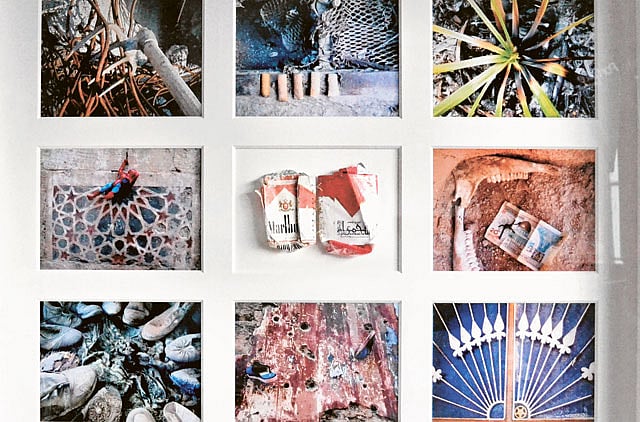
Braithwaite is also showing a series of collages titled Panopticon of Poetic Rubbish that highlight the political, religious and ideological divide caused by the 9/11 bombings and the need for a dialogue to bridge the gap between the extreme positions taken by various groups. At the centre of these collages are twinned objects, such as packets of cigarettes or cough drops with English and Arabic labels, that have been stitched together.
These "twin towers" are surrounded by photographs of unlikely objects put together to create a new context. The images are the result of interventions by the artist to place various found objects in improbable locations, representing a dialogue between East and West, traditional and modern, violence and pacifism.
"I do not like the binary language of ‘either you are with us or against us' in the War on Terror. I want to mediate between extreme positions, create crossover points and tell people to find a middle path of tolerance," Braithwaite says.
The centrepiece of the show is titled Capsule. It is a handmade wooden cabinet with a motif on the doors inspired by an architectural detail from the destroyed World Trade Center in New York. It is filled with paper spheres that are actually scrunched-up pages from Leo Tolstoy's War and Peace, placed in the correct page order.
"Tolstoy's book describes a different period in history, but its theme is timeless and universal. By drawing parallels between the past and a conflict of our times, I am looking at how the passage of time affects the way we view history and come to terms with trauma. The entire text of the book is present in this work, but it is concealed or encapsulated — perhaps to be reconsidered in the future," Braithwaite says.
Transgressions will run at XVA gallery, DIFC until February 13.
Sign up for the Daily Briefing
Get the latest news and updates straight to your inbox
Network Links
GN StoreDownload our app
© Al Nisr Publishing LLC 2026. All rights reserved.