A bird’s-eye view
Life-changing experience for the pilgrim and a spectacle of profound abstract geometries for the artist
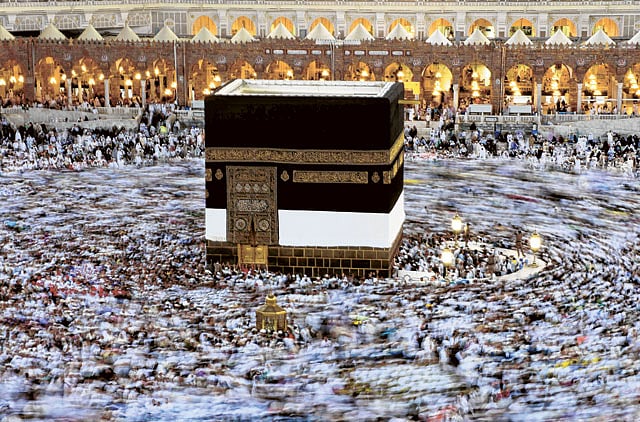
The Haj — the once-in-a-lifetime pilgrimage to Makkah — is very much a growth industry. In 1932, 20,000 pilgrims made the symbolic journey, the fifth pillar of Islamic obligation. This year, the faithful will number more than 3 million. One of the striking aspects of this eye-opening exhibition at the British Museum is the way that the yearly mass migration invokes profound abstract geometries.
The anti-clockwise currents and eddies of human bodies around the great black stone of the Ka'aba, each pilgrim shuffling to complete the necessary devotional seven laps, is a gift to time-lapse photography. You come away with perfect cubes and the circular motion of a white-robed tide of humanity imprinted on your retina. The sight, even on film, of the weeping millions on the Plain of Arafat, every contour of the central mountain moving with bodies from across the globe, is perhaps the most powerful spectacle of the physical attraction of faith the world has to offer.
Every time a devotee turns to pray to Makkah, this sacred cartography is invoked. The concentric rings of orderly submission gesture to an all-powerful centripetal force. The Saudi artist Ahmad Mater Al Ziad makes the obvious but perfectly executed analogy of magnetism to describe this global force field. In one corner of the show, he has recreated his celebrated piece in which a black cube of magnet draws its attendant iron filings into Haj-like patterns of devotion on a sheet of white paper. Some of the chips of metal lie prostrate; others are held quivering upright.
Idris Khan, the young Birmingham-born artist, has created two similarly simple pieces. At the entrance to the old Reading Room, which houses the linear progression of the exhibition, he has placed 49 cubes of black marble, each face sandblasted with a Quranic verse.
Bookending the show is another piece by Khan called I Was Here for You and Only You, in which devotional mantras and spiritual questions — "Are you leaving as you had come?" — directed to pilgrim and gallery-goer alike have been painstakingly applied with a child's rubber-stamp set, like thousands of black spokes of a wheel around the inevitable hub.
In taking the commission, Khan, of Welsh and Pakistani parentage, described how he was moved by the life-changing effect of the Haj on his father. His two pieces are a nice testament to some of that paternal emotional mystery. The hand-printed piece is displayed alongside a taped loop of British Muslims talking about their experience of the Haj.
The Yorkshire and home counties accents are inflected with unashamed awe and wonder. "I felt like I was moving towards a centre of silence," says one; "You feel at a new level of closeness to Him," says another. At the Plain of Arafat, many say, they were reminded, in the 45-degree heat, and amid the millions, of how they would leave this world alone. These voices in the dark become hypnotic, fading to the mantras of Khan's devotional spirograph: "What am I going to sacrifice to God, in my life?" they ask.
Sign up for the Daily Briefing
Get the latest news and updates straight to your inbox
Network Links
GN StoreDownload our app
© Al Nisr Publishing LLC 2026. All rights reserved.