Two weeks and Dh1m to play the market
Competition puts students through Dubai stock trading drill with virtual resources
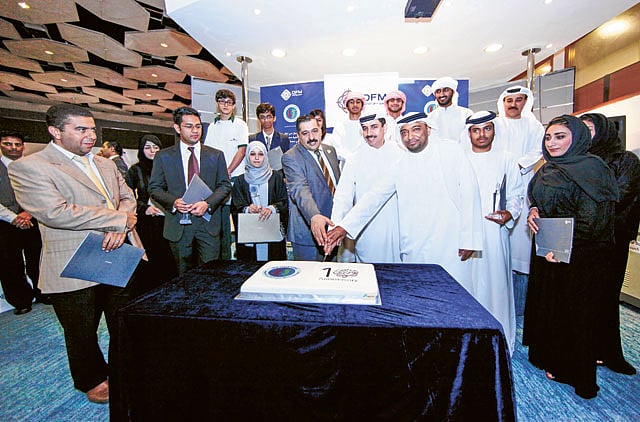
Unlike many of the professionals, Kawthar Fernini, defied the market and walked away with a profit of Dh154,000 at the end of this year's Dubai Financial Market's stock market game.
"I had to be on my feet and had to constantly track the movements of the stocks," said Fernini who eventually made a profit of more than 15 per cent on the virtual Dh1 million she had to trade for 11 days. She will be graduating this month with a degree in human resource management from UAE University. This was the Algerian student's second attempt at the competition. Last year she came in seventh.
This year, the students had to use real-time values to execute orders. Also, a single-buy order or multiple orders for any company could not exceed the offer volume for the same company.
Real-time learning
For many of the students, the 11 days of short-term trading was frantic as they had to make quick decisions on selling, buying and holding, based on news reports and research on the companies.
"The game teaches students not just the risks and the benefits of investing in the stock markets, but how to deal with real market situations," says Jamal Ebrahim Al Khadar, senior vice-president, human resource and strategic planning at DFM. "They learn how difficult it is to execute the second order after buying a share for the first time and [seeing] the market [go] down." The top 13 students not only made money on their virtual investment but they were successful in beating the index by a healthy margin. The DFM General Index, in two weeks — from April 16 to April 30 — of the contest, had declined 2.7 per cent and the average return of the winning students was a positive 7.1 per cent.
The market was highly volatile. Some of the stocks they chose declined for consecutive days, and then recovered a bit and some fell again.
"I bought some stocks of DIC and Gulfnav initially and sold some of them, but then started losing out when Tabreed and Tamweel started going down," said 22-year old Lamia Yousuf, an Emirati who is pursuing a bachelor's degree in business management at the American University in the Emirates. Tabreed, she said, saw too much fluctuation but within days also recovered and gave her a considerable profit.
Not very different were the first-day choices of Laeeq Al Deen Ahmad, a 22-year-old Pakistani second-year student of travel and tourism at Skyline University College. Based on technical and fundamental analysis he found Gulf Navigation, Union Properties, Tabreed and Aman reasonable to invest, he says.
Getting over losses
Ahmad said he was completely devoted to the game, signing in right at 10 am and withdrawing himself at 2 pm. "There were situations where I went into big losses and to cover up the only option available was to closely observe the market and switch deals," he said.
Yousuf did not have the luxury of monitoring the stocks continuously for four hours. "I didn't take off during the game as we had our regular classes. Whenever we had some free time we would sit together in the student lab and play the game. Our professors would also join us," she said.
The students also learnt that they needed steady nerves to handle losses.
"The name sounds like it's a game but when you are on the screen and when you have floated all your finance in the market it becomes very stressful," said Ahmad. "Many a times I invested and within a few minutes those shares started dropping rapidly."
On the last day, he lost Dh2,000 in the last few minutes. However he was able to make a profit of close to Dh93,000, coming in third.
Fernini, who made substantial gains on the final day on stocks such as DIC, Aman, Aramex, and DFM, admitted she is not too comfortable with the pressure of constant buying and selling in the short term.
"I was nervous for the four hours of trading. It was a challenge. Only when the session ended at 2 pm could I feel a bit relaxed."
However, she added that when staring at losses, rather than panicking and selling the losing stocks immediately, she would wait for a day to see where the stock was headed. Giving the example of UPP, she said that it stayed at the same price for three days, before it went up.
"Initially I used to get a bit tense when I lost the money," said Yousuf, who participated for the first time this year. Later on she learnt to be more relaxed about dealing with her losses. At the end of the session on April 30, she made a profit of Dh58,000, coming in sixth in the competition.
One of the youngest participants, 15-year-old Dara Bahour, a student of grade 10 at Deira International School, saw his profits go down by Dh20,000 on an investment he made on Air Arabia. He sold its shares half way through the contest, failing which he would have lost more.
"There is no point in getting stressed when you lose," Bahour said. "However when you lose you should learn the reason why you lost. Also you have to try to minimise the loss or try to recover it." Bahour made an overall gain of Dh78,000 on his two main investments of Tamweel and Tabreed and ranked fourth in the contest.
Career option
Juma Mosabah, 29, an Emirati student of human resource management at American University in the Emirates, observed: "To be honest I was not scared, just too excited to see such a huge amount of money and investing it in the market." At the end he made also made a substantial profit and came in seventh. For some, trading might now well be a career option in the future.
"Playing this game has made this career as an option for me," Yousuf said. "I am yet to decide on what career I will choose and yes equity investments is one of them."
Ahmad is keeping his options open and will decide in his final year which path to opt for.
Once she gets a full-time job, Fernini doesn't mind allocating some of her savings for stock market investments. "But I would rather be a long-term investor than short term," she said.
Better left to the professionals
Research has shown that average individual investors get it wrong when investing in markets. Investing should be better left to professionals, who have the skills and time for the purpose.
According to Professor Terrance Odean, a behavioural economist at the University of California, Berkeley's Haas School of Business, and who has studied the average investor for nearly 20 years, "The institutional investors are the pros who show up in that backroom every day, and that's how they make their living," Odean says. "When you start trading actively, you are betting you are going to outsmart the pros, who are historically smarter."
"I do think that people make money in the market through skill, but those people are not part-time, amateur investors," he adds.
But among professionals too, overconfidence does creep in and they also get it wrong many times. Says Binod Shankar, a former finance professional and currently the managing director of Genesis Institute in Dubai, says, "The illusion that they have control over investment outcomes, the illusion of knowledge, task familiarity, contribute to their thinking that they must be right. Also, company management feeds such analysts only positive information plus the ‘Anchoring' bias wherein analysts are reluctant to move from their initial estimate. Thus it's not surprising why so many professional investors [also] get it wrong."
But he adds that in inefficient markets, there are lots of mis-pricings that can be exploited and so professional investors with their fundamental approach can make abnormal returns for some time and beat the market.
Sign up for the Daily Briefing
Get the latest news and updates straight to your inbox
Network Links
GN StoreDownload our app
© Al Nisr Publishing LLC 2026. All rights reserved.