Pakistan must seek inflation cure
Priority is to ensure security of country's financial system
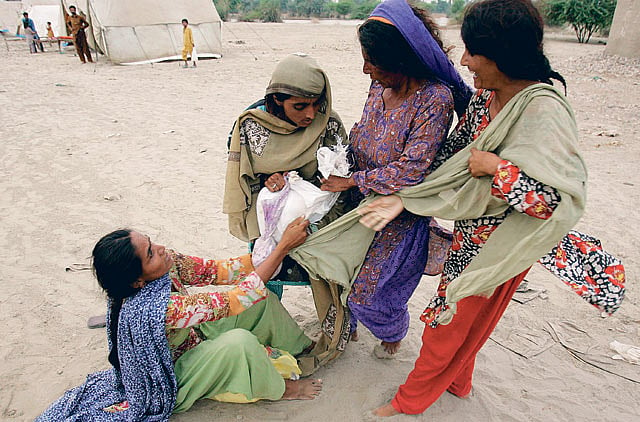
Islamabad : Pakistan's new central bank Governor Shahid Kardar said his primary task is to cool Asia's highest inflation rate after the nation's most destructive floods swept away crops and roads and inflicted $7 billion (Dh25 billion) of damage.
"My priority is to control inflation and ensure soundness and security of the financial system," Kardar, 57, said in a telephone interview yesterday.
Kardar, a director at the Royal Bank of Scotland Pakistan, will replace Syed Salim Raza, who quit in June. He will take charge at the State Bank of Pakistan on September 14 for a three-year term.
Revival needed
Oxford University-educated Kardar needs to revive an economy already undermined by terrorism and falling foreign investment before floods struck the nation on July 22. Prime Minister Yousuf Raza Gilani on September 1 said the disaster will cut gross domestic product growth to 2.5 per cent in the year through June, two percentage points less than a government target, and stoke inflation to as high as 20 per cent.
"It will be a challenging job for the new governor," Ayub Humayun Ansai, an analyst at Invest & Finance Securities Ltd., said in Karachi before Kardar's appointment. "The post-floods scenario will be tricky to deal with — supporting growth and controlling inflation at the same time isn't easy."
The cost of insuring Pakistan government debt is near a four-month high. Credit-default swaps on Pakistan government debt had increased by 329 basis points to 829.5 basis points between July 31 and September 6, according to data provider CMA. The last time they traded at a higher level was on May 26, when the contracts closed at 840.9 basis points.
Pakistan's inflation rate may climb from 12.34 per cent in July as the government estimated the floods to have destroyed $1 billion of crops, causing shortages.
Consumer-price gains in the South Asian nation are the highest in Asia Pacific, according to data from 17 countries in the region tracked by Bloomberg.
Agriculture report
Pakistan will harvest 4.4 million metric tons of rice in the year starting November 1, down 35 per cent from the previous year, according to a report by a unit of the US Department of Agriculture.
Kardar is a chartered accountant who studied politics, philosophy and economics at Oxford. The central bank is scheduled to release the next monetary policy statement in the last week of September. The State Bank of Pakistan was led by Deputy Governor Yaseen Anwar since June, when Raza quit. Anwar raised rates by half a point to 13 per cent on July 30, describing the move as a response to "risks to the inflation outlook."
The Food and Agriculture Organisation has called for funds to replace half a million tonnes of wheat seed stocks depleted by the floods, with planting of the staple due to take place over the next three months.
Gilani said this month 4,000 kilometres of roads and 1,000 bridges were washed away, pushing up the cost of delivering goods and services. He said inflation may climb to between 15 per cent and 20 per cent, and estimated total losses from the natural disaster at $7 billion.
Flows in the Indus River basin reached 10 times their normal monsoon season levels, racing south through Punjab and Sindh provinces.
Toyota Motor Corp. and Unilever affiliates in Pakistan said last month the disaster may sap growth and force production.
Sign up for the Daily Briefing
Get the latest news and updates straight to your inbox
Network Links
GN StoreDownload our app
© Al Nisr Publishing LLC 2026. All rights reserved.