Markets choppy ahead of Fed chief testimony before US Congress
Strong US economic data has fuelled speculation Fed might change monetary policy
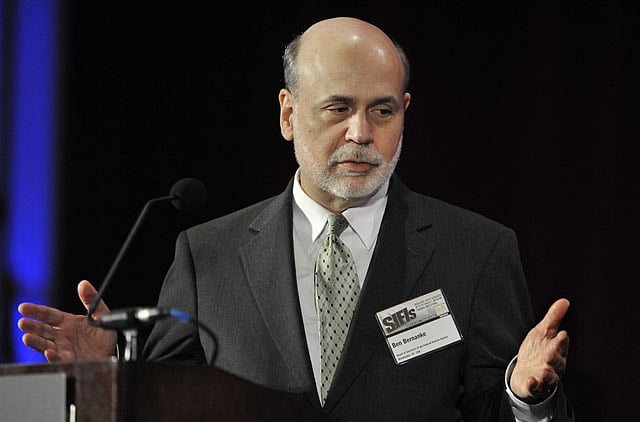
London: Markets were fairly choppy on Tuesday as investors were reluctant to push stock indexes up further ahead of a much-anticipated statement from US Federal Reserve chairman Ben Bernanke.
The Fed is conducting its third round of massive bond purchases known as quantitative easing. The aim has been to help drive down interest rates and spur lending.
A recent run of strong US economic data, largely related to housing and jobs, has fuelled speculation that the Fed might consider changing course. The prospect of a less-easy monetary policy has put a brake on stocks this week and helped support the dollar.
On Wednesday, Bernanke will appear before lawmakers Congress and the central bank will release minutes of its most recent policy meeting. Both events have the potential to really alter the prevailing backdrop in financial markets.
“What Bernanke has to say [on Wednesday] will have a big bearing on the next move, not only in currency markets, but also equity markets,” said Michael Hewson, senior market analyst at CMC Markets.
As a result, investors across financial markets were largely in wait-and-see mode.
In Europe, the FTSE 100 index of leading British shares was steady at 6,758, a day after it struck a 12-year closing high, while Germany’s DAX fell 0.5 per cent to 8,416. The CAC-40 in France was 0.6 per cent lower at 3,997.
Wall Street was poised for an uninspiring open, with both Dow futures and the S&P 500 futures down 0.1 per cent.
Over the past five years, the markets have got used to operating in an easy-money environment. The extra liquidity provided by many of the world’s central banks has been recycled and has helped stock indexes hit highs despite a fairly patchy recovery from recession. The Dow Jones and the S&P 500 indexes in the US have both hit all-time highs — as has Germany’s DAX.
“It is broadly recognised that the fuel for this movement into risky investments has been the generous provision of cheap liquidity by central banks,” said Jane Foley, an analyst at Rabobank International.
The dollar recovered some of its Monday losses when investors booked some recent gains — the dollar has been increasingly in demand amid speculation of a winding down in the Fed’s asset purchases. The euro fell 0.2 per cent at $1.2866, while the dollar rose 0.5 per cent to 102.67 yen.
The yen’s renewed weakness against the dollar helped Japan’s main Nikkei stock index to eke out a small 0.1 per cent gain to close at 15,381.02, its highest finish in more than five years. The Nikkei has been a big winner this year, rising 48 per cent, after the Bank of Japan announced a big monetary stimulus programme designed to shake the country out of a two-decade stagnation and get prices rising, albeit modestly. One repercussion of that policy has been to pile the pressure on the yen — a development that can help Japan’s exporters and provide another fillip to growth.
Elsewhere in Asia, Hong Kong’s Hang Seng declined 0.5 per cent to 23,366.37 while South Korea’s Kospi fell less than 0.1 per cent to 1,981.09. Benchmarks in mainland China rose too.
Oil prices were subdued too, with the benchmark New York rate down 22 cents at $96.49 (Dh354.41) a barrel.
Sign up for the Daily Briefing
Get the latest news and updates straight to your inbox
Network Links
GN StoreDownload our app
© Al Nisr Publishing LLC 2026. All rights reserved.