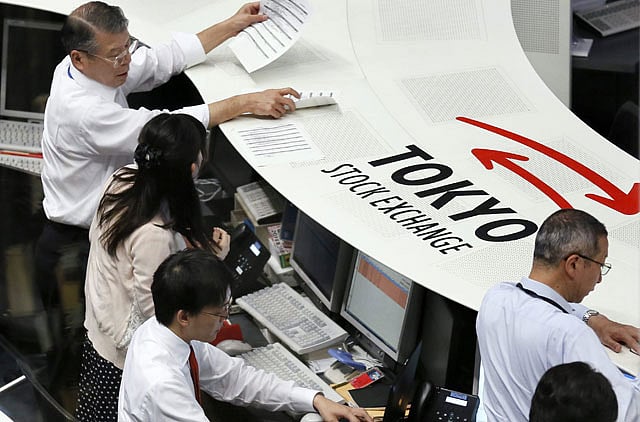
Tokyo: Stocks plunged more than 6 per cent on Thursday due to a strong yen and worries about an end to central bank stimulus just months after the Bank of Japan unleashed a huge spending plan.
The benchmark Nikkei dived 6.35 per cent, or 843.94 points, to 12,445.38, slicing about 20 per cent off its peak last month above 15,600, and meeting the definition of a bear market.
The broader Topix index of all first-section shares fell 4.78 per cent, or 52.37 points, to 1,044.17.
Thursday’s drop was largely attributed to jitters over an end to central bank stimulus, particularly the US Federal Reserve’s massive monetary easing, which has been credited with propping up global equity markets.
However, cracks have also begun to emerge in a plan by Japanese Prime Minister Shinzo Abe to power the world’s third-largest economy, a blueprint dubbed ‘Abenomics’.
Last week, investors turned up their noses at what some saw as a half-hearted bid to force structural reforms in the long-tepid economy, the so-called ‘third arrow’ of Abe’s plan.
Foreign investors had piled into the market since late last year as the government and Bank of Japan set about a policy prescription of big spending and aggressive monetary easing, which pushed down the yen.
A weaker yen benefits Japanese exporters by making them more competitive overseas and tends to push up Tokyo stocks. However, investors were sent running after the central bank said it would hold off any new easing measures on Tuesday, a day after data showed the economy was growing faster than expected.
The dollar had already plunged against the yen, with the US Federal Reserve in focus ahead of a policy meeting next week that many fear will herald the end of its $85 billion-a-month bond-buying scheme.
Investors tend to flock to the safe-haven yen in times of turmoil and uncertainty, weighing on the stock market.
“We have seen such wild fluctuations lately that few investors want to press on with buying,” said Hirokazu Kabeya, senior strategist at Daiwa Securities. “It’s a kind of a chicken-and-egg situation — volatile markets keep buyers away and the absence of buyers leads to market volatility. We are trapped in a negative spiral right now.”
Despite the latest plunge in Tokyo, the market is still more than 40 per cent above its level in mid-November, when it started its bull run after Abe indicated he would do whatever was needed to boost the economy.
“It’s fair to describe the current situation as a bear market,” said Kenzaburo Suwa, strategist with Okasan Securities. “But I still think it’s a correction — the one before the bear since the latest decline came after outstanding gains.”
On currency markets, the greenback fetched 94.03 yen in Tokyo, from 95.88 yen in New York late on Wednesday and from the high 98-yen range in Tokyo at the start of the week.
That puts the dollar-yen rate back to levels seen when the Bank of Japan announced in April it would unleash a torrent of easy money as part of a plan to reverse years of falling prices and tepid growth.
In stock trading Thursday, major exporters took a hit with Toyota falling 4.60 per cent to 5,590 yen, while Sony fell 3.50 per cent to 1,930 yen and Panasonic lost 3.98 per cent to finish at 722 yen.
On Wall Street the Dow saw its first three-day losing streak this year amid worries about central banks’ stimulus plans. The blue-chip index shed 0.84 per cent to 14,995.23.
“This sense of uncertainty could persist until next week’s [Fed policy] meeting,” Masashi Murata, senior currency strategist at Brown Brothers Harriman in Tokyo, told Dow Jones Newswires.
A senior trader at a major Japanese bank said further losses in the Nikkei would be a negative signal from investors on the Japanese premier’s economic policies.
“An eventual breach of 12,000 for the Nikkei could see forex rates and share prices back to levels seen before the BoJ’s decision” in early April, he said. “If that happens, we’ll just be left with higher bond yields.”
Sign up for the Daily Briefing
Get the latest news and updates straight to your inbox
Network Links
GN StoreDownload our app
© Al Nisr Publishing LLC 2026. All rights reserved.