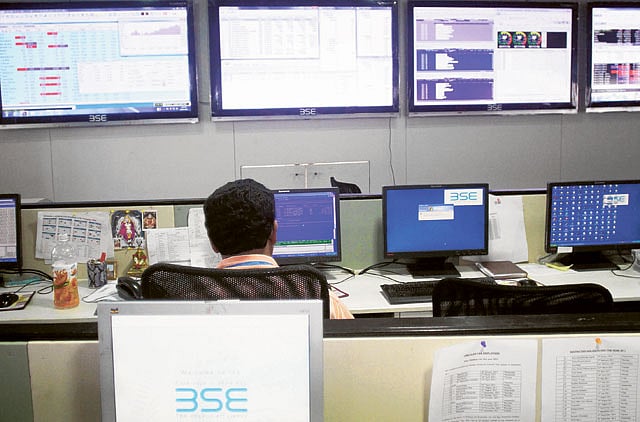
Mumbai: A slide in the rupee to record lows against the dollar could not have come at a more inopportune time for investors in India. It has pumped up the bears to tighten their stranglehold on the stock market that has been on the decline for over two months.
The Reserve Bank of India (RBI), which sold more than $20 billion between September and March, has since stepped up the market intervention to defend the rupee, but has been overwhelmed by dollar demand from oil importers and withdrawals by foreign funds.
With a current account deficit at the highest since 1980, and economic growth slowing to the weakest in nearly three years, there will be more pressure on the rupee which has lost about 10 per cent since the start of March.
This is bad news for foreign portfolio investors, the trend-setters for shares in India. The rupee's slump has magnified their losses, and the heightened currency risk is set to dry up fresh inflows until the market stabilises.
"It's like the proverbial last straw on the camel's back," said equity trader Kevin D'Souza. "Foreign funds have been on the back foot after the budget and the wobbly rupee is adding to the jitters."
The government's handling, or lack of it, to retrieve the economic slide has added to the frustration. After the rupee breached its record low on Wednesday, the finance minister blamed the Eurozone crisis and claimed the Indian economy was "intact".
There were no takers for the claim, which was made in parliament while Prime Minister Manmohan Singh sat impassively. And the rupee slid further, weakening as far as 54.91 to the dollar on Friday before closing at 54.43, down 1.5 per cent on the week. It has fallen for seven consecutive weeks, the longest run since the Lehman crisis almost four years ago.
Citing weak macro fundamentals, limited appetite for RBI intervention and high sensitivity to global market sentiment, Barclays Bank forecast the rupee could hit 56 in a month's time.
This is indeed possible. Six-month onshore currency forwards traded at 56.19 on Friday, while offshore non-deliverable contracts were at 56.43.
Analysts say much of the present problem is an offshoot of the annual budget, which was widely seen as short on vital reforms to revive growth and underlined the lack of political will to cut bulging subsidies that caused the fiscal deficit to balloon to nearly six per cent of GDP.
An ill-advised budget proposal to tax portfolio inflows routed through places such as Mauritius, which is used by large funds because of its tax-spared status, also knocked market sentiment. Although New Delhi shelved the proposal, the damage was already done.
Another proposal that has raised an outcry is to slap tax retrospectively on overseas acquisitions deals that involve underlying assets in India. The frustration among investors is running high.
"It is not an exaggeration to state that the magnitude of the economic damage and mismanagement by the Congress party under Dr Singh's watch will be embarrassing for even a student of introductory economics," Rajeev Malik, a Singapore-based economist with investment group CLSA, wrote in the Business Standard.
The top-30 Sensex closed at 16,152.75 on Friday, down just under 1 per cent on the week, after slipping below 16,000. The widely tracked benchmark is likely to drop towards 15,000 over the near term as foreign funds reduce their exposure.
Foreigners pulled out $927 million from stock and debt in April and the outflow could pick up if India's sovereign ratings are downgraded. Fitch Ratings was in New Delhi last week to review its call, after rival Standard & Poor's put the country on watch for a possible cut to junk status.
Both the agencies currently have a BBB- rating, the lowest investment grade.
The writer is a journalist based in India.
Sign up for the Daily Briefing
Get the latest news and updates straight to your inbox
Network Links
GN StoreDownload our app
© Al Nisr Publishing LLC 2026. All rights reserved.