Investors' love affair with the "other" currencies may be just beginning.
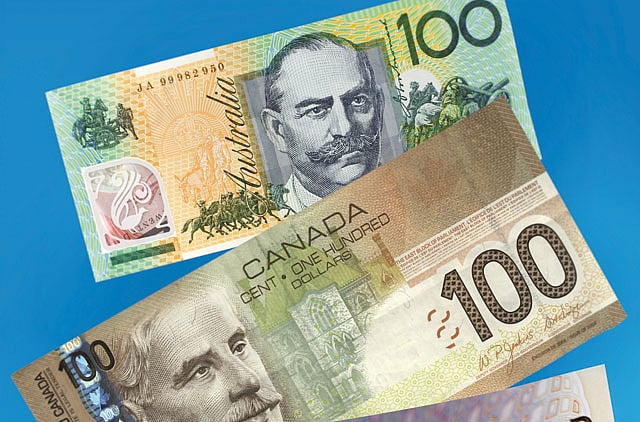
The Canadian dollar, Australian dollar and Swedish crown are gaining in popularity as investors increasingly look for alternatives amid troubling outlooks for the United States, Eurozone and Japan.
Global reserve managers are leading the trend. In the first quarter, central banks who report their reserves added a record $24.5 billion (Dh90 billion) of "other" currencies to their portfolios, Nomura data show.
The share of reserves in "other" currencies stood at 3.7 per cent in the first quarter, up from 1.5 per cent at the beginning of this decade. It's generally believed this category includes currencies of Canada, Australia, Norway, Sweden and New Zealand.
Jens Nordvig, head of G10 foreign-exchange strategy at Nomura in New York, said the growing inflows into what he called the "new safe havens" are set to continue as central banks rethink their allocations, a development that could boost these currencies in the years ahead.
"It's going to be a massive amount of money that potentially comes in, and there could be a very big impact on these currencies even if it's a relatively moderate amount of central bank portfolios," he said.
Such demand may have already helped cushion the impact on some of these currencies from the recent global turbulence.
Same period
The Canadian dollar, for example, has shown resilience in recent months despite a rout in commodity prices and stocks worldwide on economic worries.
Since mid-April, the MSCI world equity index has fallen 10 per cent, while oil prices have lost 8 per cent. During the same period, the loonie lost only 2.6 per cent versus the US dollar, going as low as C$1.0851. After the collapse of Lehman Brothers in late 2008, the loonie fell as low as C$1.3017, according to Reuters data.
"The Canadian dollar is a currency you want to own," said David Rosenberg, chief economist and strategist at money management firm Gluskin Sheff in Toronto. "Canada has basically been re-rated coming out of the credit crisis as a bastion of stability in an increasingly unstable world."
As a percentage of GDP, Canada's general government net debt is estimated at 32 per cent for 2010, the lowest among the Group of Seven economies.
In contrast, Japan has the highest net debt at 122 per cent and the United States is at 66 per cent, according to data from the International Monetary Fund. Currencies of smaller G10 economies tend to have better liquidity and track records of inflation than emerging market currencies, making them good candidates as safe havens.
Their healthier fiscal outlook also makes them appealing as investors increasingly discriminate between currencies with strong sovereign balance sheets and weaker ones. To be sure, there's a limit on how much reserve managers can invest in the "other" currencies because of the smaller size of these countries' domestic bond markets.
The size of Canada's and Australia's domestic government debt markets are $905.5 billion (Dh3.33 billion) and $228 billion, respectively. In comparison, the US domestic government debt market totalled $9.5 trillion, the second largest after Japan's local market with $9.7 trillion, Bank for International Settlements data show.
Emma Lawson, currency strategist at Morgan Stanley, said 1 per cent of all global reserves would account for 74 per cent of the local Australian sovereign debt market and "there isn't the scope for any more". The Canadian market is "only slightly larger", she said, with 1 per cent of global reserves taking up to 30 per cent of the local market, and if it increased to 3 per cent, this would account for 81 per cent and would be "arguably too high".
Diversification
"For long-term holders like central banks, these commodities currencies provide good diversification and to some extent, one could call it gaining safe-haven status," said Matthew Strauss, senior currency strategist at RBC Capital Markets in Toronto. "But given their liquidity is far, far less than the majors, they can never serve as full-fledged safe-haven currencies."
Strauss also said while the Canadian and Australian dollars provide a relatively safe store of value over the long term, they "do remain cyclical currencies as well, given their commodity status", which means they tend to fluctuate more than the major currencies.
Still, debate over the dollar's role in the global economy continues.
Talk of more stimulus money and the possibility of a double-dip recession could lead to escalating worries about the swelling US deficits.
Jerome Booth, head of research at Ashmore Investment Management in London, said investors "should never equate the dollar with risk-free". Booth added that the argument that the US Treasury market is the most liquid in the world may not hold true if a few central banks started selling.
Sign up for the Daily Briefing
Get the latest news and updates straight to your inbox
Network Links
GN StoreDownload our app
© Al Nisr Publishing LLC 2026. All rights reserved.