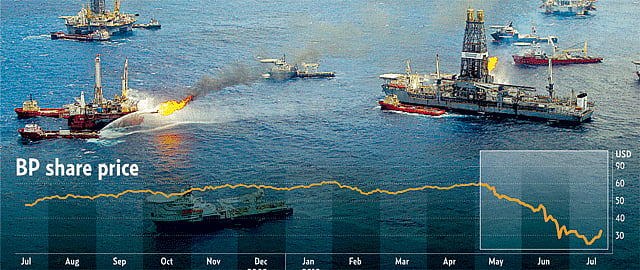
Dubai: A 10 per cent stake in embattled British institution BP would now cost a strategic investor less than $10 billion (Dh36.7 billion) at current valuations — about half of what it would have been worth at the beginning of the year.
From a market capitalisation of $181 billion at the end of 2009, BP's value dropped to $99.9 billion at the end of trading on the New York Stock Exchange on Tuesday, when it closed at $31.91 per share.
On the London Stock Exchange, BP's stock was up 4.05 per cent to 360.30 pence at 11.55am yesterday on news that the company would seek strategic investment from a Middle Eastern sovereign wealth fund.
BP shares have lost about half their value since the Deepwater Horizon oil rig sank in the Gulf of Mexico in April, causing the worst offshore oil spill in US history.
Chief executive Tony Hayward's arrival in Abu Dhabi on Tuesday added fuel to the speculation that he would meet some of the UAE's most powerful investment funds, although BP spokesman Andrew Gowers said: "He's visiting partners as he does from time to time. He's conducting normal business."
Hayward has been criticised for his handling of the oil spill in the United States, and in recent days has travelled to other countries where BP operates.
"Whether he is seeking strategic investments, sending out feelers about a possible sale of BP's shareholding in various projects, reassuring partners, or simply bidding them farewell — [it] is not clear yet," one oil industry professional told Gulf News on condition of anonymity.
Hayward arrived in Abu Dhabi from the capital of oil-rich Azerbaijan, where he tried to calm fears BP might sell assets there to help pay for the spill cleanup. While in Baku, Hayward met with Azerbaijan President Ilkham Aliyev.
The BP chief executive also met with Russian officials in Moscow last week. Following those meetings, an official at the company's Russian joint venture TNK-BP said that firm would consider buying some of BP's assets if they were put up for sale.
Joint venture partner
BP has a long-standing partnership with the UAE going back about 80 years. It is a joint venture partner with the Abu Dhabi National Oil Company (Adnoc).
With its upstream activities in Abu Dhabi and downstream business managed from Dubai, the UAE is BP's hub for operations across the Middle East and Pakistan.
In the early 1930s, Air BP established a refuelling depot in Sharjah to serve the first airplanes en route from the United Kingdom to India. Air BP was in the news this week for refusing to refuel Iran Air planes as a result of the sanctions imposed on Iran.
BP's UAE head office is in Abu Dhabi. Dubai is the regional hub for its refining and marketing businesses known as BP Middle East. Through the activities of Air BP, BP Lubricants and BP Marine, the Dubai operation reaches out to 38 countries, ranging from Egypt in the west to Sri Lanka in the east.
"BP is today a distressed stock because it has been hammered out of all proportion to its value," one equity analyst told Gulf News.
"Regional investors have seen value in such companies in the past and profited from it. I see no reason why the BP story should be any different," he said.
"The support of sovereign funds could stave off a possible takeover bid from a major competitor such as Exxon, Shell or Total."
The BP group has joint venture partnerships with Adnoc and shareholdings in Abu Dhabi Marine Operating Company, Abu Dhabi Company for Onshore Oil Operators, Bunduq Company and Abu Dhabi Gas Liquefaction. It is also an anchor partner of the Masdar alternative energy initiative. Masdar and Hydrogen Energy, the joint venture between BP and Rio Tinto, announced plans in January 2008 to examine the feasibility of an industrial-scale hydrogen-fired power generation project that will include the capture of carbon dioxide to create the first such project in the region.
Gasfields
BP Sharjah produces and sells natural gas, condensate and liquefied petroleum gas (LPG) in the UAE. The company operates three gas fields — Sajaa, Moveyied and Kahaif — along with a processing plant, gas compression facilities and two liquid export terminals for condensate and LPG.
From its joint venture blending plant in Jebel Ali, Dubai, BP Lubricants produces and markets lubricant products such as Castrol, Duckhams and Veedol.
In Sharjah, it also operates an aviation fuel supply jetty and manages Sharjah Aviation Services Company (SASCO), an independent joint venture that provides fuel storage and handling services at the airport.
The company said this week it would welcome new investors but had no plans to issue any new shares to help pay for the oil spill.
Hayward was forced to set aside $20 billion to compensate the spill's victims and finance the clean-up. To pay for it, the company cancelled three-quarters of its dividend and planned to sell assets across the globe.
BP is a "good buy" after the drop in the share price, Shokri Ganem, Libya's top oil official, said in a Bloomberg Television interview on Tuesday. He's advising Libya's sovereign wealth fund to take a stake in BP. The company has, however, said it has no plans to sell shares to raise funds.
Sign up for the Daily Briefing
Get the latest news and updates straight to your inbox
Network Links
GN StoreDownload our app
© Al Nisr Publishing LLC 2026. All rights reserved.