Doha Round negotiators struggle for small wins, tackle big ones later
WTO to concentrate on topics such as agreements on uncontroversial trade areas
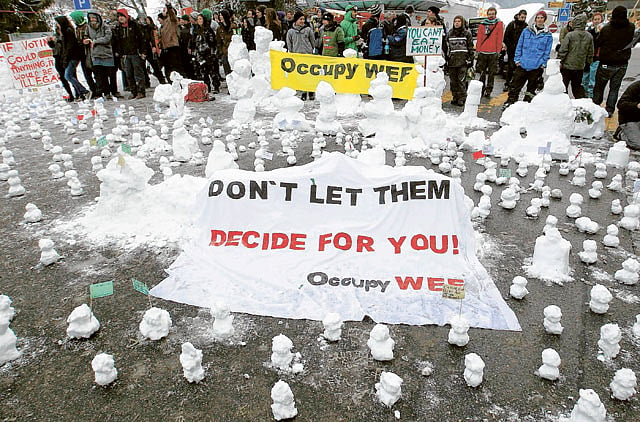
Davos: The long-delayed Doha Round of trade negotiations is not dead, but it is definitely unwell. The strategy is to go for small wins and build confidence that the big contentious issues could eventually be addressed.
Trade ministers and business leaders are not giving up on the much-delayed Doha Round of global trade negotiations, but they admit that it is not in the best of health.
"Doha is not dead," Craig Emerson, Australia's Minister of Trade, told participants at the World Economic Forum. "I think there's enough life in the Doha Round to persist with it."
Launched in 2001, the Doha Round involves all 153 member states of the World Trade Organisation (WTO) negotiating among themselves to lower trade barriers and revise trade rules on 20 areas of trade. The talks have been held back by the contentious issues of agriculture, services, intellectual property, among others, and the advent of the global financial crisis in 2008.
"You need a lot of political energy to do things multilaterally and it's just not available," said Pascal Lamy, director-general of the WTO.
"It's in short supply, just as it is in climate change." Instead, government leaders are focusing their energies on bilateral talks and regional arrangements, such as the proposed Trans-Pacific Partnership comprising the US, Australia, Vietnam, Peru and four other countries.
Lamy is concerned about different, and perhaps contradictory, industry standards and regulatory regimes that the parties in various bilateral and plurilateral agreements may commit themselves to. This will pose new barriers to multinationals and global supply chains.
Ron Kirk, US Trade Representative, said that Washington has not given up on the Doha Round, but the reality is that it is easier to negotiate bilateral agreements, which can create more jobs and bring benefits to the two parties.
But Gita Wirjawan, Indonesia's Minister of Trade, said the Doha Round is still needed because it remains the best way for every nation, especially developing countries like Indonesia, to be treated fairly in trade matters.
Lamy said that the WTO's new strategy on Doha is to set aside the big issues for now and instead concentrate on small wins, such as agreements on relatively uncontroversial trade areas like trade facilitation.
The WTO will stay in quiet mode for now, get things done and build confidence that the organisation can then tackle the big issues.
india defends reforms
"The macroeconomics of India are fundamentally strong. Those who have these alarm bells ringing should look inwards," said Anand Sharma, Minister of Commerce and Industry, Textiles of India. Speaking at the World Economic Forum, Sharma vigorously defended the reforms made by his government and the economic prospects of India. "India can take care of itself, I can assure you," he said.
When questioned on India's growing current account deficit, he told participants: "We need to spend to empower and educate our people."
Supachai Panitchpakdi, Secretary-General of the UN Conference on Trade and Development (UNCTAD), echoed Sharma's optimism. "India is not immune, but it has its own cushion with the size of domestic demand," he said. He praised India's open market policies, saying the country has one of the least interventionist exchange rate policies among emerging economies.
India's investment grade rating of BBB- is more likely to improve than deteriorate, said Douglas L. Peterson, President of Standard & Poor's. He cited India's strong domestic demand and domestic growth as reasons for optimism. "There are development challenges," Peterson said, "such as the need in the agricultural sector for modernisation."
Sign up for the Daily Briefing
Get the latest news and updates straight to your inbox
Network Links
GN StoreDownload our app
© Al Nisr Publishing LLC 2026. All rights reserved.